The Thought Experiment
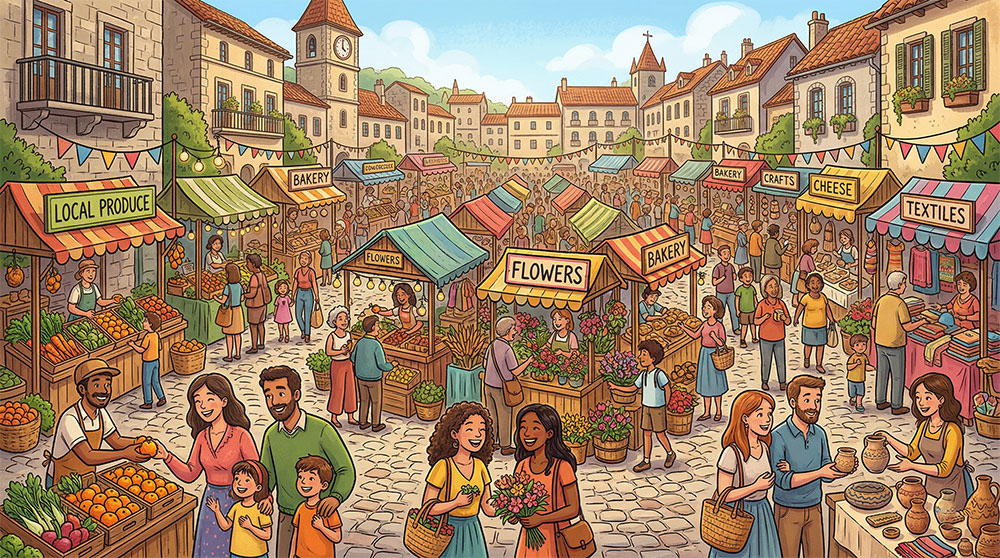
Imagine waking up to a world where none of it was built. No infinite scroll. No algorithmic rabbit holes. No 5-second ad you have to sit through before you can watch someone teach you how to make pasta. Instagram didn't exist. YouTube didn't exist. TikTok was never invented. What you had instead was a thousand smaller, purpose-built digital spaces — each one dedicated to a craft, a subculture, an industry, a way of seeing the world.
Would that world be worse than this one? The honest answer is: it depends entirely on what you think the internet is for. If it exists to move information at scale and connect billions of strangers, the monolith wins. If it exists to deepen expertise, distribute wealth more equitably, and serve human wellbeing rather than advertiser metrics — the village model starts to look very appealing indeed.
This isn't a nostalgic argument. It's a structural one. The architecture of how we build digital spaces determines what those spaces are capable of producing — and what they cost us.
"The product isn't the content. It's your time. Large platforms are engineered around intermittent reinforcement — the same psychological mechanism used in slot machines."
— GlamBon CultureThe Case for the Giants
Before we dismantle anything, intellectual honesty demands we acknowledge why the giants won. Large platforms provide infrastructure and reach that no niche player can replicate. YouTube turned the world into a classroom. It created an entirely new professional class — educators, independent journalists, information specialists — where a plumber in Ohio can learn from a master craftsman in Kyoto in real time. That is genuinely miraculous. The network effect is real: the value of these platforms comes, in part, from the sheer fact that everyone is on them.
A small fashion brand can reach a global audience without a million-dollar media budget. A kid in Lagos can build an audience for her original music without a record label. A retired professor in Porto can teach econometrics to ten thousand students who couldn't afford his university. These are not trivial things. They are the genuine achievements of the monolith era, and any honest critique of large platforms has to hold them.
The question isn't whether the giants created value. They obviously did. The question is whether they extracted more than they created — and what would grow in their absence.
Wealth, Skills and the Long Tail
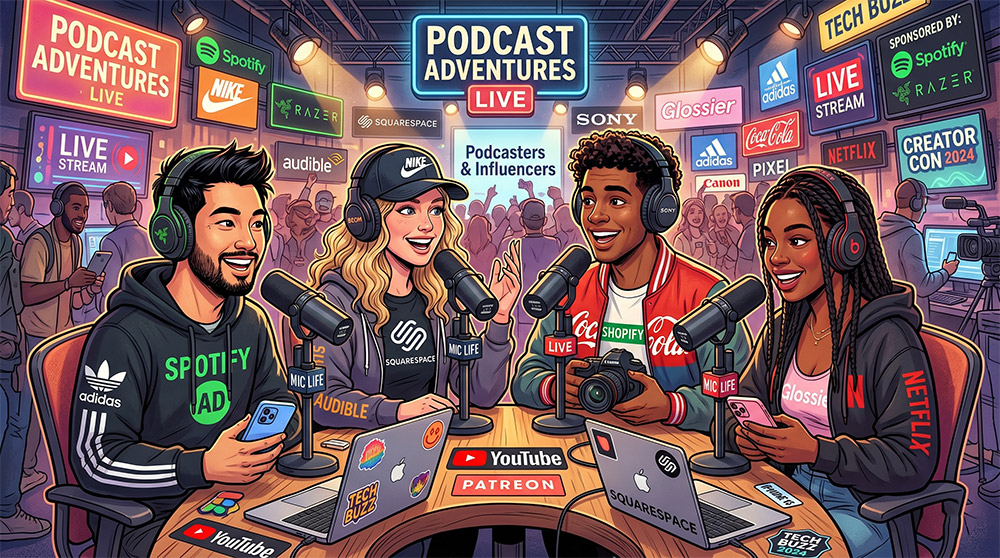
In the current era, wealth on digital platforms follows a power law. The top one percent of creators capture the overwhelming majority of attention and revenue. The rest compete for crumbs in an architecture designed to reward virality over depth. Replace that with fifty smaller platforms — one for film photography, one for high fashion, one for architectural drawing, one for fermentation — and the distribution of income changes shape.
Smaller platforms operate on different incentives. Because they don't need to aggregate a billion passive viewers, they don't need to engineer addiction. They tend toward subscription models, direct-to-fan sales and high-intent sponsorships. The economics of this are genuinely different. An ad for a watchmaking tool on a platform dedicated to horology is worth multiples of the same ad shown to a teenager scrolling TikTok at midnight. The audience is smaller, but the signal is sharper.
Scenario A — The YouTube Mega-Influencer
5 million subscribers · 20 million views per month
AdSense at ~$4 RPM: $80,000/month
Broad market sponsorships: $150,000/month
Total: ~$230,000/month — but algorithm-dependent and platform-captive. One policy shift and it evaporates.
Scenario B — The Niche Specialist (The Patreon Model)
15,000 dedicated followers · 1,000 paying subscribers at $15/month
Direct subscriptions: $15,000/month
Product sales (presets, tutorials, lookbooks): $10,000/month
High-intent niche sponsors: $5,000/month
Total: ~$30,000/month — owned audience, portable data, income that survives platform changes.
The mega-influencer earns more in absolute terms, but is a sharecropper. They do not own their audience. Their income is structurally fragile. The niche specialist earns less — but owns the relationship. That distinction, compounded over a decade, changes careers, livelihoods, and what kind of content gets made.
On the question of skills: when your community of peers numbers five hundred experts rather than five million amateurs, the feedback loop sharpens. You are not chasing a viral hook. You are learning a craft. You are being held to a standard by people who know the difference. Skills, in a niche world, likely grow faster — not because there is more content, but because the signal-to-noise ratio becomes tolerable.
Creator Income Calculator
Enter your audience size and see how the income picture compares between a large platform volume model and a niche direct-support model.
The Dopamine Trap
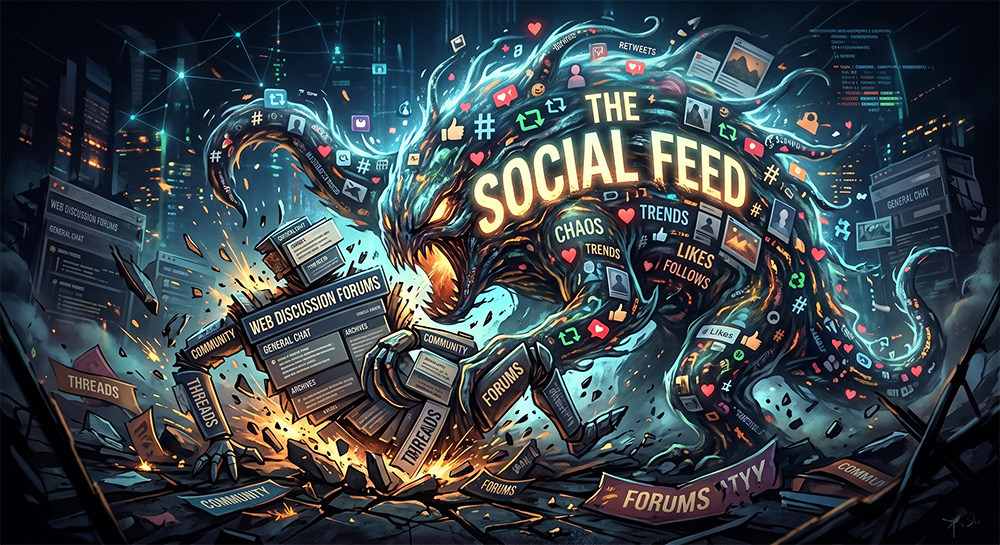
Here is the thing that gets buried under the discourse about creator monetisation and discovery algorithms: the product on large platforms is not the content. It is your time. Every engineering decision — the infinite scroll, the autoplay, the notification badge — is designed to maximise the duration of your session because duration is what gets sold to advertisers. This is not a conspiracy. It is the business model, stated plainly.
The psychological mechanisms are well documented. Intermittent reinforcement — the unpredictable reward schedule that makes slot machines addictive — is baked into the feed. You scroll because you might find something good. You usually don't. But the possibility keeps you going. Passive consumption of this kind is consistently associated with heightened anxiety, disrupted sleep and what researchers call upward social comparison: the persistent, low-grade feeling that everyone else is living a better, more curated version of life.
For creators, the volume model is equally corrosive. To remain relevant in a global feed, you must post daily. You must optimise for the hook. You must sacrifice depth for discovery. The content treadmill is a recipe for burnout disguised as a career path.
Niche platforms — those operating on subscription or direct-purchase models — are structurally incapable of this behaviour. They have no financial incentive to keep you scrolling. You pay a subscription. You get value. You close the app. That sounds obvious, but it represents a fundamentally different relationship between platform and user. One that doesn't treat your attention as a resource to be strip-mined.
"We trade the infinite scroll for the infinite craft. In a niche world, the measure of a platform's success is not how long you stayed — it is how much you learned."
— GlamBon CultureThe Discovery Problem
The strongest argument for the monolith is also the simplest: YouTube is a search engine. When you want to learn something — anything — you go there. The discovery mechanism is centralised, powerful and largely free. In a fragmented world of niche villages, how does anyone find anything? This is the question that serious advocates of platform decentralisation have to answer honestly.
The answer is that discovery in a niche world becomes human-centric rather than algorithm-centric. It relies on curators: trusted nodes in a network whose recommendations carry genuine weight because their reputation is on the line. A well-regarded fashion photographer on a niche platform mentioning a new digital artist they admire is worth more than a million algorithm-driven impressions, because it arrives with context and credibility.
The Fediverse model — platforms that talk to each other through open protocols like ActivityPub — offers another path. Your account on a photography platform can follow accounts on a travel platform. Content can move across boundaries without requiring everyone to be in the same room. We are already seeing early versions of this in 2026, and the infrastructure is maturing.
Then there is the personal AI agent model: rather than a platform-owned algorithm deciding what you see, you have a personal tool that searches across platforms on your behalf. You tell it what you are genuinely interested in. It finds it. The filter serves you rather than the advertiser. None of this is science fiction. The technology exists. What is missing is the will to build a digital economy that prioritises it.
The Industrial Case
There is a dimension to this conversation that rarely gets the attention it deserves: the geography of technical talent. In a world dominated by three or four platforms, expertise concentrates in a handful of cities. The best engineers move to San Francisco or Seattle or Shenzhen. They work on engagement algorithms. The rest of the world provides the users.
This is a knowledge siphon. It extracts technical capability from everywhere and deposits it in a few ZIP codes. A fragmented platform world would reverse this. If the most important technical problems are building the best platform for architects, or the most secure payment layer for independent photographers, or the most robust identity verification system for a network of creative communities — then those problems can be solved anywhere. Engineers in Croatia, in Melbourne, in Nairobi, in Porto build the best tools in their category. They do not need to emigrate to do it.
For the startup community, the implications are equally significant. The current ecosystem incentivises startups to build features, not companies — because the exit strategy is acquisition by a giant. In a niche world, a platform built for a specific community of serious practitioners does not need to be the next Facebook. It needs to be the best in its category. That is a realistically achievable goal. It creates sustainable businesses. It creates careers that last decades rather than sprint toward a Series C.
Innovation, in this model, becomes generative rather than aggregative. Large platforms optimise existing systems. Niche players solve new problems. The result, over time, is a healthier ecosystem — more resilient, more globally distributed, and less dependent on the health of a handful of companies whose decisions affect billions of people simultaneously.
The Verdict
A world without the social giants would be harder to navigate and simpler to inhabit. You would lose the frictionless discovery, the global cultural moment, the occasional miracle of a video that somehow finds the exact person who needed to see it. These are real losses. They should not be waved away.
What you would gain is harder to quantify but easier to feel. You would gain platforms that have no structural interest in keeping you on them longer than is good for you. You would gain communities where accountability is possible because everyone is visible to everyone else. You would gain a creator economy that distributes wealth across a professional middle class rather than concentrating it at the very top. You would gain technical talent dispersed across the globe rather than pooled in a few cities that can barely house the people who live there.
Most importantly: you would gain a digital environment where the measure of a platform's success is not how many hours it extracted from your day. That shift — from attention mining to genuine value exchange — is not a minor adjustment. It is a different philosophy of what the internet is for.
The giants will not disappear. They are too structurally embedded, too financially powerful, too useful to too many people. But the conversation about what grows alongside them — or eventually in their place — is one worth having seriously. The niche village model is not nostalgia for a simpler time. It is an argument for a more considered future.
Questions Worth Asking
Large platforms like YouTube and Instagram operate on a volume model — they profit from keeping as many people scrolling as long as possible, monetising attention through advertising. Niche platforms operate on a value model — serving smaller expert communities through subscriptions, direct sales and high-intent sponsorships, with no incentive to manipulate behaviour.
Yes. The '1,000 True Fans' model shows that a creator with 1,000 dedicated subscribers paying $15 per month generates $15,000 monthly — without millions of views. Niche platforms also carry lower revenue splits and enable higher-value sponsorships from brands targeting expert audiences rather than mass-market scroll sessions.
Discovery in a niche world would be human-centric rather than algorithm-centric — relying on trusted curators and referral networks, open protocols like ActivityPub (the Fediverse model), and personal AI agents that search across platforms on your behalf, finding content based on your actual interests rather than what an advertiser pays to surface.
Structurally, yes. Niche platforms do not profit from extended session time because they use subscription or direct-purchase models rather than ad revenue. Without the financial incentive to keep you scrolling, there is no reason to engineer dopamine loops. Communities are also smaller and more accountable, reducing the upward social comparison effect consistently linked to anxiety on mass platforms.
More generative innovation, though less homogenised. Large platforms optimise existing engagement systems; niche players solve new problems for specific communities from the ground up. A fragmented landscape would also decentralise technical talent globally — reducing the Silicon Valley brain drain and enabling engineers everywhere to build world-class specialised tools without leaving home.