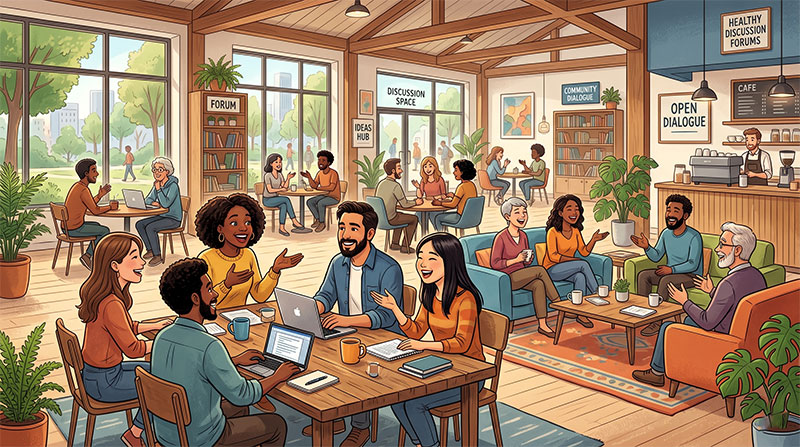
- Discussion forums were built for retrieval; social feeds are built for retention. One helps you leave with an answer; the other is designed to keep you from leaving at all.
- The feed didn't beat the forum on merit — it beat it on economics. High-arousal content monetises better than helpful content.
- Reddit is architecturally a forum but behaviourally a feed: the upvote is a tiny dopamine machine bolted onto a thread.
- The distinction that matters in 2026 isn't adding value vs destroying it — it's adding value vs creating it. Forums created value. Feeds mostly rearrange it.
- Forum-style rooms are quietly returning: Discord servers, niche subreddits run as real communities, independent boards, paid Circle/Skool spaces. The pull is calm, not virality.
Twenty years ago, if you wanted to know how to set the back-button focus on a Canon 5D, or whether a 24-105 was worth buying used, or why your RAW files were opening warm in Lightroom, you didn't scroll. You searched. And what you found, almost always, was a forum thread — sometimes from five years earlier — where a stranger with a username like tungsten_dave had written three paragraphs answering exactly that question. Someone else had tested it. A third had corrected the first two. By the bottom of the thread, the problem was solved, permanently, for anyone who came looking.
That thread is still there, probably. It just isn't how we find things anymore.
The modern web is not a library. It is a river. And rivers, by design, do not let you go back to the same water twice.
Creating Value vs Adding Value
In business — especially in corporate environments, where I've spent most of my working life — we talk constantly about adding value. It's the language of every strategy deck: this initiative adds value; this hire adds value; this workflow removes friction, therefore adds value.
Adding value is real and useful. But it is also incremental. It assumes something already exists, and improves it by some factor.
Creating value is different, and much rarer. Creating value means bringing something into being that wasn't there before. A thread from 2006 explaining how to configure a specific autofocus mode on a specific camera, written freely by a stranger, indexed and findable a decade later — that thread is a small unit of value that simply did not exist until someone created it. It wasn't optimised. It wasn't repackaged. It was new.
Forums, at their best, were value-creation engines. Millions of small, specific, permanent units of knowledge, written by people who had no commercial reason to write them, indexed and preserved for whoever came next. That's why searching for a camera problem in 2010 worked so well: a decade of strangers had already created the answer.
A forum thread from 2006 that still solves a stranger's problem in 2026 is pure value creation. Optimisation is what you do afterwards. Creation is the part nothing else can substitute for.
The Assassination Was Financial
The forum didn't die because something better came along. It died because something more profitable came along.
A forum is architecturally hostile to modern advertising. Users arrive via search, looking for a specific answer. They find the answer — usually in a thread that loads fast, serves minimal media, and doesn't need them to stay. They solve the problem and leave. That's a successful visit, from the user's point of view. It's a catastrophic visit from a programmatic ad network's point of view.
The feed inverts this. The feed's goal is not to answer your question; it is to make sure you don't finish. It is engineered, down to the microsecond of each animation and the ordering of each card, to keep you scrolling. The longer you scroll, the more impressions you generate. The more impressions, the more revenue.
The conflict tax
The ugly part — and it is ugly — is that once you're in an attention economy, the emotions that keep people scrolling aren't the pleasant ones. High-arousal negative emotions (outrage, fear, contempt, moral indignation) produce dramatically more engagement per impression than calm, useful content. An algorithm optimising for retention is not ideological. It doesn't want you angry because it has an agenda. It wants you angry because angry people don't close the tab.
So the algorithm learns, over billions of small experiments, that antagonistic replies rank higher than helpful ones. That a post about a shared enemy outperforms a post about a shared solution. That nuance, which used to be the signature of a good forum moderator, is now a liability: nuance makes you finish reading and leave.
This is the conflict tax, and all of us pay it. Every time you open a social app for two minutes in a waiting room and close it feeling slightly worse than when you opened it — that small deduction from your mood — is the tax.
Forums ran the internet
become the default
Private rooms rising
Is Reddit a Forum? Sort Of.
The obvious objection to everything above is Reddit. Reddit is structured like a forum — subreddits, threads, replies nested beneath replies. The architecture is right. And yet anyone who has spent serious time there knows it does not feel like the forums it resembles.
The reason is small, and load-bearing: the upvote.
A classic forum had no voting. A helpful answer and an unhelpful one sat next to each other; you read both; you made up your mind. The upvote collapses that into a leaderboard. Whatever reply accumulates early momentum gets buoyed to the top, and whatever reply lands wrong — even if it's more accurate — sinks. The mechanic rewards novelty, snark, tribal alignment, and perfect timing. It rarely rewards the careful, correct, three-paragraph answer, because the careful answer is slower to read than the clever one-liner above it.
So Reddit is a forum at the level of HTML, and a feed at the level of incentive. Which is why the best subreddits — the ones that still behave like 2006 forums — are almost always the ones with aggressive moderation teams that fight the voting mechanic, not align with it.
Boring Is the New Luxury
Here is the part where I expected to feel pessimistic and instead don't. Because something is happening, quietly, that I didn't see coming.
In 2026, people are paying — in time, in attention, increasingly in money — to re-enter calm rooms. Discord servers run as genuine communities. Paid Circle and Skool spaces. Small subreddits where the mods care more than the algorithm. Independent phpBB boards that never died and are now benefiting from a trickle of returning users. Newsletter comment sections that function as mini-forums. Slack communities run by creators for a few hundred people at a time.
None of these are "winning" in the metrics that Silicon Valley measures. Their MAUs are small. Their engagement curves are flat. Their revenue-per-user would make a growth team cry. That's precisely why they're working. The constraints that make feeds profitable — endless growth, maximum retention, algorithmic ordering — are the constraints that make feeds unpleasant. Removing them is the entire value proposition.
What "boring" actually means
"Boring" in this context is a compliment. It means: you can open it, get what you came for, and close it without a dopamine hangover. It means the community rewards usefulness rather than performance. It means a camera question gets a camera answer instead of a pile-on.
The modern web has trained us to mistake stimulation for engagement. They are not the same thing. Stimulation is how you feel during the scroll. Engagement is whether you'd actually recommend the space to a friend. By that second measure — the one that matters — the quiet rooms are winning.
The Return of the Useful Internet
The pitch for bringing forums back is not nostalgic. I am not asking anyone to resurrect phpBB's default skin from 2003 (though I would click on it). The pitch is economic, emotional, and — most interestingly — generative.
A web made of forums creates a permanent record of useful knowledge. A web made of feeds produces a torrent of reactions that is almost entirely unrecoverable thirty days later. When you imagine the internet of 2046 trying to answer a camera question asked in 2026, the forum version leaves a trail. The feed version leaves nothing.
That's the real cost of the assassination. Not just the mood damage, not just the conflict tax — though those are real. The deepest cost is that an entire generation of problem-solving has been routed through an architecture that doesn't preserve it. Every helpful thing anyone has said on a social feed since 2015 is, for practical purposes, lost.
Forums preserved value because they were designed as libraries. Feeds destroy value because they are designed as casinos. The quiet movement back to small, slow, topic-specific rooms isn't nostalgia. It's recovery.
Sometimes the most innovative thing a culture can do is reach backward for something it already knew how to build.
Frequently Asked
The algorithmic feed. Forums were built for organisation and retrieval; feeds are built for velocity and retention. Once ad revenue became tied to time-on-platform, the slower, more useful architecture couldn't compete for attention or capital.
Structurally yes, behaviourally no. Reddit uses the thread-and-reply format of a classic forum, but its upvote-downvote mechanic rewards snark, novelty and tribal alignment over careful problem-solving. The architecture is a forum; the incentives are a feed.
Because high-arousal emotions — outrage, fear, contempt — produce more engagement per impression than calm, useful content. The algorithm is not ideological; it is indifferent. It promotes whatever keeps you on the platform longest, and conflict happens to be extraordinarily sticky.
Adding value improves something that already exists — a faster checkout, a cleaner interface, a sharper margin. Creating value brings something into existence that wasn't there before. A forum thread from 2006 that still solves a stranger's problem in 2026 is pure value creation. The first is optimisation. The second is genuine novelty.
Quietly, yes. Feed fatigue is pushing users toward smaller, topic-specific communities — Discord servers, niche subreddits run as genuine forums, independent phpBB-style boards, and newer platforms built around long-form threads. The numbers are modest, but the direction is clear: people are paying for calm, organised, ad-free rooms.