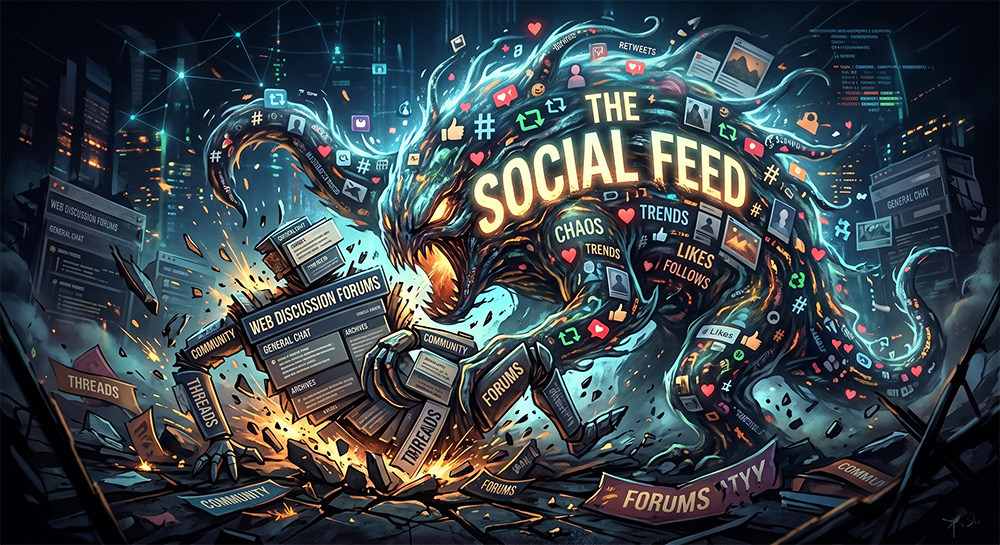
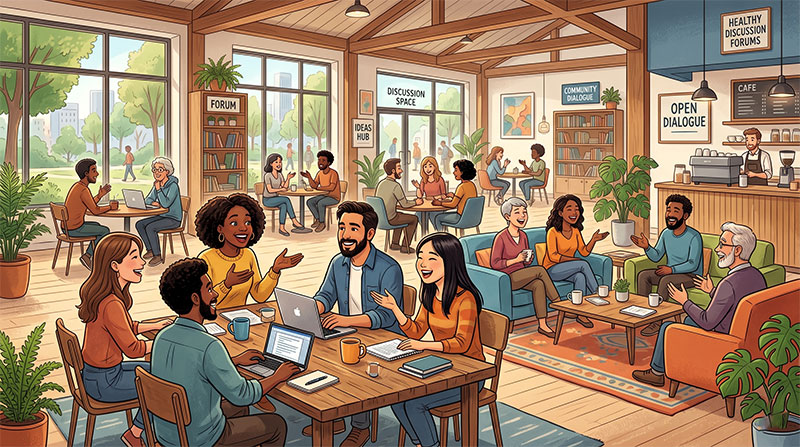
The most useful tool a billion people discovered last year did not buy a single billboard. It did not run a single television commercial, did not sponsor a single football match, did not pay for a single pre-roll on the videos you watched on the way home from work. And yet your colleague mentioned it on a Tuesday and by Friday you were using it every morning. This is not a curiosity. This is the shape of the thing that replaced advertising while nobody was looking.
The interesting question is not why Claude, ChatGPT, and Gemini grew without advertising. The interesting question is what it means that they grew faster, reached further, and embedded more deeply than any consumer technology in living memory — while the fashion houses and car brands and quick-service restaurants spent their way through the most expensive year in the history of paid media, and measurably moved almost nothing.
The cheerful explanation is that the AI tools were simply so good that word of mouth carried them. This is true and also insufficient. Plenty of things have been good and nobody has heard of them. Something else is operating here — a reorganisation of how humans decide what to try, what to keep, and what to tell their friends about. The interruption, which was the fundamental unit of twentieth-century commerce, has quietly stopped working.
by a frontier AI lab
ads as a fair exchange
to a scrolled display ad
Part IThe Broadcast Era, and What It Taught Us
To understand why performance advertising is failing, it helps to remember what broadcast advertising was doing right. The iconic spots of the twentieth century — the Apple "1984" commercial, the "I'm a Mac, I'm a PC" series, Volkswagen's "Think Small" — were never really about selling the product in the next thirty seconds. They were about telling you what kind of person would own one.
That distinction sounds small and is not. Brand advertising treated the audience as an intelligence worth courting. It assumed people bought things partly to signal who they wanted to be, and it built stories large enough to stand inside. When the campaign worked, it worked for a decade. The television slot was expensive because the cultural real estate it bought was expensive. You were not renting a thirty-second window on a Tuesday night. You were paying for a reservation in the collective imagination.
The fatal mistake of the performance era was treating that model as inefficient. The internet promised advertisers the ability to measure everything — every click, every impression, every millisecond of hover. And in the rush to measure, the industry forgot that the most valuable thing advertising ever did was something that could not be measured at all. Cultural resonance does not fit on a dashboard.
Part IIThe Performance Era, and Why It Broke
Performance advertising, as an industry, has been operating for roughly fifteen years inside a quiet crisis of legitimacy. Every working advertiser knows that the platforms measure conversions generously. Meta uses view-through attribution — claiming credit if a user saw an ad anywhere in the preceding week and eventually bought the thing. Google counts last-click. When the two disagree, as they always do, nobody is lying. They are simply measuring different realities, and both are partially correct, and neither is the one the advertiser was trying to buy.
Anyone who has run a campaign has experienced this. Instagram reports a thousand engagements, a four-percent click-through, a successful placement; Google Analytics reports that most of those clicks bounced within a second, and the handful who stayed were reading something else entirely. The platforms show you a green number. The reality shows you the bounce rate. Between them is a gap that has cost the global economy hundreds of billions of dollars and produced an entire generation of people who have learned to unsee anything that looks like a sponsored post.
This is the cost of having trained an audience to scroll past. Every cheap impression raised the bar for the next one. Every "skip ad" button confirmed that the interruption was worth less than the content it was interrupting. The medium, once merely annoying, has become a kind of ambient static that adult humans filter out as automatically as they filter out the hum of a refrigerator.
The medium, once merely annoying, has become a kind of ambient static that adult humans filter out as automatically as they filter out the hum of a refrigerator.— GlamBon Editorial
Part IIIThe Podcast Tightrope
Into this vacuum stepped the podcast ad — and for a moment, it looked like the answer. The medium is intimate. The host is, for an hour at a time, closer to the listener than any celebrity endorser ever managed to be. The psychological term is parasocial interaction; the practical effect is that when a host recommends a product, the listener's defences do not rise. The ad slides past as a tip from a friend rather than a claim from a seller. Recall rates are reported to be seventy to eighty percent higher than display advertising, which is substantial enough to have built an entire sub-industry around the format.
But the honest thing to say about podcast advertising is that it is a tightrope. When it works, it works because the host genuinely uses the thing and lets that use into the conversation. When it fails, it fails in a way unique to audio: the tone changes. You have been listening to two thoughtful people discuss architecture for thirty-four minutes, and then one of them briefly becomes a different person, louder and more enthusiastic, reading copy about a snack brand. The shift is jarring because the trust was doing quiet work underneath, and the shift announces — in the plainest possible terms — that the work was partly commercial.
The contextual friction is the whole problem. It is also, with some effort, solvable. The better podcast ads are no longer sixty-second reads; they are five-minute segments in which the host threads the sponsor through the actual subject of the episode. Not an ad pause but an expansion. When a show about art history spends five minutes on the history of Italian pigment and mentions that a particular brand is reviving that tradition, the listener is given information first and solicited second, which is roughly the order in which humans prefer to be addressed.
The medium was scarcity. Three networks, a handful of magazines, a cinema reel — and every slot expensive enough that the work had to be remarkable to justify the spend. Agencies hired novelists and filmmakers. A great ad was a small cultural event, discussed the next morning. The audience was treated as an intelligence worth courting because there was no cheaper way to reach them.
Digital distribution promised the industry what it had always wanted — the ability to measure every click, hover, and conversion. In the rush to quantify, something important was left behind. Impressions became cheap enough that brands bought them by the billion, and audiences evolved to unsee them almost entirely. The ads worked on paper and failed in rooms. Every platform reported its own metric, and each metric was partially true, and the sum of all partial truths was the collapse of trust in the numbers themselves.
The best-grown products of the new era advertise nothing and grow faster than anything before them. The mechanism is simple. When utility or beauty is high enough, the user does the advertising — voluntarily, for free, in conversation with the people they already trust. Brands that understand this are moving toward additive advertising: long-form stories, photo essays, documentary segments — work that would be worth consuming even if the brand name were removed from the credits. This is not a loophole. It is what advertising becomes once it can no longer rely on interrupting anyone.
Part IVThe Native Answer
There is a useful comparison to make, and it is the cleanest way we know to describe what we mean by a native story.
The difference between the two columns is not a matter of cleverness. It is a matter of who the hero of the story is. In the traditional ad, the brand is the protagonist — its existence is the reason the sentence exists. In the native story, the experience or the craft or the question is the protagonist, and the brand is the patron who made the telling possible. Patronage is a five-hundred-year-old relationship between money and art, and it has always produced better work than direct commission.
The shift changes everything downstream. Because a reader has to engage with a story to receive it, the bounce rate problem disappears — you cannot accidentally read a 1,500-word photo essay the way you can accidentally click a Buy Now button. The data the publisher gathers is no longer a guess at interest but evidence of it: the reader who finished the piece about Adriatic architecture is a reader who cares about Adriatic architecture, and that fact is worth more than any impression count the platforms can invent.
Part VThe Value-Add Filter
The whole question of whether native advertising is honest or manipulative collapses into a single diagnostic. It is the question we ask of every piece of sponsored work that crosses this desk, and it is the only question that matters.
If we removed the brand name, would this article still be worth reading?
If the answer is yes, the sponsorship is additive. The brand has bought the right to be associated with something the reader genuinely values, which is, not coincidentally, the oldest and most durable form of advertising that exists. If the answer is no, the piece is dressed-up display advertising — and the reader will eventually feel it, because readers always eventually feel it, and the only thing more expensive than a native story that works is a native story that pretends to.
The standard is not merciful. It rules out most of what calls itself native advertising in the wider industry. Fifteen-hundred words of thinly-veiled product description do not pass. A listicle reverse-engineered from a brief does not pass. What passes is the piece that the reader forwards to a friend without a caveat.
Part VIThe Moat
Storytelling is the manual labour of the digital age. It is more expensive per unit than automated advertising by a considerable margin. It takes writers and photographers and editors and time — the actual time it takes a human to think about a thing clearly enough to say something true about it. None of that labour scales the way a programmatic campaign scales. All of it produces something that, once produced, cannot be replicated by an algorithm.
This is the moat. Every generic piece of performance creative that floods a feed next year is generated by a model that will also generate ten thousand indistinguishable cousins of itself. A genuine photo essay about a dying craft in a Croatian village, produced in the specific voice of a specific publication, is not replaceable. It is not commoditisable. It is, in the long run, the only form of advertising that accrues value over time rather than depreciating the instant it runs.
There is a reason every AI company we mentioned at the top of this essay grew through word of mouth. Utility so profound that the user could not help mentioning it is a kind of organic advertisement that no amount of paid media can manufacture. GlamBon's ambition, in this era, is the adjacent one: beauty, craft, and stories so specific that the reader cannot help sharing them. The word-of-mouth flywheel starts spinning when the thing shared makes the sharer feel slightly more themselves, slightly more informed, slightly more alive to something they did not know about yesterday. That is the only engine of growth we believe in, and it is the only form of advertising we are interested in producing.
Questions worth asking
Because the product is the marketing. When a tool saves someone four hours of work, the user becomes the advocate. This is product-led growth — utility so high that the shared result, not a purchased impression, does the selling. Claude, ChatGPT and Gemini all grew this way, by word of mouth between people who had just discovered something useful.
They measure different things. Meta uses view-through attribution and claims credit when a user sees an ad and later converts, even without clicking. Google Analytics uses last-click, session-based attribution and only counts a visit arriving from a specific source. Platforms are incentivised to show you conversions; analytics tools are incentivised to show you reality. Both are partially true, which is why they never reconcile.
Both, depending on execution. Host-read ads benefit from parasocial trust — listeners feel recommended to rather than advertised at — and recall rates run well above display ads. But when the tone of the ad clashes with the tone of the conversation, the interruption is felt as a violation rather than an endorsement. The deciding factor is contextual congruence, not volume.
A single test. If you removed the brand name, would the article still be worth reading? If yes, the sponsorship is additive and the reader is served. If no, it is performance advertising wearing an editorial costume, and the reader will eventually feel the difference.
If your brand has a story, we are interested in telling it.
GlamBon collaborates with a small number of brands each year on long-form native work — photo essays, documentary features, artist profiles, sponsored editorial series. Every commission is held to the same standard as our unpaid editorial: if the name were removed, the story would still be worth reading.
Enquire about partnerships →