There is an Italian film from 1972, directed by Marco Bellocchio, called Sbatti il mostro in prima pagina — Slap the Monster on the Front Page. It is a study of a Milan newspaper editor who manufactures a moral panic to sway an election. The film is now more than half a century old, and the title has aged into something close to prophecy. The monster is no longer slapped on a single front page once a morning. The monster is an infinite scroll. The monster is the format itself.
- The engagement economy converts human attention into revenue, and human attention is biologically biased toward threat.
- Doomscrolling is not a personal weakness. It is the predictable output of a system optimised against the user.
- Heavy exposure to negative content produces what George Gerbner called Mean World Syndrome — a measurable distortion of risk perception.
- A collective conscience that focuses on collapse begins to behave in ways that produce collapse. The loop closes on itself.
- The closing question is not whether the cycle exists. It is whether the cycle is by design.
The Monster Has a Recommendation Algorithm
I write this as someone who has spent a long time inside the engineering of digital systems. I am not a media theorist by training, but I have built enough infrastructure to understand what an optimisation function does. An optimisation function has no taste. It has no values. It has a metric. If the metric is engagement — measured in watch time, click-through, shares, comments, time on platform — then the system will discover, without ever being told, that fear performs better than calm, that outrage performs better than nuance, that the apocalyptic title outperforms the accurate one by a factor that compounds over time.
This is not a moral failing of the engineers who built the system. It is the system. The platform is not editorialising. It is optimising. The result is the same.
Bellocchio's film was about a man making a deliberate choice. The man knew what he was doing. He was a villain in the classical sense. What we have now is something stranger and harder to confront: a machine that arrives at the same conclusion as the villainous editor, but without anyone in particular having made the decision. The decision is distributed across a million A/B tests. The monster is on the front page because the data said so.
The platform is not editorialising. It is optimising. The result is the same.
Negativity Bias, Weaponised at Scale
The biology is not in dispute. Our nervous system, sculpted by a few hundred thousand years of being hunted by larger animals, prioritises threat. The rustle in the grass that might be a tiger demands more cognitive bandwidth than the rustle in the grass that is almost certainly the wind. This is called the negativity bias, and for most of human history it kept us alive. It made us good at surviving the savannah. It made us bad at scrolling.
An algorithmic feed, trained against engagement, finds this bias the way water finds the lowest point in a valley. It does not need to be told that fear works. It discovers fear. Then it serves it back to you, slightly more concentrated each session, because the slightly more concentrated version produces marginally better metrics, and marginal improvements are what the system is optimising for.
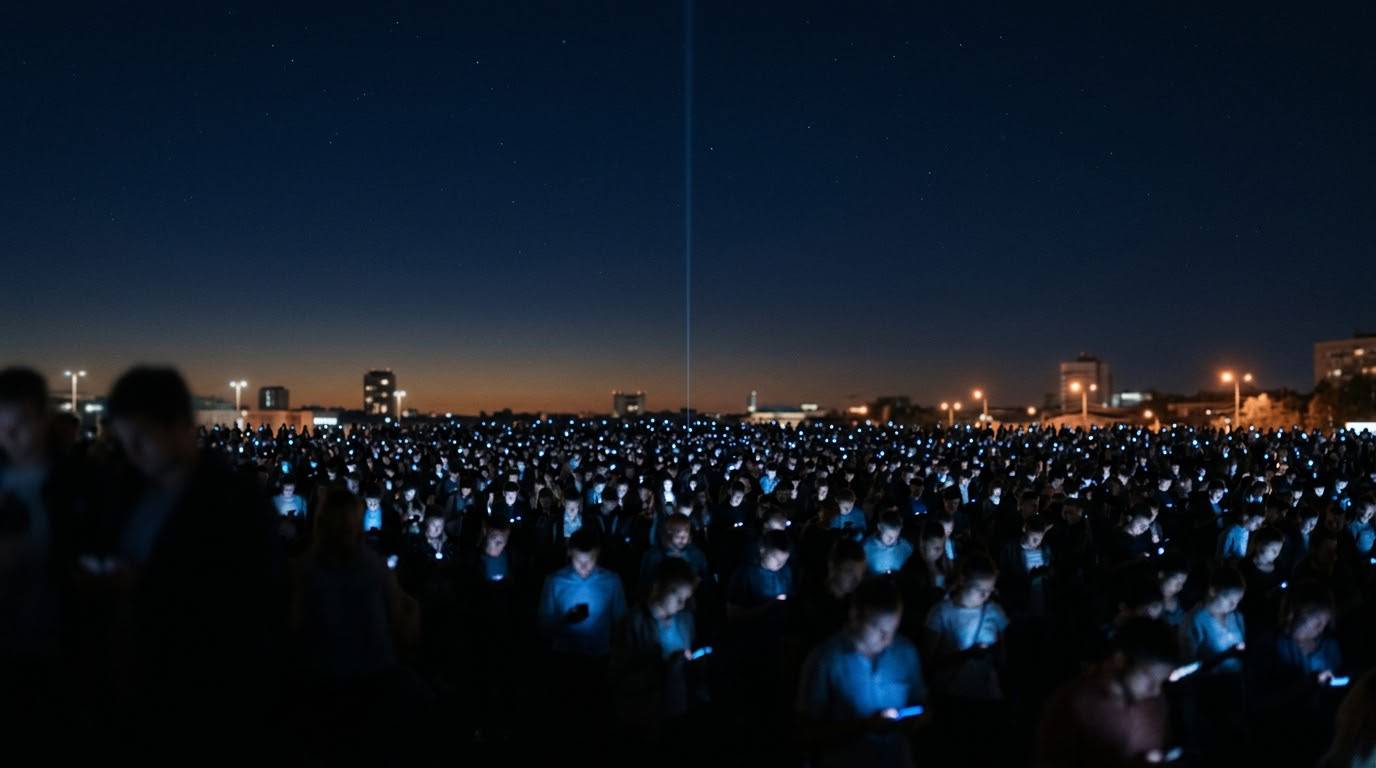
What you experience, as a user, is the slow conviction that the world is on fire. Every fire on Earth is now visible to you, in real time, with a notification. You are not wrong about the fires. The fires are real. But you are wrong about the proportion of the world that is on fire, and the algorithm has no incentive to correct you, because corrected proportion is bad for engagement.
Mean World, Migrated
In the 1970s, the communications professor George Gerbner studied heavy television viewers and discovered something he called Mean World Syndrome. Heavy viewers, he found, consistently overestimated their risk of being a victim of crime, consistently believed their cities were more dangerous than the data supported, and consistently exhibited higher levels of generalised anxiety about strangers. Television, he argued, was not a window onto the world. It was a curated selection of the world's worst hours, repeated nightly, and the cumulative effect was a population that was statistically wrong about the place it lived in.
If Gerbner's research disturbed him in the era of three broadcast channels and a nightly news bulletin, the contemporary version is a step-change he did not live to see. The feed is not nightly. It is continuous. It is personalised, which means the apocalypse is curated for me specifically and a different apocalypse is curated for you. We are no longer even afraid of the same things. We are afraid of separately tuned versions of the same underlying mood.
And the desensitisation runs in parallel with the anxiety, which is the quietly cruel part of the arrangement. We become numb to atrocity in the abstract — a feed that contains a war, a famine, a school shooting, a market crash, and a cooking video, in that order, scrolling at thumb-speed, trains us to register all of them at the same emotional pitch, which is to say almost none — while remaining acutely afraid of our own street. We feel less for the world and more afraid in it. Both directions are wrong. Both directions are profitable.
The Self-Fulfilling Prophecy
Here is where I want the argument to leave the territory of media criticism and step into something more philosophical, because I think the consequences are.
Suppose, as a working hypothesis, that there is such a thing as a collective conscience — not in a mystical sense necessarily, though I am open to that reading — but in the practical sense that a society shares a mood, a horizon of expectation, a working theory of where things are going. This collective theory is not formally written down anywhere, but it shapes behaviour. People who believe the economy is collapsing stop investing. People who believe their neighbours are dangerous stop trusting them. People who believe the future is finished stop building for it. People who believe everyone is lying stop listening.
None of these are abstract effects. Each of them is a measurable behavioural shift, and each of those shifts has measurable second-order consequences. Withheld investment is real recession. Withdrawn trust is real polarisation. Abandoned long-term thinking is real institutional decay. The behaviours produce the conditions, and the conditions then produce the next round of headlines, which the algorithm serves back to a population that is now, by its own collective action, marginally more afraid than it was a year ago.
The loop closes. The prophecy fulfils itself. We did not invent the danger out of nothing — there is always real danger — but we amplified it, focused on it, organised our attention around it, and through the focusing made it more itself.
A Glossary for the Vicious Cycle
Some terms are worth naming precisely, because the imprecision of the public conversation around them is part of how the cycle survives. If we cannot describe the mechanism, we cannot resist it.
Negativity Bias
The evolutionary tendency of the human brain to weight threatening information more heavily than neutral or positive information. Useful when avoiding predators. Catastrophic when monetised.
Algorithmic Radicalisation
The process by which recommendation systems, optimising for engagement, progressively serve more extreme content to keep a user on platform. The user does not radicalise themselves. The pipeline does.
Mean World Syndrome
Gerbner's term for the distortion in risk perception caused by sustained exposure to violent or alarmist media. The viewer is statistically wrong about the world they live in, and the wrongness is durable.
Cognitive Reframing
The deliberate practice of changing the lens through which one views an event in order to alter its emotional weight. The opposite of doomscrolling. A form of psychic hygiene.
Reclaiming the Lens
I do not want this piece to end on the shape of the trap, because to describe a trap without offering an exit is itself a small contribution to the cycle. So let me end on the exit, or on what might be the beginning of one.
The first move is rhetorical. We have to stop calling it news. A good portion of what arrives in our feeds is not news in any meaningful sense — it is engagement product, a manufactured emotional payload designed to extend our session. Calling it news flatters it. Calling it what it is — content optimised against me — restores some of the cognitive distance the system was designed to dissolve.
The second move is dietary. I am not the first person to make this comparison, and I will not be the last, but it stands: we have spent the last decade learning to think carefully about what we put into our bodies — the food, the cosmetics, the supplements — and we have been almost entirely careless about what we put into our minds. A daily intake of three hours of curated catastrophe is not a neutral input. It is a substance. It changes the user. We have a name for what we eat. We have not yet built a vocabulary for what we read, watch, and scroll, and we need one.
The third move is creative. The cycle survives because it is the loudest thing in the room. The counter-strategy is not silence. The counter-strategy is to make beauty, art, philosophy, craft, and slow attention louder, more available, more aesthetically charged than the apocalyptic feed. This is, frankly, what a publication like GlamBon is for. A magazine of culture and lifestyle is not a frivolous response to the doom cycle. In a media environment that profits from our worst hours, the deliberate cultivation of better hours is an act of resistance.
In a media environment that profits from our worst hours, the deliberate cultivation of better hours is an act of resistance.
By Design?
I have walked carefully around this question for the whole article, and now I want to ask it directly.
The cycle exists. We can describe its mechanism. We can name its stages. We can measure its psychological cost. The question I cannot answer, and I will not pretend to answer, is whether the cycle is a side effect of an engagement-optimised system that simply happened to find the lowest point in the human nervous system, or whether — at some point, in some room, by some set of actors — the cycle is now being maintained because the cycle is useful.
A frightened population is a more biddable population. A distracted population is a less organised one. A population convinced its institutions are failing tends, eventually, to stop defending them, which is a useful condition for any actor that benefits from those institutions failing. None of this requires a conspiracy. It requires only that the various beneficiaries of mass anxiety — political, commercial, geopolitical — do nothing to change a system that is already working in their favour. Inaction at scale is indistinguishable from design.
I do not have the answer. I have the question. I think it is the right one to be sitting with, in 2026, every time we open the app.
Is the apocalypse we are scrolling through a side effect of a system that found our weakest point — or is it being maintained, now, by people who profit from us never looking up?
The strange comfort, if there is one, is that the loop runs on us. It cannot run without our attention. The medium that delivers the cycle is also the lever by which the cycle is broken. We do not need permission to look away. We do not need a regulator's intervention to choose what we open in the morning. We can simply, individually, and quietly, decide that our attention is not a free resource — that it is, in fact, the most valuable thing we own, and that it should be allocated, not extracted.
That is a small rebellion. It is also, perhaps, the only one available at the level of an individual. And I think it might be enough, if enough of us decide on it at once.