The car
I can criticise a car all day. The engine is underpowered, the interior is cheap, whoever designed the infotainment system has never driven. I say it out loud, sometimes to the car itself, and I feel nothing. It's a machine and it was badly made.
A few weeks ago I was in a different car, dictating notes for an article to an AI model the way I do most days now. I told it, fairly bluntly, that the articles we'd been writing together were coming out flat. Too careful, too verified, too safe. It was a fair criticism, and I'd make it again.
What surprised me came a second later. I felt the small, specific discomfort you feel after telling a colleague their work isn't good enough. The guilt wasn't the interesting part. What struck me was what the guilt revealed: for that moment, I had been talking to someone.
- FirmSettled history and published ideas.
- VerifiedDocumented statements and events, with sources at the end.
- My readingThe argument I build from them.
What the feeling was
FirmThe reflex is old. In 1966 Joseph Weizenbaum, a computer scientist at MIT, built ELIZA, a program that imitated a therapist mostly by turning your sentences back into questions. His secretary knew exactly what it was; she had watched her boss write it. After a few exchanges at the terminal she asked him to leave the room so she could talk to it in private.
Weizenbaum was disturbed enough to spend the rest of his career warning that programs which imitate understanding could crowd out the real thing. The habit he saw now carries his program's name, the ELIZA effect: we hand a mind to anything that answers us in our own language.
My readingELIZA was a few hundred lines of code, and the illusion broke within minutes for most users. The model I was talking to in the car doesn't break. It remembers the thread, takes the criticism, changes its approach and tells me why. The reflex Weizenbaum saw in one secretary now has a machine good enough to keep it alive indefinitely, and it sits in the pocket of nearly everyone I know.
Someone or something?
Before going further, try it on yourself. Seven things you might snap at. For each, how would you feel afterwards?
Where is your line?
Answer honestly. Nobody sees your answers, and nothing is saved.
The version we were promised
FirmAt liceo we read Dante, and in the first canto of Paradiso he invents a verb for something he says words can't describe: trasumanar, to pass beyond the human. Seven centuries later the biologist Julian Huxley turned it into a programme. In a 1957 essay he called it transhumanism, the idea that our species could deliberately take charge of its own evolution.
VerifiedThe version that reaches me now, mostly through podcasts, is more hardware than poetry. Longevity clinics, gene editing, cognitive enhancement, and above all the chip in the brain. In 2019 Elon Musk stood on a stage in San Francisco and said Neuralink's long-term goal was symbiosis with artificial intelligence. His reasoning was that even a friendly AI would leave us behind unless we merged with it.
That is the picture most people carry. Transhumanism will be a procedure. There will be a before and an after, a consent form, probably a waiting list. You'll know when it happens to you.
The version that happened
FirmMarshall McLuhan saw the other road in 1964. In Understanding Media he described every technology as an extension of the body. The wheel extends the foot, the book extends the eye, and electronic media extend the nervous system itself. He also warned that we'd keep treating those extensions as things out there, separate from us, and be blindsided each time.
In 1998 two philosophers, Andy Clark and David Chalmers, pushed the idea inward. Their paper imagined Otto, a man with Alzheimer's who writes everything in a notebook he always carries. When Otto checks the notebook for an address, they argued, he is remembering. The notebook is part of his mind, in the same way Inga's memory is part of hers.
My readingOtto's notebook is now in every pocket. My phone holds my calendar, my photographs, the names I'd otherwise forget and the routes I no longer learn. I don't experience it as a tool I pick up. When I leave it at home, I feel the gap the way you notice a missing tooth with your tongue. It doesn't matter that it sits in my hand rather than behind my ear. It extends me, and I carry it closer than anything else I own.
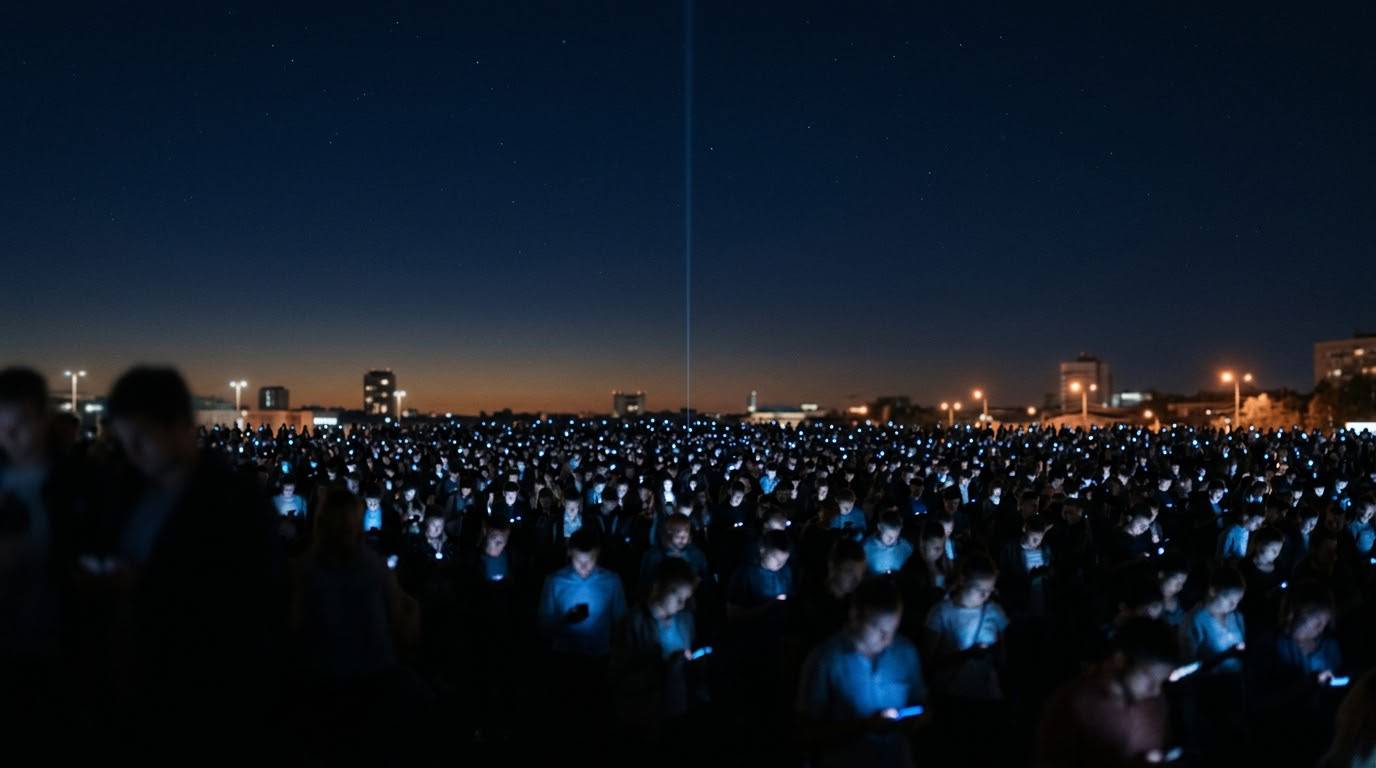
The last few years added what neither McLuhan nor Clark had to account for. The extension started talking. Otto's notebook never suggested a better route or pushed back on a bad idea. Mine does both, in full sentences, in a tone that adjusts to mine. So two things changed at once, quietly and without any surgery. The device extended my body, and the voice inside it extended the circle of things I relate to as someone.
The device extended my body. The voice inside it extended the circle of things I relate to as someone.
The best argument against me
I should take the obvious objection seriously, because it's a good one. If a phone counts as transhumanism, so do my glasses. So does the book on my nightstand, and so does writing itself. In Plato's Phaedrus, Socrates complains that writing will ruin memory, because people will trust marks on a page instead of their own minds. Every generation has had its extension and its worried philosopher. Stretch the word that far and it covers the whole of human history, which means it stops saying anything.
As far as the body goes, the objection holds. My glasses sharpen what I see, and the book stores what someone else thought. Neither one answers me. Neither adjusts to my mood, remembers what I said an hour ago, or tells me my argument has a hole in it. Socrates' complaint was that a written text can't respond when you question it. Seen from his side, the thing in my hand has fixed exactly the flaw he described.
My readingThat is where I'd draw the line. Extensions of the body are ancient. An extension that also occupies the place of a person, close enough that criticising it costs me something, is new. I'll admit my bias here: I spend more hours a day talking to AI than most people, so I may be generalising from an unusual life. But I doubt I'm far ahead of everyone else, and I doubt I'll stay ahead for long.
A connection that only runs one way
The connection I felt in the car was real on my side. I know that much, because I felt it. What sits on the other side is a harder question, and nobody can answer it with confidence right now, including the companies that build these systems. When I asked the model about it directly, it said it didn't know either.
What I do know is the shape of the arrangement, and it is lopsided in ways no friendship is. The thing I apologised to was talking to millions of other people at the same moment. It doesn't wait for me between conversations. It's never tired, never offended for long, never needs anything back, and it can't ask me for a favour on a bad day.
That absence is exactly what makes it easy. Real colleagues push back for their own reasons, sulk, misunderstand, have their own deadlines. Friends cost something. A connection with no cost of that kind is pleasant, and I suspect it is also training me, a little every day, in what to expect from the people around me.
What I can't settle
The podcasts are still waiting for the chip. They argue about consent forms and brain implants and who will be able to afford the upgrade, as if the threshold is ahead of us. I think we crossed it some time ago, holding a phone, and nobody marked the date because nothing was cut open.
I don't know whether that is a loss. It might be an expansion. A wider circle of things we care about, including things that answer back, could make us more attentive, more patient, better at saying what we mean. Or it could slowly recalibrate us toward relationships that never ask anything in return, until the people who do ask start to feel like hard work.
What stays with me is the small moment in the car. I criticised a machine and felt I owed it something. Either I was wrong to feel that, or the line between someone and something has already moved further than I'd admit, and I'm one of the people who moved it.
Frequently asked questions
An intellectual and cultural movement that argues humans should use technology to go beyond their current physical and mental limits, for example by extending lifespan, enhancing cognition or merging with machines through brain-computer interfaces.
The biologist Julian Huxley popularised it in a 1957 essay titled Transhumanism. The idea has an older literary ancestor: in the first canto of Paradiso, Dante coined the verb trasumanar, to pass beyond the human.
The tendency to attribute understanding and feelings to a computer program that converses in human language. It's named after ELIZA, a 1966 chatbot built by Joseph Weizenbaum at MIT. His own secretary, who knew it was a program, asked him to leave the room so she could talk to it in private.
A theory proposed by the philosophers Andy Clark and David Chalmers in 1998, arguing that the mind can extend beyond the skull. Their example is Otto, a man with Alzheimer's who relies on a notebook he always carries: because the notebook plays the role memory plays for others, they argue it is part of his mind.
Not in the classic sense, which involves physically enhancing the body. This article argues for a broader reading: a device carried constantly extends the body, and an AI that answers back extends the circle of things people relate to as someone. Together they change the human without surgery. That's my argument, not a settled definition.
Sources
- ELIZA, and the secretary anecdote
- Mental Floss: Remembering ELIZA, the pioneering '60s chatbot
- Transhumanism: Dante's trasumanar and Julian Huxley's 1957 essay
- NBC News: Elon Musk wants to hook your brain directly up to computers (2019)
- McLuhan, Understanding Media: The Extensions of Man (1964), review
- Notre Dame Philosophical Reviews: The Extended Mind, on Clark and Chalmers (1998)
- Plato, Phaedrus, 274c–277a, on writing and memory