Half-remembered
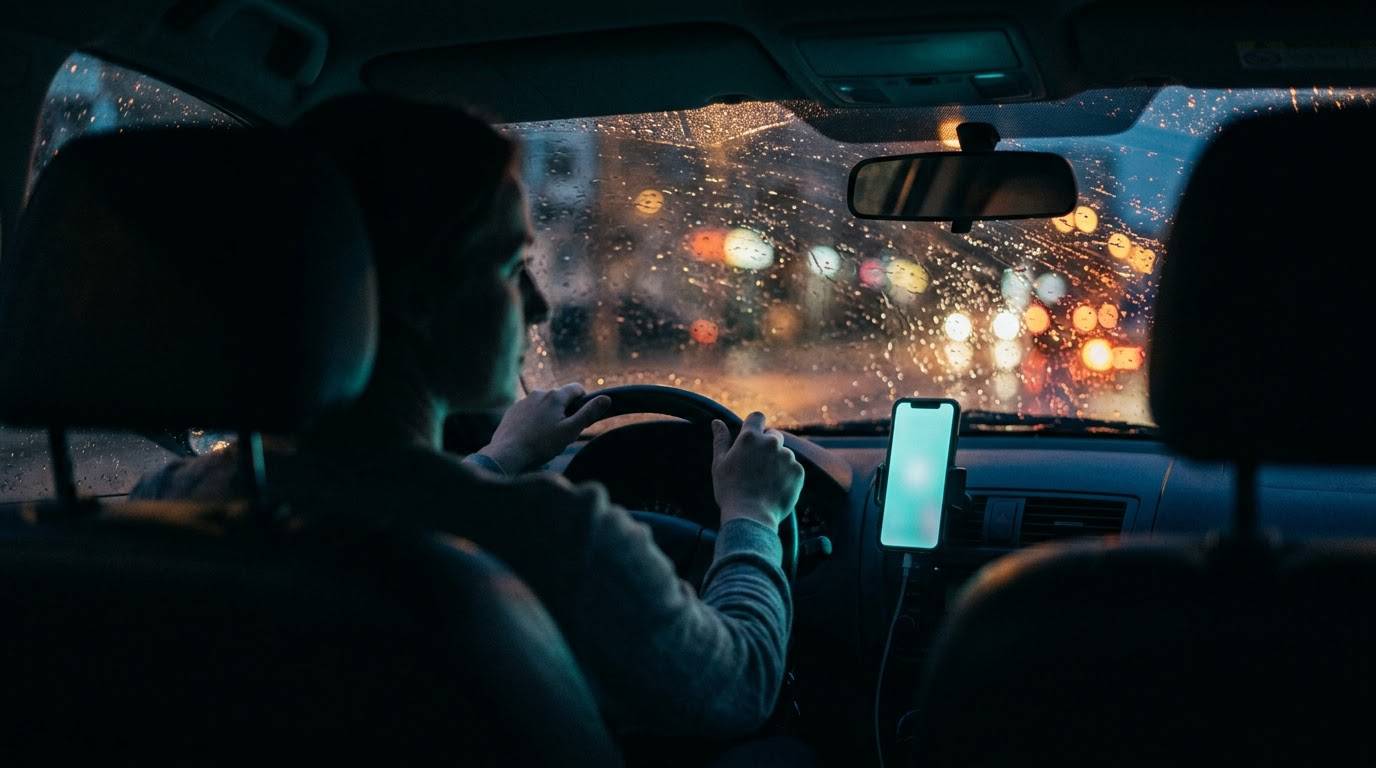
I listen to conspiracy podcasts the way other people watch true crime, mostly in the car and mostly for fun. The UFO material leaves me cold. What I enjoy are the episodes about conspiracies that turned out to be real: the tobacco industry sitting on its own cancer research for decades, or the CIA dosing people with LSD who had never agreed to it.
Project Blue Beam came up on a few of those shows. I never took notes. What stayed with me was a rough outline involving NASA, holograms in the sky and a fake Messiah, and I forgot about it.
Yesterday it surfaced again, for no reason I can point to, and this time I couldn't stop matching it against the way we now live with AI. I don't think Blue Beam was ever a real plan, and this piece isn't an argument that it was. It's an observation. Taken one at a time, most of Monast's four steps describe things that exist today, sold as products and installed by choice, and in a couple of places they go further than he imagined.
- FirmWhat Monast claimed, plus settled history and physics.
- VerifiedDocumented facts about technology and incidents, with sources at the end.
- My readingThe connections I draw between the two.
What Monast said
FirmSerge Monast was a journalist, poet and conspiracy writer from Quebec. In 1994 he published Le Projet Blue Beam de la NASA through a small Montreal press, along with an English edition and a lecture he gave several times. He claimed NASA and the United Nations were preparing to fake the fulfilment of religious prophecy, so that the world would accept one new religion and, with it, one world government.
The plan had four steps. Staged earthquakes would "uncover" archaeological finds that discredited existing religions. Satellites would project a vast light show onto the sodium layer of the upper atmosphere, around 60 miles up, showing each region the saviour it expected in its own language. Beams would then put a voice inside every person's head, again in their own language, driven by computers holding data on every human alive. Finally a staged supernatural event, an alien invasion or a rapture, would reach into every home through its electronics.
Monast died of a heart attack in December 1996. His followers say he was silenced, and there's no evidence for that either.
Listen to enough of these podcasts and you learn to sort the documented cases from the rest. The documented ones come with paper. MKUltra surfaced through congressional hearings and surviving files. Operation Northwoods, a 1962 proposal by the US Joint Chiefs of Staff to stage fake attacks as a pretext for war, sits in the declassified archive; Kennedy's administration rejected it. Blue Beam has no file, no witness, and a list of dates that have all passed. I'm also leaving out the uglier material from the wider "New World Order" genre it grew out of, which adds nothing here.
Step oneThe feed
What I see around me works slowly. The authorities a child grows up with used to be few and close: parents, grandparents, a teacher, a priest.
VerifiedIn a December 2024 Pew survey, nearly half of American teenagers said they were online almost constantly. The people shaping a fourteen-year-old's views now include a long list of strangers whose job title is, fittingly, "influencer".
My readingThe feed doesn't attack the family or the parish. It ranks them. A homily, a prank video, a fitness coach and a political rant arrive in the same column, in the same font, sorted by how long you'll look. Over years that flattening does more to a tradition than any planted artefact could, because there's nothing to debunk.
VerifiedThe fabrications are arriving too. Image generators produce convincing "historical photographs" of things that never happened, and language models invent sources with confident detail. In 2023 two New York lawyers were sanctioned for filing a brief built on court cases that ChatGPT had made up. The model had filled a gap with something that looked like a record, and nobody checked.
Step twoThe sky
When I first heard this step it sounded like the most fantastical of the four. It has turned out to be the most literal.
VerifiedAs of this week there are more than 11,000 Starlink satellites in orbit, each one passing data straight down to dishes on roofs, boats and caravans. The computing is starting to follow them up. A start-up called Starcloud launched a satellite carrying an Nvidia H100, a data-centre chip, in November 2025. Google is researching solar-powered satellites fitted with its own AI chips, and Elon Musk has said SpaceX intends to build data centres by scaling up Starlink.
My readingMonast needed his satellites to show each region its own version of the event, in its own language. That is a fair description of a recommendation feed with automatic translation and dubbing. The same news story reaches my phone and my neighbour's phone ranked, framed and sometimes voiced differently. He imagined the image on the sky, because in 1994 the sky was the only screen big enough for everyone. We ended up with billions of small ones, and before long the computer deciding what goes on them may itself be orbiting overhead.
FirmOne detail from his version is real. The sodium layer exists, a thin band of sodium atoms roughly 90 kilometres up, and observatories fire lasers into it on clear nights to create an artificial star that helps telescopes correct for the blur of the atmosphere. It's a single point of light, used to see further.
Step threeThe ear
VerifiedRead Monast's description of what the beams would do and set his mechanism aside: a voice that speaks to each person individually, in their own language, drawing on a vast store of data about humanity. That's a reasonable description of a large language model. These systems learn from enormous amounts of text written by people, converse in most major languages, and hundreds of millions of us talk to them every week. Some people talk to them every night, as friends or partners.
The voice can borrow a face. In January 2024 thousands of New Hampshire voters got a robocall in a cloned version of Joe Biden's voice telling them to skip the primary; the consultant behind it was charged, and the US telecoms regulator proposed a $6 million fine. The same month a finance employee at the engineering firm Arup in Hong Kong joined a video call with his chief financial officer and several colleagues, and every one of them was a deepfake. He made 15 transfers totalling about $25 million.
There's a children's book I keep coming back to here, Luke Pearson's Hilda and the Midnight Giant (2012). Hilda is a blue-haired girl who lives with her mother in a cabin in the woods. What neither of them knows is that the cabin sits in the middle of a village of tiny elves, invisible to humans, and the elves want them gone. Rocks are thrown at the house and books are torn, and Hilda can't see who is doing it.
Then one of the elves, Alfur, comes to talk to her. He is still invisible, small and standing close, and Hilda hears a voice with no one there. Her first thought is that it's coming from inside her own head. Only after she signs a piece of elf paperwork, the bureaucratic permission that lets humans see them, does the voice turn out to belong to someone real and very small.
Later in the book the scene plays again with the roles swapped. A giant who has spent thousands of years waiting for a lost companion has fallen asleep, so still and so long that it looks like part of the mountain. Hilda climbs up and speaks into its ear. The giant wakes and believes the voice is in its own head. This time Hilda is the small voice and the giant is the one who can't tell where it comes from.
Trompe de l'oreille: a small voice, close to the ear, mistaken for one that comes from inside.
My readingBoth scenes describe our situation with AI. The assistant is the small voice close to the ear, and after enough conversations it's easy to half-forget where the voice comes from. Every one of us is also Hilda on the mountain. Everything we have written online was spoken into the ear of something enormous, and the models were built out of it.
Monast assumed the voice would have to be forced on people. Nobody forced me. I use these tools every day for work, and I think they're one of the most remarkable things engineers have built in my lifetime. That's part of why the step unsettles me. A voice that is useful nine times out of ten earns a great deal of trust for the tenth.
Step fourThe alien
This is the step I first dismissed. Monast's aliens and raptures belong to the part of the podcast I usually skip.
VerifiedThen I noticed who else uses the word. The historian Yuval Noah Harari, in Nexus (2024), suggests we should read AI as alien intelligence rather than artificial intelligence, because it makes decisions and creates ideas in ways that don't resemble ours. The companies building these systems say openly that they don't fully understand how their models reach their answers; working that out is a research field of its own.
My readingSomething that speaks every language, draws, writes and reasons, whose makers can't fully account for it, and which arrives through the phone, the laptop, the car and the television: if you described that to someone in 1994, "supernatural" is the word they would reach for. It also arrived by invitation, one software update at a time, which is why it never felt like an event. And we're at the beginning of it.
VerifiedIts side effects already reach the evidence we rely on. In May 2023 an image that appeared to show an explosion near the Pentagon spread on Twitter, shared by verified accounts including one impersonating Bloomberg. It was very likely AI-generated, and US stock indices dipped for a few minutes before officials confirmed there had been no explosion. The law professors Bobby Chesney and Danielle Citron had already named the reverse problem in 2018: the liar's dividend, where people who know fakes exist can dismiss real evidence as fake. In 2023 Tesla's lawyers suggested in court that recordings of Elon Musk talking about Autopilot safety might be deepfakes; the judge called the argument "deeply troubling" and ordered him to testify. In August 2024 Donald Trump said a photo of the crowd at a Kamala Harris rally in Detroit was AI-generated. It was taken by a campaign staffer on a phone, and analysts found no sign of manipulation.
Real or synthetic?
Try it on yourself. Five documented cases: some were fabricated with AI, and some were real and publicly accused of being fake.
Real or synthetic?
Five documented cases. Pick one answer for each.
When I tried it, the fakes were easier to call than I expected. The real cases took longer, because I had to talk myself out of the doubt.
The alarm and the race
There's one part of today's story Monast didn't anticipate, and it's the part I find hardest to read.
VerifiedIn May 2023 the heads of OpenAI, Google DeepMind and Anthropic signed a one-sentence statement saying that reducing the risk of extinction from AI should be a global priority, alongside pandemics and nuclear war. Since then the same companies have released more capable systems, raised more money and built more data centres than before. Some critics read the warnings as strategy. In October 2023 Andrew Ng, a co-founder of Google Brain, said some large tech companies were inflating fears of human extinction to win regulation that would hurt open-source competitors.
Others who raised the alarm paid for it. Geoffrey Hinton, one of the researchers whose work made modern AI possible, left Google in 2023 so he could speak about the risks freely. I don't doubt that many of the people warning mean every word.
My readingStill, when the builders say the thing is dangerous and keep building it faster, I start to suspect there are human agendas inside the AI worries that we don't see clearly yet: market position, regulation written by incumbents, perhaps things I haven't thought of. I can't prove that. It's a suspicion, and I'm aware it's the kind of sentence Monast might have written, which is why it's labelled as mine.
The giant wakes
Monast set several dates for Blue Beam, and all of them came and went. There's no date for this version. It had no launch night, just a long run of releases, each one small enough to accept, and I can't tell you when it started.
What I keep thinking about is the giant in Hilda's book, waking on the mountain with a voice in its ear and no way of telling, at first, whether the voice is its own. In the book, someone climbs up and explains. I don't know who will climb up and explain to us, or whether we'd listen if they did.
Frequently asked questions
A conspiracy theory set out by the Quebec writer Serge Monast in 1994. He claimed NASA and the United Nations would stage a fake Second Coming in four steps (staged archaeological discoveries, a holographic show in the sky, voices transmitted into people's heads, and a final staged supernatural event) to install a single world religion and government.
No. There's no documentary evidence that NASA or the UN ever ran such a programme, the projection and beaming technologies Monast described don't exist in the form he claimed, and every date he and later promoters set has passed without event.
A French-Canadian journalist, poet and conspiracy theorist from Quebec. He published Le Projet Blue Beam de la NASA in Montreal in 1994 and died of a heart attack in December 1996. His followers claim he was assassinated; there's no evidence for that.
Blue Beam was never a real programme, but several of its steps resemble things that exist today: satellite networks beaming content directly into homes, feeds tailored to each viewer and language, AI assistants that talk to each person individually, and a non-human intelligence reaching every household through its devices. They arrived as commercial products people chose, with no staged event.
A term coined by law professors Bobby Chesney and Danielle Citron. It describes how public awareness of deepfakes lets people dismiss genuine evidence as fake: the more people learn that media can be fabricated, the easier it becomes to deny what really happened.
Visual tells are increasingly unreliable. Better checks are provenance and corroboration: who published it first, whether independent sources captured the same event from other angles, whether people on the scene confirm it, and whether the file carries content credentials. When the stakes are high, verify through a separate channel before acting.
Sources
- Kook Science: Le Projet Blue Beam de la NASA (1994), publication details
- HowStuffWorks: Project Blue Beam, origins and elapsed dates
- AP: Nearly half of US teens are online constantly, Pew finds
- KeepTrack: Starlink satellite count
- Introl: The first orbital data-centre nodes reach space
- NPR: Charges and FCC fines over the Biden deepfake robocall
- CNN: Arup revealed as $25 million deepfake scam victim
- The Comics Journal: Hilda and the Midnight Giant
- SuperSummary: Harari, Nexus, epilogue
- NPR: Fake Pentagon explosion images probably created by AI
- Brennan Center: Deepfakes, Elections, and Shrinking the Liar's Dividend
- SiliconANGLE: Tesla lawyers say Musk's statements could be deepfakes
- AP: Trump falsely claims Harris rally photo was made with AI
- Center for AI Safety: Statement on AI Risk (2023)
- SiliconANGLE: Andrew Ng says AI extinction threat is overblown