A magician's whole art is in the hand you're watching. Not the hand that lies — the hand that's interesting. The trick was never in that hand. It was in the other one, resting quietly at his side, the one you had no reason to look at because the first hand had already claimed your eyes.
I keep thinking about that arrangement when I read about climate. Not because I doubt the science — I don't, and I want to be exact about that before I've earned the right to say anything else. The warming is real, it's ours, and that case is about as closed as science closes. I talked about electric cars with my engineering professors in the early nineties; I have never once thought they were a trick. The trick isn't in any of the claims. Every claim might be true. The trick is in the composition — in which hand is lit, and which one you were quietly encouraged not to watch.
A magician never lies. He governs your attention.
And a science communication that governs your attention — that decides for you what belongs in the frame and what stays in the dark — is doing something other than science, even when every sentence it speaks is accurate. A frame, unlike a fact, is always somebody's choice.
So this isn't an accusation. I don't know what's in the magician's other hand. That's the point. I only know there is one, and that I was never invited to look. What follows is four things I think are sitting in the dark just outside the lit frame — not because they're necessarily large, but because they're real, and unasked. I'm not going to tell you why they're out of frame. I'm going to ask.
You begin with the lit hand — the part you've always been shown. Pull the frame back, and watch what was cropped out of it.
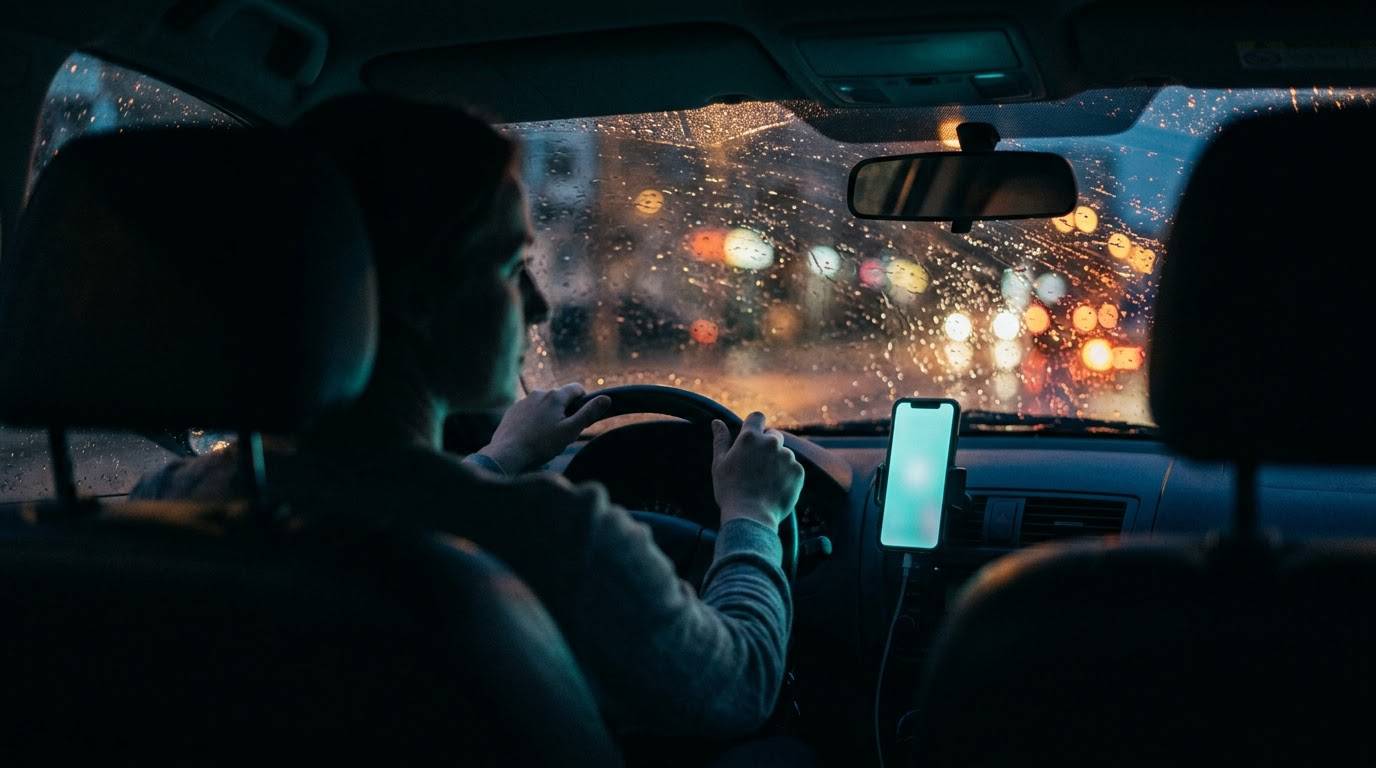
Everything, to your door, by tomorrow. We debate the fuel of the van endlessly. Why is the model itself never put on the table — only its fuel?
Specimen 01 · The strange oneThe Cloud We Seeded
Small, intentional, unmodeled — and never raised.
Start with the strangest one, because it teaches the eye. Right now, in dozens of countries, we are seeding clouds on purpose. We fire silver iodide into the sky from aircraft and ground generators to make water fall where we want it — over a reservoir, off a ski resort, away from a parade. This is not speculative. It is operational, funded, scaled, and routine.
Here's what I find strange. Ask what cloud seeding does to the climate and the honest answer is: very little. It moves water around locally; it doesn't move the planet's energy budget. As a number on the great ledger of warming, it rounds to zero. So a climate accountant is right to leave it out. But that's exactly the move I want to slow down — because my question isn't about its magnitude. It's about its kind.
We are deliberately reaching into a chaotic system and giving it a push. Not a metaphorical one — a literal, intentional perturbation of atmospheric microphysics, performed thousands of times a year. And the strange part is not that the push is large. It's that nobody is following it. The regional effects are genuinely unsettled: does seeding here starve the clouds downwind, or rain a little extra a hundred miles on? The studies disagree — sometimes about the very sign of the effect. We are doing the thing first and asking the question, if at all, later.
Chaos theory was born in exactly this place — Edward Lorenz found it in a weather model, the original butterfly. And the lesson of that mathematics was never “small things cause big things.” It was subtler and worse: in a coupled nonlinear system you cannot tell in advance which small pushes get absorbed and which ones propagate, because the system's sensitivity is not uniform. So the perturbation worth worrying about was never the giant obvious lever everyone is watching. It was the small, deliberate, un-modeled one nobody thought to track.
We have run this experiment before, and we kept the receipts. In 1935, on expert advice, Australia released the cane toad to control a beetle eating its sugar crop. The toad ignored the beetle and became a continental plague that poisons whatever tries to eat it. That was not settler thoughtlessness — it was the applied science of its day, confidently deployed, and wrong in a direction nobody had modeled. The thoughtless version exists too: twenty-four rabbits loosed for sport in 1859 became hundreds of millions, a single afternoon's whim rewriting a continent's ecology. In these stories the butterfly is not a metaphor. It's a census figure.
Or take the fence. To protect sheep, Australia strung 5,600 kilometres of wire across its interior from the 1880s and pulled the dingo out of one side. A century later the consequence is visible from orbit: no top predator, so the herbivores explode, so the vegetation is grazed to the dirt, so the wind and the sand now move differently across a line you can trace from space. We built it for sheep. We are still arguing about whether its reach extends all the way to the local rainfall — and that unresolved still arguing is the entire point. The effect outran the intention by a margin we cannot yet fully measure.
Each time, the people doing the deed held the best understanding available to them, and each time the system did something their understanding had no slot for. Today we are told the models are better, that we can predict now. In a narrow sense, true — we know far more than the men who loosed the toads, and a great deal of what we now know more about is precisely how much we cannot predict. That was the lesson the wreckage was trying to teach. Better-than-Victorian is not the same as adequate-to-a-chaotic-system. So when the frame radiates a confident, predictable safety, I notice that confidence is the one feature every one of these disasters shared before it happened. I'm not asking you to conclude that the next seeded cloud is a catastrophe. I'm asking why the question isn't even on the table.
Cloud seeding is the cleanest specimen of that I know. Small. Intentional. Unmodeled. And — this is the part that earns its place here — entirely absent from the popular conversation about what we're doing to the sky. Not debated and dismissed. Just never raised. It is the first thing I noticed sitting in the dark, and once you've seen one, the eye starts to adjust.
Specimen 02 · The verifiable oneThe Emissions No One Counts
You don't have to take my word for this one. There's a treaty.
Now that the eye has adjusted, here is one you can check yourself. The world's militaries are estimated to produce around 5.5% of global greenhouse emissions. Counted as a single country, they would be the fourth-largest emitter on the planet — ahead of entire industrialized nations. That is not a rounding error. That is not cloud seeding. That is an enormous, ordinary, fossil-fuel number. And you have almost certainly never seen it, because it is, by arrangement, not counted.
In 1997, negotiating the Kyoto Protocol, the United States won a blanket exemption for military emissions from mandatory reporting. The 2015 Paris Agreement removed the exemption — and then made the reporting voluntary, which is the same thing wearing better clothes. The stated reason is national security: disclosing fuel use could reveal operational scale. Whatever you make of that reasoning, notice its shape. This is not a scientific judgment that the emissions are small. It is a political decision that they will not be looked at.
You can even watch a single instance escape the ledger in real time. When the Nord Stream pipelines ruptured in September 2022, they vented roughly 465 kilotonnes of methane — the largest single anthropogenic methane release ever recorded. A geopolitical event, a sabotaged piece of infrastructure, releasing one of the most potent greenhouse gases on the planet in a quantity that dwarfs your entire lifetime of recycling. Where does that go, in the framework that asks you about your commute?
This is the specimen that convinced me the frame is composed, not merely incomplete. Cloud seeding might be an oversight. This is a treaty. Somebody drew the edge of the picture on purpose, and the largest institutional emitter on Earth ended up just outside it.
Specimen 03 · The structural oneThe Model No One Questions
The first two were uncounted. This one was never put on the table at all.
The first two specimens were things left out of the count. This one is different, and the difference is a gear change. This is a thing that was never placed on the table to begin with.
We have built, in a single generation, an economy whose premise is that anything should arrive at your door tomorrow. Ships cross oceans, then trucks cross continents, then vans cross your neighborhood, so that a thing you decided you wanted last night is in your hands by afternoon. The logistics are a genuine marvel. The emissions are enormous and rising.
And here is what I notice: the conversation we're handed never questions the model. It questions the fuel. Make the van electric. Make the ship run on green ammonia. Make the truck a cleaner truck. All good, all real — and all carefully confined to the substrate, never the premise. No one on the lit stage asks the prior question: does the thing need to arrive tomorrow at all? Does it need to arrive by van? Does the model itself — fast, individual, door-to-door, endlessly repeated — belong on the table?
I'm not claiming the answer is no. I'm noticing the question isn't asked. The fuel is infinitely negotiable; the model is sacred. And a frame that lets you argue forever about how the thing arrives, while quietly placing whether it should beyond discussion, is doing the magician's work — keeping your attention busy with a real choice so you don't notice a larger one was removed from the menu.
Specimen 04 · The one that looks backThe Guilt You Were Handed
And the last specimen in the walk is us.
Which brings me to the last one, and it's the one that turns around and looks back at you. You have a carbon footprint. You know your rough number, or you feel like you should. The phrase sits so naturally in the language that it feels like it was always there, a neutral fact about your life, like your height.
It was not always there. It was popularized — weaponized is not too strong — by a roughly hundred-million-dollar-a-year advertising campaign that British Petroleum ran in the mid-2000s, which took an existing academic idea and aimed it squarely at you. The point of the campaign was not to lie. BP didn't need to lie. It needed only to put a hand in front of your face — your footprint, your choices, your guilt — so that the other hand, belonging to an industry where roughly a hundred companies account for around seventy percent of global emissions, could rest quietly at its side. One scholar calls it a micro-truth in service of a macro-lie: yes, you have a footprint; no, it is not where the weight is.
And here is the part I have to say carefully, because it implicates me as much as anyone. The misdirection worked not only because it was performed, but because some part of me wanted to watch the lit hand. The footprint gave me something to do. Recycle, switch the bulb, buy the better car — manageable, fixable, mine. The other hand offers only things I can't fix alone: treaties, industries, a chaotic system we poke without modeling. One of those is bearable and one is not.
I am not certain I was deceived. I think it's possible I volunteered.
The question I won't closeWhy This Hand?
So: why these four, in the dark? Why is this the part left out of the frame?
I told you I wouldn't answer, and I won't — because the moment I do, I've turned a question you can sit with into an accusation you can argue against. But I can hold up the doors.
Maybe it's commercial: what gets lit is what can be sold. A footprint sells you a calculator, an EV, an offset, a greener product. Nobody can sell you less — fewer deliveries, a slower economy, a thing you simply don't buy. Reduction has no marketing budget, so it never gets the spotlight.
Maybe it's power: what stays dark is whatever is strong enough to exempt itself. A consumer can be assigned a footprint. A military writes itself out of the treaty. Perhaps the things outside the frame are simply the things with the standing to step outside it.
Or maybe — and this is the door I can't walk past — it's us. Maybe the frame is composed the way it is because we prefer the small, fixable sin to the large, unmodelable one. Maybe the magician only has to direct our gaze because we were already looking where it doesn't hurt.
I don't know which door it is. It may be all three, taking turns. What I'm sure of is narrower and stranger than an accusation: the picture I was handed has an edge, the edge was drawn, and I was encouraged not to look at it. That's not a claim about what's true. Every lit thing may be true. It's a claim about what's framed.
So I've started doing the only thing the situation seems to allow. Not doubting the science. Widening the frame. Asking what's resting in the other hand — not because I think I'll catch the magician, but because the looking is the one move he can't perform for me. And the first thing I find, every time, at the dark edge of the picture, is that cloud we seeded on purpose and never followed. I still don't know where its rain came down.
Before you argue with me
No — the opposite is assumed throughout. That human emissions are warming the planet is taken as settled. The argument is not about the science but about the framing: which true facts are placed in the public frame and which equally true facts are left in the dark. A frame built entirely of accurate claims can still mislead by what it leaves out.
Precisely because of its size. As a climate forcing it rounds to zero; its regional effects, though, are genuinely uncertain. It's offered not as a hidden major driver but as the cleanest specimen of a whole category — deliberate, intentional interventions in a chaotic system that the popular conversation never even raises.
Largely. A blanket exemption was won under the 1997 Kyoto Protocol; the 2015 Paris Agreement removed it but left reporting voluntary. Estimates put the world's militaries near 5.5% of global emissions — the fourth-largest total on Earth if counted as one country.
No — the concept came from academics Wackernagel and Rees in the early 1990s. BP popularized and weaponized it, via a mid-2000s Ogilvy & Mather campaign that built a personal carbon calculator and aimed the idea of individual responsibility at consumers. The distinction matters: the misdirection used a true idea, which is exactly the point.