There is a thought I keep coming back to — usually at odd hours, usually when I'm not looking for it. It goes something like this: if the present is the only moment that really exists, then maybe everything that has ever existed exists right now. Not as a memory. Not as a record. As a fact. And maybe we are not travellers passing through time at all, but the very thing through which time becomes visible.
There's a tidy little philosophical line you'll have heard before: time doesn't exist, only the present does. We live in the now. The past is gone, the future hasn't arrived. It's the kind of sentence that sounds wise and then promptly gets folded back into the same linear story we always tell — birth at one end, death at the other, and a tightly bordered "present" sitting somewhere on the timeline between them, about the width of a single breath.
But there's a strange asymmetry in that idea, and the more I sit with it, the more it bothers me. If the present is the only dimension that truly exists, then why do we keep defining it so small? Why do we draw a line around our own biography and call that the now? If now is all there is, then the now must be enormous. It must be the container, not a tenant. It must hold everything.
That's the thought I want to follow for a while. It's not science exactly. It's not religion exactly. It sits somewhere between the two — in the place where physics and philosophy and old contemplative traditions all keep arriving at the same furniture in the dark and bumping into it. I'm not trying to convince anyone of anything here. I just want to follow the thread.
The Density of a Single Second
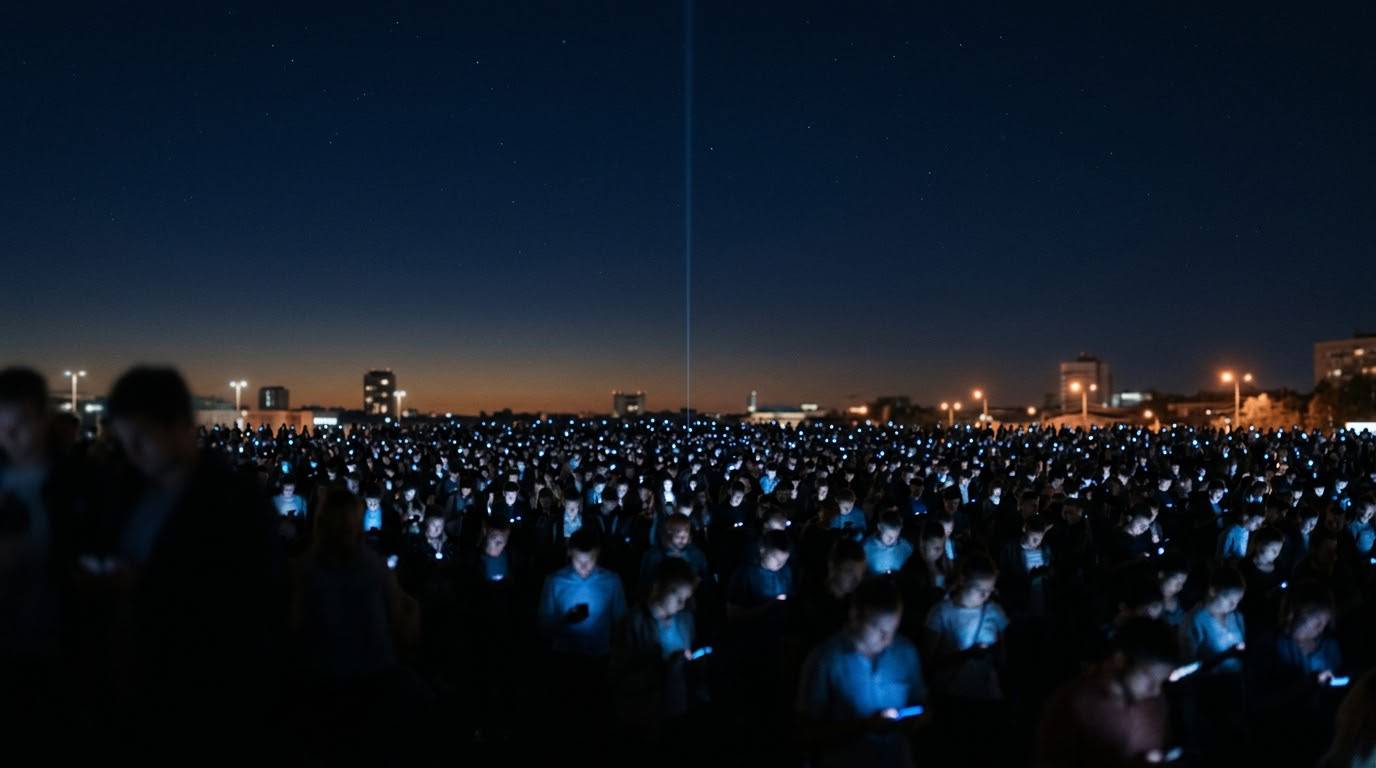
Start with this: if everything that has ever existed is happening right now, then the present is not a sliver. It's dense. Impossibly dense. Every sunset, every sentence ever written, every heartbeat, every quiet afternoon nobody remembers — all of it pressed into this second, vibrating beneath the thin surface we call "the moment."
Physicists already entertain something close to this. The "block universe" view, which falls naturally out of relativity, treats time as just another dimension of a four-dimensional structure. From inside that block, the Roman Empire isn't gone — it's at a different coordinate. The heat death of the universe isn't a future event — it's already there, geometrically, the same way Tuesday is already there relative to Monday. Our experience of "passing time" is a feature of being conscious creatures moving a spotlight across a stage that already exists in full.
Nothing is truly lost to the past if the past is a permanent fixture of the now. We are not living after history. We are living beside it.
I'm not making the strong physical claim. I'm not telling you Einstein proved anything mystical — he didn't, and the philosophers who fight about this fight hard. But it's striking that the most mathematically successful description of reality we have makes the everyday assumption — that the past is gone — look much more like a parochial habit than a fundamental truth.
A Vertical Connection, Not a Horizontal One
Now extend that. We talk about the "collective consciousness" or the "collective unconscious" — Jung's idea, basically, that humans share a substrate of archetypes and symbols that show up across cultures with no obvious channel of transmission. Most of the time we picture this as a horizontal thing. A field connecting everyone alive. A planetary mind humming between the eight billion of us breathing right now.
But if eternity is in the now, that picture is missing a dimension. The connection isn't only horizontal between contemporaries — it's vertical, plunging through every era at once. The cave painters at Lascaux. The architects of Chartres. Whoever first looked at the night sky and thought it was a problem to be solved. They aren't behind us. They're beside us, in the same field. And we are in their field too — already, somehow, contributing to a present they are also currently inside.
This is where the language gets slippery, because we don't really have grammar for it. English is built for sequence. Was, is, will be. Try to say something that lives outside of those tenses and you start sounding like a translation. But the idea is simple enough underneath the awkward words: if all of time is present, then all of mind is present too.
What That Does to Inspiration
One thing it does is make a mess of our standard story about creativity. The romantic version says the artist creates from nothing — pulls beauty out of empty air through some private alchemy. The cynical version says everything is derivative, just remixes of what came before. Neither story quite fits the lived feeling, which is closer to discovery. You weren't building, you were tuning. You weren't inventing the chord, you were finding it where it already was.
If the eternal field is real, that lived feeling stops being a metaphor. Inspiration is resonance. You're a receiver briefly aligning with a frequency that's been broadcasting all along. Genius isn't a private property — it's a quality of attention. The artists we call great are the ones whose tuning is unusually fine.
Religion Re-Read
This is where it gets interesting for me, because I think it's the missing key for a lot of religious language that otherwise reads as either literal nonsense or pure metaphor. If the divine isn't a person hovering somewhere outside the system but the totality of the field itself — the entire dense now, with everything in it — then most contemplative traditions stop sounding like superstition and start sounding like phenomenology. They are reports from people who, by various technologies of attention, learned to feel the field directly.
Prayer, meditation, ritual, chant, fasting, dance — what do they all have in common? They're techniques for changing the texture of perception. They're tuning instruments. The mystics aren't telling us something supernatural happened to them. They're telling us they got, briefly, a more accurate read on what was already there.
Worship, in this frame, is not communication with something distant. It is the moment your local frequency lines up with the whole, and you feel, all at once, that you have never been separate from it.
I should say plainly: I don't think this validates any particular religious claim. The field, if it exists, is bigger than the doctrines. But it does explain why every culture that has ever stopped to look has reported something similar — a sense of being part of something vast, present, and undivided. They aren't making it up. They're describing the same room from different doors.
The Other Singularity
The tech world is obsessed with one kind of singularity right now — the moment artificial intelligence becomes recursive enough to outpace us, the event horizon beyond which nobody can predict the next sentence. It's a useful idea, and I think about it often. But I suspect there's a quieter, much older singularity sitting next to it that nobody is funding.
The human one. Not the moment we merge with machines, but the moment we stop perceiving ourselves as small things travelling through a big thing called time, and recognise we are the place where time happens. Not in time. As time. The singularity of the observer.
This isn't a new idea. Versions of it run through the Upanishads, through Plotinus, through Meister Eckhart, through Spinoza, through the modern philosophers of consciousness who get accused of mysticism by their colleagues for noticing the obvious. What's new is that physics is starting to show up at the same address. Not confirming any of it, exactly. But not ruling it out. Leaving the door open.
The Observer and the Wave
Here's what tipped me into writing this. The double-slit experiment — the most famous result in quantum mechanics — does something genuinely strange. A particle behaves like a wave of possibilities until you observe it, at which point it "collapses" into a single definite outcome. Not because the act of measurement physically pushes the particle. Because measurement, in some sense we still don't understand, is what selects a reality from a field of potentials.
Now hold that next to the eternal-now picture. If the field is everything that could be, and consciousness is what collapses possibilities into a specific lived moment, then perception isn't passive reception. It's participation. The world isn't a finished object you walk through. It's a wave you're constantly, by being attentive, choosing to make solid in this particular shape rather than that one.
Apply that pressure to ordinary life and it starts to bend. Your mood doesn't just colour your experience — it selects it. The frequency you inhabit decides which of the infinite possible "nows" gets pulled into the foreground and called real. People who walk around expecting hostility find a hostile world. People tuned to beauty find a beautiful one. We've always known this folk-psychologically. The strange suggestion is that it's not just psychology. It might be physics.
A Small Thing You Can Try
Below is a toy version of the double-slit setup. Watch what happens to the particles depending on whether the detector — the observer — is on or off. It's not a real experiment. It's a sketch of one. But it makes the central strangeness visible: the same source produces an interference pattern when nothing is watching and a particle pattern when something is. Reality is not indifferent to being observed.
The Inversion
And here's the turn that I keep getting stuck on, the one I find hardest to articulate and most important to try. We've been talking as if there's a field, and we are inside it, tuning into it, observing it, collapsing it. But that picture still has us as separate things — small beings looking at a big something.
What if the more honest version is that we are the field? That every individual is a singular aperture through which the entire eternal now is, momentarily, looking at itself. Not a witness in a stadium watching a game. The stadium, the game, and the witness, all at once, condensed for a heartbeat into the specific shape we call "you."
You are not in the now. You are the now. Every blink of an eye is the entire universe witnessing itself, briefly, in the shape of one human being.
If that's true, then "search for meaning" stops being a search. The thing being searched for is the thing doing the searching. The pressure to be original — to invent something from nothing — eases. Originality stops being the goal. Resonance does. You don't have to summon beauty out of emptiness. You only have to let the field, which you already are, pass through you with as little distortion as possible.
What's Actually at Stake
I want to be careful here, because this kind of idea can curdle into something glib. Just be present, dude. Everything is one. That's not what I mean. The stakes of taking this seriously are not aesthetic. They're practical.
If the past is folded into the present, then nothing you have ever done is gone. It is structurally part of who is reading this sentence right now. There is no "moving on" because there was never anywhere to move from. There is only the integration of more and more of what is already here.
If the future is folded into the present, then anxiety has a strange new flavour. The thing you are afraid of is not coming for you. It is, in some sense, also already here, latent in the field of what could collapse next. Which means your attention now is not preparation for a battle later — it is the battle.
If the divine is the field, then religious experience is not exotic. It's the moment you stop pretending to be small. You don't have to go anywhere. You don't have to earn anything. You only have to notice what was always the case.
And if you are the field, then the question "what should I do with my life" inverts. Life is not an object you do things with. It is something the field is doing through you. The work is to be a clean instrument. To let the signal come through without too much of the static of the small self getting in the way.
A Note Before You Close the Tab
I'm an engineer by training. I am wary of arguments that sound profound and prove nothing. I know that "everything is connected, man" can be the laziest sentence in the English language. I am not asking you to believe any of this. I'm telling you it's the most honest description I can give of a thing I keep noticing — that the standard model of time, with its tidy past, knife-edge present, and unwritten future, doesn't actually match the texture of being alive when you pay close attention.
Maybe the texture is wrong. Maybe my attention is. But I notice that the people I most admire, across very different traditions — physicists and contemplatives, artists and engineers — keep arriving at versions of the same room. They use different vocabularies. Block universe. Brahman. Wave function. Tao. The Kingdom that is "spread upon the earth and men do not see it." The eternal now.
That's a lot of independent witnesses describing the same furniture. I'm inclined to take it seriously. Not as doctrine. As a hypothesis worth living inside for a while, and seeing what it does to the way you walk down a street, look at a painting, finish a sentence, or sit in a chair on an ordinary afternoon and notice — for one unguarded second — that the chair is already infinite, and so are you.