Let me take you down the rabbit hole for a moment. What if the reality around us is very different from what we believe it to be? What if our thoughts carry a power we cannot yet measure, and we are connected — through the vibrations of our inner lives — in ways we haven't been taught to recognise?
I am not a physicist. I am not a theologian, though I am Catholic, and I have found, over the years, that the questions I cannot shake are the ones that sit precisely at the border between those two disciplines — in that charged, uncertain territory where science and spirit stop talking past each other and start pointing at the same thing. This essay is an attempt to think through one of those questions. It is not a manifesto. It is not a sermon. It is an invitation to look at the world we are living in and ask whether we have fundamentally misunderstood our place in it.
The AC/DC tour manager once said that "God" is simply the cover we put over the mystery. I find that strangely liberating. So let's call it the Field. Not because I want to flatten something sacred into something clinical, but because the word reminds us of something we already know exists — the electromagnetic field, the gravitational field, forces that operate invisibly around us, carrying real information and producing real effects. You cannot see your Wi-Fi signal. You cannot feel it. But it is there, and it is working.
The Field
What if human consciousness works the same way? What if there exists something like a Noosphere — a layer of thought and feeling that surrounds and connects all of us — that is neither mystical fantasy nor metaphor, but an actual substrate of shared reality? Philosophers have named it. Physicists have gestured toward it. Ancient religions have described it in their own vocabularies for millennia. And yet, mainstream culture treats the idea as fringe, as wishful, as the territory of people who burn incense and read their horoscopes.
I want to suggest that this dismissal may be one of the most strategically convenient mistakes we have ever made.
The Field is neither good nor bad. It is a canvas. And what gets painted on it depends entirely on what we contribute to it — consciously or not.— Christian Bertolini, GlamBon
In Christian tradition, we are told that we are made in the image of God — Imago Dei. I used to read that as a statement about form. We have two eyes, two hands, an upright posture, and so, presumably, does the divine. But I don't think that is what it means at all. If God is the Creator — the primordial generative intelligence — then being made in His image is a statement about function, not anatomy. It means we are, each of us, co-creators. It means our inner life has an outer consequence that we have barely begun to understand.
Faith that moves mountains. I used to take that as encouragement — a poetic way of saying that with enough determination, you can overcome great obstacles. But what if it is more literal than that? What if it is a technical description of what happens when a human mind aligns its intention perfectly with the Field?
How the Field Gets Hijacked
If the Field is a neutral canvas — a medium that amplifies whatever we pour into it — then the question becomes urgent: who is doing the pouring?
Look at the world honestly. There is real evil in it. Not the abstract philosophical kind — the kind that shows up in the ledgers of arms dealers, in the architecture of systems designed to keep billions in scarcity so that a few thousand can accumulate power beyond imagination. I am not a conspiracy theorist. I am a person who reads the news and notices that it is very, very difficult to come away from it feeling anything other than afraid, small, and powerless. That is not an accident.
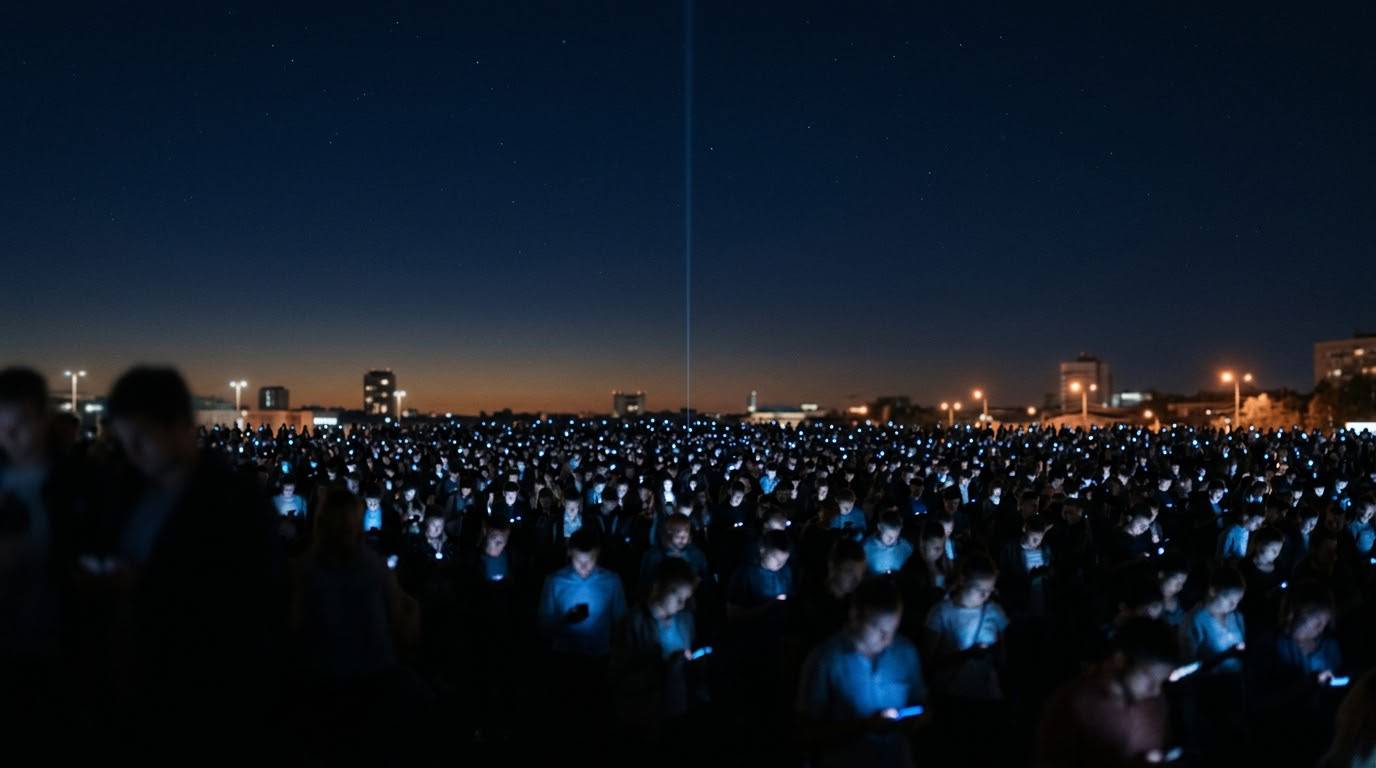
In spiritualism, a "medium" is an entity that communicates between worlds. Our media — the news channels, the social feeds, the algorithmically curated scroll — functions as a medium in exactly this sense. It carries messages between the powerful and the many. And the message, relentlessly, is fear. Scarcity. Division. The enemy lives in a different neighbourhood, votes for a different party, prays to a slightly different version of the same God.
We are tribal by nature — but tribalism, today, is a technology. A deliberately maintained condition. The question is who benefits from keeping us there.— Christian Bertolini, GlamBon
Biologically, fear keeps us in a state of survival. High cortisol. Low empathy. Tunnel vision. In this state, we make poor decisions, we distrust our neighbours, and we are exquisitely easy to manipulate. We buy things we don't need to feel safe. We vote for strongmen because they promise certainty. We scroll and scroll and scroll, looking for the threat we've been told is just around the corner.
And here is where the Field becomes relevant. If consciousness contributes to a shared substrate, then millions of humans held in a sustained state of fear are not merely suffering individually. They are — together, unintentionally — broadcasting something into the Field. They are collectively painting the canvas in precisely the colours that serve the interests of those who profit from their fear.
It is, as I said, a self-fulfilling prophecy. The more you feel desperate, the more the world around you organises itself to confirm that desperation. Not through magic. Through the very ordinary mechanics of what we notice, what we create, what we tolerate, what we vote for, what we teach our children.
Why Love Is the Most Radical Thing Left
We have been taught to think of love as a feeling — something that happens to us, that we fall into, that we are lucky enough to find. But love, in the sense I am exploring here, is something closer to a frequency. It is a state of orientation. A quality of attention. And in a world systematically organised to produce its opposite, choosing to remain in it is not soft. It is not passive. It is the most demanding and dangerous act of resistance available to us.
I never understood, for most of my life, the monastic impulse. Why would someone retreat from the world to sit on a mountain and pray? It seemed like the ultimate abdication — a turning away from reality at precisely the moment when reality most needed people of good will to engage with it. I think I was wrong.
The studies on group meditation — particularly the Maharishi Effect, which documented measurable reductions in violent crime during periods of large coherent group practice — suggest something remarkable. That the monks on the mountain are not hiding. They are transmitting. They are signal towers, keeping a frequency alive that the noise of the world is trying to drown out.
You don't have to go to a mountain. But you do have to decide — deliberately, daily — what you are broadcasting into the Field.— Christian Bertolini, GlamBon
This is what I mean by the frequency of sovereignty. Not sovereignty in the political sense — not an assertion of rights or a demand for autonomy. Sovereignty in the original sense: the condition of being the highest authority over your own inner territory. The noise wants your attention. The fear wants your energy. Every scroll, every outrage cycle, every manufactured crisis is a request — politely phrased as information — for you to hand over the one resource that actually matters.
A Practical Metaphysics
I want to be careful here not to drift into the territory of toxic positivity — the Instagram spirituality that tells you to simply vibrate higher while the world burns. That is not what I am describing. Acknowledging that the world contains real evil, real suffering, and real injustice is not fear. It is clarity. What I am describing is the difference between seeing clearly and being consumed. Between knowing the darkness exists and choosing to live inside it.
Curate what enters you
The media is a medium. If you would not invite a stranger into your home to narrate an unbroken stream of catastrophe into your ear for six hours, you should consider what it means to carry that stranger in your pocket and invite them in every time you unlock your phone. This is not about ignorance. It is about the difference between being informed and being marinated.
Understand what you are doing when you think
Your thoughts are not private events. They shape your body through your neurochemistry. They shape your relationships through the energy you bring to them. And if there is a Field — and I believe there is, even if we lack the instruments to map it precisely — they contribute to something larger than yourself. This is not a burden. It is an invitation. You have more power than you have been allowed to believe.
Protect your capacity for stillness
The noise is not an accident. The scroll is not designed to relax you — it is designed to keep you just stimulated enough that you never drop into the frequency where you hear yourself think. Stillness is not emptiness. It is the condition under which the signal becomes audible. This is what meditation does, at its most essential: it removes the static so you can find the station.
Create — always create
Destruction is easy. It requires no imagination, no love, no sustained attention. Creation — cooking a meal with care, writing something true, building something useful, raising a child with intention — is the most direct expression of the divine principle I know. When we are made in the image of the Creator, this is what it looks like in practice. Destruction comes from scarcity. Creation comes from love. One confirms the Field of fear. The other begins to shift it.
The most subversive thing you can do, in a world organised around your despair, is to refuse to despair. Not through denial. Through the disciplined, daily practice of orienting toward what is good.— Christian Bertolini, GlamBon
I do not know if this is true in the way that the laws of thermodynamics are true. I believe it is true in the way that the best things I know are true — partially, provisionally, and with enough force that acting as if it were true makes life larger and better and more generous than acting as if it were not.
We are, each of us, tuning instruments. The question is not whether we are broadcasting — we are always broadcasting. The question is what we choose to transmit, once we understand that the choice is ours to make.