Every era of fashion editorial produces a visual language — a set of recurring compositional choices, colour decisions, lighting philosophies, and pose conventions that, taken together, constitute a legible statement about what the culture considers beautiful, aspirational, or interesting at that moment. These languages are never entirely conscious on the part of the people who produce them. They emerge from the intersection of economic conditions, technological capability, cultural mood, and the accumulated decisions of thousands of photographers, art directors, stylists, and editors who are each, individually, making work they believe is urgent and original.
Reading the visual language of contemporary fashion editorial — understanding what it is saying and why — is a more useful exercise than it might initially appear. It is not an exercise in criticism for its own sake. It is an attempt to understand the relationship between a culture and the images it produces to represent itself to itself. Fashion editorial is, in this sense, one of the more honest documents of any given moment: funded by commerce, shaped by aspiration, and inflected by every anxiety and desire that the culture is currently experiencing.
What follows is a reading of the dominant visual codes in fashion editorial as it stands in 2026 — not a catalogue of trends, which would be obsolete by publication, but an analysis of the underlying structural shifts that are producing the images currently considered authoritative.
The Dominant Visual Codes
The clearest structural shift in contemporary fashion editorial is the collapse of a certain kind of aspirational distance. For most of the twentieth century, fashion editorial operated on the assumption that the gap between the image and the viewer was generative — that desire was produced precisely by inaccessibility, by the sense that the world depicted in the photograph was a world the viewer was being permitted to glimpse rather than occupy. This is no longer the dominant mode.
The most interesting contemporary fashion editorial is not selling a world you cannot enter. It is selling a version of the world you already occupy — but seen at its most precise and intentional.
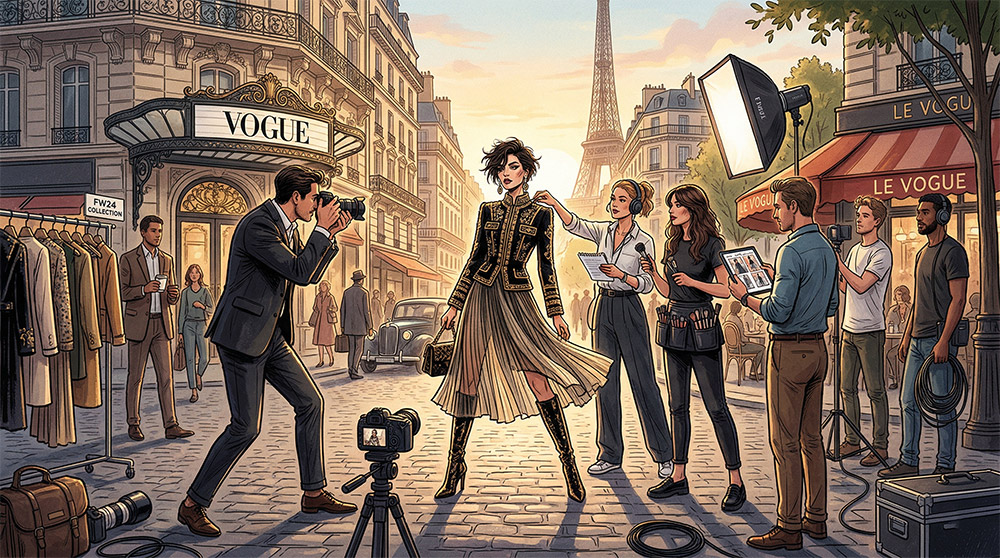
— GlamBon Culture EditorialThe shift is visible in location choices, in model casting, in lighting philosophy, and in the relationship between garment and environment. Editorial that once placed clothing against the neutral authority of the studio backdrop now places it against the textured specificity of a particular street in a particular city, a particular interior, a particular landscape. The backdrop is no longer neutral. It is a character. And that character is chosen to produce the sensation of proximity rather than distance — the feeling that this image is about a world that shares coordinates with your own.
This is not, it should be said, a more democratic aesthetic than the one it is displacing. Proximity can be just as carefully constructed as distance. A photograph that appears to capture an unguarded moment on a Paris side street in the golden hour involves as much production — as many stylists, as much pre-production, as much post-processing — as a formal studio editorial. What it offers the viewer is a different kind of aspiration: not the aspiration to enter a sealed world, but the aspiration to live in the world you are already in, but more beautifully.
A Glossary of the Current Visual Vocabulary
The visual language of contemporary fashion editorial has produced a set of terms — some inherited, some newly coined — that circulate among practitioners as shorthand for particular aesthetic intentions. Understanding these terms is not about mastering jargon. It is about developing the ability to read an image at the level at which it was made: to see not just what is depicted, but what aesthetic position the image is taking, and why.
Select a term to explore its meaning and visual context in contemporary fashion editorial
A Brief Genealogy
The visual language of contemporary fashion editorial does not emerge from nowhere. It is the product of a series of decisive shifts — moments when the dominant aesthetic assumptions of fashion imagery were challenged, displaced, or absorbed into something new. Understanding those moments is useful context for reading the current vocabulary.
On Fashion Editorial
Contemporary fashion editorial is characterised by the collapse of distance between the aspirational and the accessible. The vocabulary has broadened: raw location shooting, deliberately imperfect styling, and an increased tolerance for visual ambiguity now exist alongside the clean studio traditions. What ties them together is intentionality — every visual decision, however apparently spontaneous, is serving a specific tonal register.
Digital distribution has accelerated the visual vocabulary considerably. Images that once lived for a month in a print publication now compete for attention in a stream that refreshes hourly. This has produced two visible responses: a turn toward extreme visual simplicity — images that communicate immediately — and a turn toward extreme visual complexity — images that reward prolonged attention and therefore drive dwell time. The middle ground, competent but unremarkable, has become the most dangerous place to occupy.
Fashion editorial has always been funded by advertising but aspired to the condition of art. That tension is generative. The best fashion editorial serves the commercial function — it makes the product desirable — while also making a claim about beauty, culture, or the moment that is independent of the product. Images that collapse entirely into commerce stop producing the cultural resonance that makes fashion media worth reading.
Several strong currents are visible: the continued authority of muted, desaturated palettes in luxury contexts where colour restraint signals value; an increased interest in texture and material specificity; a renewed engagement with location as a character rather than a backdrop; and a counter-movement toward high-colour, high-contrast imagery in youth and streetwear contexts that positions itself explicitly against the luxury palette.