In the spring of 2026, a barrel of crude costs roughly what a night in a decent hotel. The headlines — petrol queues, airline bankruptcies, diplomatic summitry around the Strait of Hormuz — are accurate, but they are also a kind of flattery. They let us believe the oil crisis is a transport story, solvable by a shorter commute and a patient wait for the next EV. The numbers beg to differ. Only about three-quarters of any given barrel is burned to move a vehicle through space. The rest becomes the quiet architecture of everything else: the polymer in a pair of running tights, the binder under a footpath, the solvent carrying a perfume, the feedstock of a blood-pressure tablet, the nitrogen fertiliser on a field in Lombardy.
When commentators speak of an oil crisis, they tend to mean a price crisis. When the supply genuinely tightens — as it is tightening now — what we are really watching is a slow inventory of modernity's hidden dependencies. The fabric of contemporary life, it turns out, is literally synthetic.
The Invisible Barrel
A refinery is a sorting house. Crude oil arrives as a dark, uncooperative liquid and leaves, through a process called fractional distillation, as a stratified economy: gases, petrol, kerosene, diesel, lubricants, waxes, bitumen. The bottom of the column — the heavy, reluctant residue — becomes asphalt. The middle fractions become the fuels everyone argues about. The lightest cuts, naphtha above all, become the feedstock of the petrochemical industry, which is where the story stops being about transport and starts being about civilisation.
Petrochemicals account for a relatively modest slice of global oil demand — somewhere between five and six per cent on most estimates — but that slice is disproportionately load-bearing. Ethylene, propylene, benzene, toluene, xylene: an alphabet of molecules few consumers will ever meet, running through plastics, fibres, fertilisers, pharmaceuticals, adhesives, paints, detergents, rubber. Strip out that fraction of the barrel and you do not just inconvenience an industry. You interrupt the material logic of the modern interior.
April 2026
petroleum inputs
becomes fuel
The Mirror and the Medicine Cabinet
Begin, as most days do, with the mirror. A bathroom shelf is a discreetly oil-based installation. Petrolatum and mineral oil sit in hand creams and lip balms because they are cheap, stable and remarkably good at holding water against skin. Propylene glycol carries active ingredients through foundations and serums. Paraffin waxes give lipsticks their structure and mascaras their stay. Synthetic fragrance compounds, often petroleum-derived, are the carrier system for nearly every perfume on the market, from the €18 eau de toilette at an airport to the rare Grasse-blended absolute. Even the tube, bottle, cap, pump and spatula are almost invariably plastic — which is to say, oil in another phase.
Cross the hallway to the medicine cabinet and the dependency deepens. Benzene, a petroleum byproduct, is an upstream ingredient in a striking number of pharmaceuticals: aspirin, paracetamol derivatives, some antibiotics, antihistamines, many synthetic vitamins. Sterile single-use plastics — syringes, IV bags, catheters, blister packs — are effectively non-substitutable in the short term. Heart valves, artificial joints, prosthetics, the casings of hearing aids and insulin pumps: all lean on polymer chemistry that begins in a refinery. Personal protective equipment, the quiet lesson of the last pandemic, is oil from mask to gown.
A bathroom shelf is a discreetly oil-based installation. Strip the barrel and you do not just change a routine — you re-engineer the mirror.
— GlamBon EditorialA Wardrobe Made of Oil
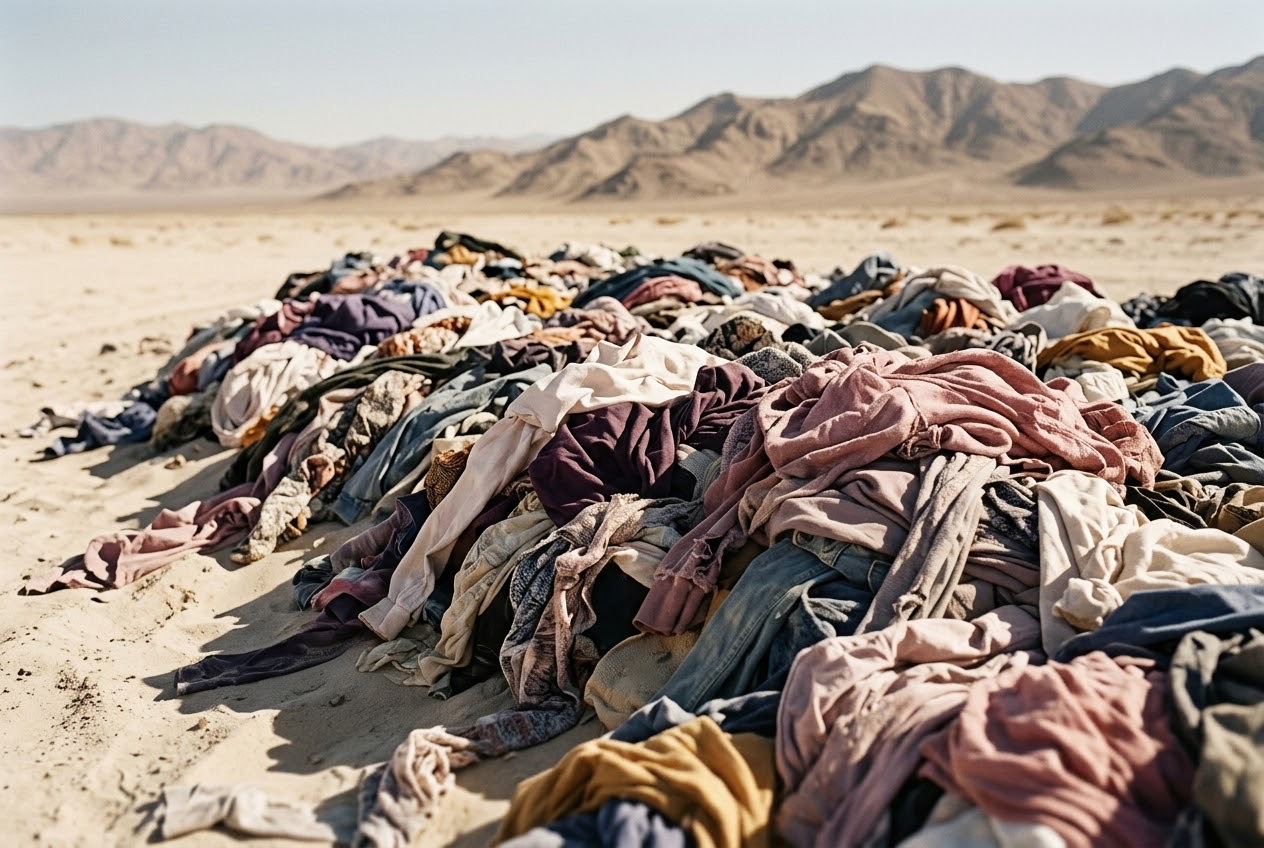
Fashion, our own beat, sits unusually exposed. Polyester, nylon, acrylic, elastane, polyamide — the synthetic fibres that dominate contemporary wardrobes — are all petrochemical products. The global apparel industry has spent the past three decades quietly reformatting itself around them: roughly two-thirds of garments manufactured today contain some share of synthetic fibre, and for athleisure, technical outerwear and fast fashion the share is closer to total.
A tight crude market therefore lands on fashion twice. Once in the obvious way, through input costs: the polyester yarn in a €20 T-shirt is appreciably more expensive than it was eighteen months ago, and that cost is either absorbed or passed. And once more subtly, through logistics: ocean freight, packaging film, hangers, polybags, shop fittings, synthetic shoe uppers, even the dyes and finishes. A yoga legging, a performance shell, a pair of running tights — each is closer, chemically, to a barrel of Brent than to a bale of cotton.
Luxury fares slightly better in narrative terms but not structurally. A silk blouse and a wool coat do not care about oil; the trims, linings, stitching threads and transit containers around them do. The entire fast-fashion model — low unit cost, high turnover, synthetic core — is a petroleum phenomenon more than a design one.
The Ground Beneath Us
Then there is the ground itself. Asphalt — bitumen, properly — is what refiners politely call the bottom of the barrel: the dense, viscous residue left when everything lighter has been distilled off. It binds the aggregate that surfaces roughly 95 per cent of the world's paved roads. It waterproofs roofs. It seals runways, car parks, bicycle paths, industrial floors. In 2026, binder prices are rising faster than diesel, and in a number of European and North American municipalities, resurfacing budgets have already been postponed into next fiscal year.
The consequences are less dramatic than a fuel queue and more insidious. Potholes become permanent features. Roofing repairs are delayed. New housing slows, partly because PVC piping, bitumen shingles, cable insulation, window seals and caulking are all petroleum-derived and all simultaneously more expensive. Infrastructure — the thing a country is supposed to do in its sleep — becomes a line item again.
The Price of a Tomato
The most unsettling displacement is the one that travels from a refinery to a plate. Industrial agriculture is, chemically, a petroleum industry in disguise. Synthetic nitrogen fertilisers — the urea and ammonia on which high-yield farming depends — are manufactured from natural gas and refinery streams. Pesticides and herbicides are petrochemical. Tractor tyres, polytunnels, greenhouse film, irrigation piping, harvest crates, refrigerated transport, supermarket packaging: oil at every joint of the food system.
When the upstream price climbs and stays climbed, fertiliser becomes the first casualty. Smaller farms ration; some skip an application season. Yields ease downward. The effect is not a crisis so much as a tax: a quiet, non-negotiable inflation threaded through a weekly shop. A tomato in April, a loaf of durum bread, a block of feed-finished cheese — each carries a small, invisible share of the barrel inside its price.
Your Petroleum Morning
The abstraction becomes easier to hold when it is domestic. Walk, slowly, through the first ninety minutes of a weekday — the ritual every reader of this magazine has in some version — and the barrel reveals itself in objects we never think of as industrial at all.
The Plastic Paradox
It is tempting, reading a litany like this, to greet a shortage as a kind of corrective. Less plastic, less waste, less fossil dependency: surely the planet exhales. The honest answer is more layered. A meaningful share of the plastic the world produces is indefensible — single-use sachets, over-wrapped produce, novelty polymer that lives for twelve seconds and lingers for a century. A price signal that removes some of that from circulation is, unambiguously, a gain.
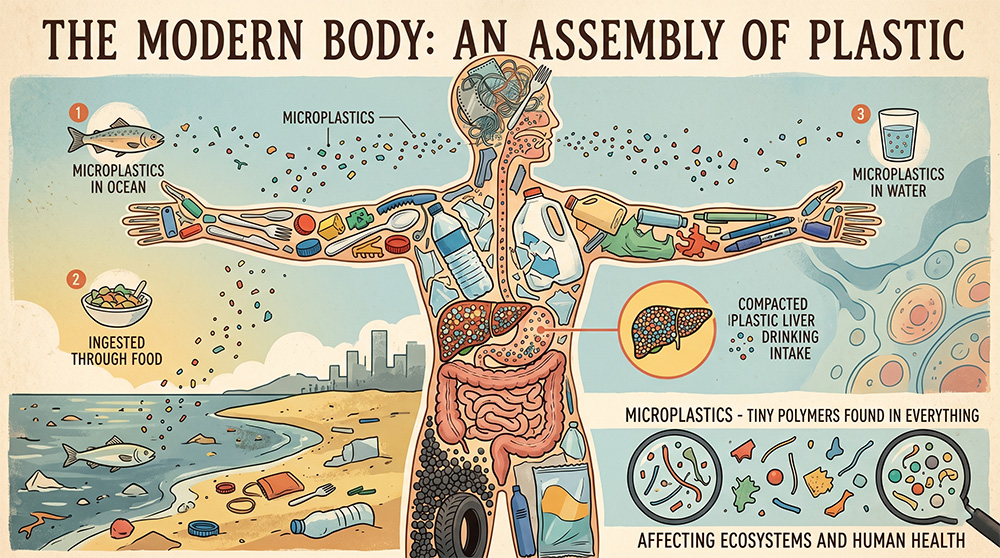
But the transition has no graceful edge. Medical-grade polymers have no scaled alternative. Food-safe packaging prevents spoilage that, itself, carries a carbon cost. Building insulation, wind-turbine blades, solar-panel backsheets, EV battery housings — the infrastructure of the clean transition — all currently require petrochemicals. Bioplastics, chemical recycling, mycelium composites and seaweed films are advancing genuinely, but none yet operates at the scale needed to absorb a sudden displacement. The paradox is structural: oil is simultaneously the problem and, for another few years, part of the scaffolding of the solution.
The Impact Matrix
| Sector | Role of crude | What a shortage does |
|---|---|---|
| Beauty & fragrance | Emollients, waxes, solvents, packaging | Reformulation, SKU reduction, price rises, smaller luxury margins |
| Pharmaceutical | Benzene-based synthesis, sterile plastics | Supply fragility for generics, blister-pack shortages, PPE risk |
| Fashion & textile | Polyester, nylon, elastane, polyurethane soles | Fast-fashion cost shock; renewed interest in natural fibres |
| Infrastructure | Asphalt, roofing, PVC piping, cabling | Deferred road repair, housing-cost inflation, slower construction |
| Agriculture & food | Fertilisers, pesticides, logistics, packaging | Yield pressure, grocery inflation, regional supply risk |
| Electronics | Polymer housings, insulation, adhesives | Device prices rise; refurbished market expands |
| Clean transition | Turbine blades, solar backsheets, EV housings | Paradoxical slowdown; green tech hit alongside fossil use |
What Actually Unravels
The useful thing about a crisis is that it makes visible what has been invisible. The 2026 oil story is not, in the end, a story about fuel. It is a story about how thoroughly the twentieth century rewrote its materials around a single commodity, and how thoroughly the twenty-first has inherited that dependence. A lipstick, a loaf of bread, a pair of running tights and a footpath all share a grandparent. When the grandparent gets expensive, the descendants do too.
None of this is an argument for panic, or for defending the industry. It is an argument for clear sight. The transition away from petroleum will happen — is already happening — but it will happen across decades, not quarters, and in layers: fuel first, then packaging, then fibres, then fertilisers, then the heaviest fraction of all, the binder beneath our feet. Treating the crisis as a fuel story is what lets us be surprised, every few years, when the price of a tomato climbs faster than the price of a tank. The tomato was always made of oil too.
The real work of this decade, both editorial and material, is teaching ourselves to see the petroleum we wear — so that when it finally thins out, we recognise what is actually being rewoven.
Questions the barrel raises
Roughly 70 to 75 per cent of a barrel is refined into transport fuels — petrol, diesel, jet fuel and heating oil. The remaining quarter is the petrochemical fraction that feeds into plastics, textiles, cosmetics, pharmaceuticals, fertilisers and asphalt. It is a small share by volume and a disproportionately large share by influence.
Industrial agriculture depends on petroleum at almost every stage: synthetic nitrogen fertilisers are derived from hydrocarbons, pesticides are petrochemical, and the diesel, rubber tyres and plastic packaging that move food from field to shelf are all oil-dependent. A crude shortage pushes costs through the entire chain, and grocery inflation is typically the first place a household feels it.
Only partially. Reduced single-use plastic and lower emissions are genuine upsides, but the short-term transition is brutal — medical plastics, insulation, wind-turbine blades and food packaging have no scaled green substitute yet. A shortage accelerates the shift; it does not paint a softer landing.
Lipsticks, foundations, hair dye, mascara, perfumes, moisturisers and many skincare emulsions contain petroleum-derived ingredients such as petrolatum, mineral oil, propylene glycol, paraffin and synthetic fragrance carriers. The packaging — tube, bottle, cap, pump — is almost universally petroleum plastic.
It refers to the heaviest residue left after lighter fuels have been distilled off — primarily bitumen, which becomes the asphalt binder used in roads, roofing and waterproofing. When crude tightens, this fraction becomes disproportionately expensive, stalling public infrastructure projects first. The road itself is, literally, the last thing in the barrel.