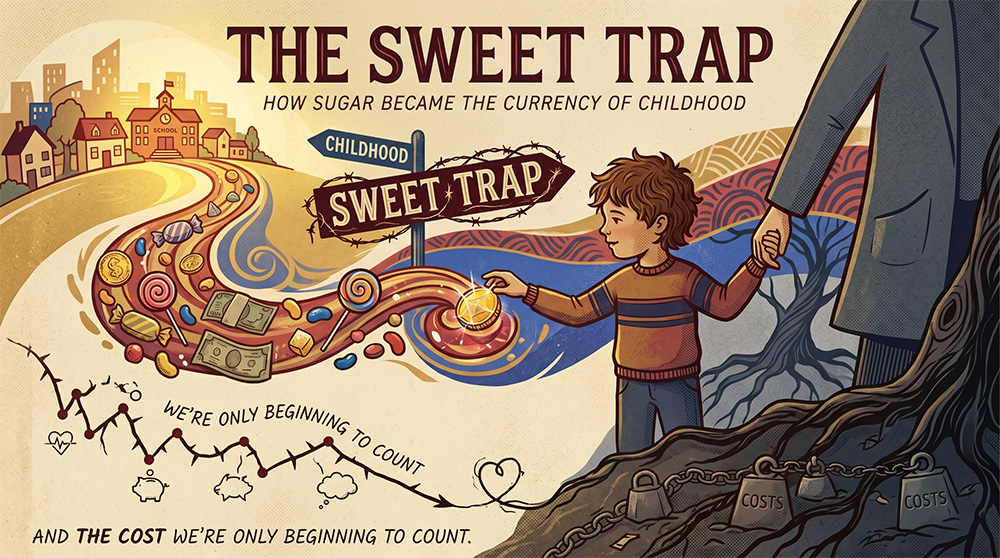
Decades of research, a landmark wartime study, and millions of lived experiences converge on an uncomfortable truth: we are wiring children’s brains for addiction before they can walk. This is not a sermon. It is a reckoning.
There is a ritual that plays out in kindergarten classrooms everywhere, as reliable as morning roll call. A child walks in carrying a box. Inside: a birthday cake. Tomorrow, another child will bring cupcakes. Next week, someone’s parents will send in doughnuts to mark a half-birthday, or a good report card, or simply Tuesday. In a classroom of thirty children, the maths are unforgiving. Cake, by any reasonable count, becomes a near-daily event.
Then comes the party. Then the piñata — invariably stuffed with lollies. Then the party bag. Then the drive home, during which a small person, cresting and crashing on a glycaemic wave, dissolves into tears over nothing in particular. Sugar high, a parent sighs, and means it affectionately. But the science behind that sigh is darker, and more consequential, than the phrase implies.
The First Thousand Days
In October 2024, researchers published a striking natural experiment in the journal Science. Using data from more than 60,000 Britons born in the early 1950s — a cohort whose earliest years coincided with post-war sugar rationing — they found that exposure to rationing in the first 1,000 days of life produced measurable benefits that persisted for decades. People who spent their infancy under rationing had roughly 35% lower risk of developing diabetes and 20% lower risk of hypertension in later life, compared to those born after rationing ended and who thus consumed sugar freely from birth. The protective effect grew stronger the longer the exposure lasted — particularly when it extended beyond six months after birth.
The implications are almost too uncomfortable to sit with. We have, in the name of love and celebration and not-wanting-them-to-miss-out, been quietly raising the chronic disease risk of our children from the earliest possible moment.
The American Heart Association’s scientific statement on children and added sugar put the recommended daily ceiling at just 25 grams — roughly six teaspoons — and called for children under two to avoid added sugars entirely. For context, a single 350ml can of soft drink contains roughly 39 grams. A standard commercial fruit yoghurt marketed to children can carry 15 to 20 grams. A “healthy” breakfast cereal with its colourful cartoon mascot often contains more sugar per serving than a chocolate biscuit.
A Day in the Life
It is easy, in the abstract, to treat 25 grams as a generous allowance. It is harder once the day is laid out in front of you. What follows is a plausible — not extreme — day for a five-year-old: cereal chosen from the children’s aisle, a fruit yoghurt thoughtfully packed in the lunchbox, a juice box, a biscuit handed out at snack time, a birthday cupcake from a classmate’s celebration, a rewarded ice-cream on the way home. None of it reads as excessive. All of it, tallied, tells a different story.
A Kindergartener’s Day, by the Gram
Tap each moment to count it in. The AHA limit is 25g for the entire day.
-
7:30Bowl of frosted flakesAdvertised as fortified with vitamins12g
-
10:00Fruit yoghurt tubeMarketed to children, “low-fat”18g
-
12:30Juice box with lunch200ml, apple & blackcurrant22g
-
14:00Chocolate chip biscuitHanded out as afternoon snack7g
-
15:30Classmate’s birthday cupcakeWith frosting, sprinkles, and a lolly28g
-
17:00Ice-cream on the way homeA small cone, sprinkles on top20g
The Body Under Siege
To understand what excess sugar does to a child, it helps to understand what it does to anyone — only more so, because children are not simply small adults. Their bodies are metabolically more sensitive, their gut microbiomes still forming, their brains still constructing the very architecture that will govern appetite, mood, and impulse regulation for the rest of their lives.
When fructose — the component of table sugar that the body cannot directly use for energy — is consumed in quantity, the liver bears the brunt. It must convert fructose to fat through a process called de novo lipogenesis. In children with high sugar-sweetened beverage consumption, this mechanism can accumulate fat in the liver, impairing liver function and, over time, contributing to non-alcoholic fatty liver disease — a condition once considered rare in paediatric medicine that clinicians are now seeing with alarming regularity.
Fructose also reduces the sensitivity of leptin, the hormone that signals fullness to the brain. The more sugar a child consumes, the less clearly their body tells them they have had enough. Liquid sugar — in juices, sports drinks, flavoured milks, and soft drinks — is particularly problematic because it bypasses the satiety mechanisms that solid food triggers. Research published in 2025 found that children who drank sugary beverages seven or more times a week had significantly elevated odds of being overweight or obese compared to those who drank them less than once a week.
Then there is insulin. Each daily serving of a sugary beverage consumed by boys is associated with a 34% increase in insulin resistance. The physiology is straightforward: every spike in blood glucose demands a surge of insulin to manage it. Over time, cells respond to insulin less efficiently. The pancreas compensates by producing more. Eventually, the system begins to fail. Type 2 diabetes — a disease once so rare in children that it was called “adult-onset diabetes” — now affects close to 50,000 young people in the United States alone.
High blood pressure follows a similarly insidious path. The likely culprit is uric acid, produced when fructose is metabolised. Elevated uric acid in adolescence is closely associated with the early onset of hypertension. The cardiovascular risk profile being quietly assembled in the bodies of sugar-heavy children is one that, in a previous generation, would not have presented until middle age.
The Brain Wired to Want More
None of this would matter half so much if sugar were easy to stop eating. It is not — and the reason is neurological, not moral.
When sugar is consumed, the brain’s reward pathway — the mesocorticolimbic system — releases dopamine. The feeling is pleasurable. The brain notes this and, in the way brains do, files it as something worth repeating. In children, whose prefrontal cortex (the region responsible for impulse control and long-term reasoning) will not fully mature until their mid-twenties, the reward circuitry has disproportionate power over behaviour.
Research published in 2024 drew direct neurobiological parallels between habitual overconsumption of ultra-processed food and substance use disorders, identifying shared pathways involving dopamine, the endogenous opioid system, and acetylcholine balance. In animal studies, rats given intermittent access to sugar solutions displayed bingeing behaviour, withdrawal symptoms when sugar was removed, and — strikingly — increased alcohol consumption during abstinence, as if one dopamine pathway had been substituted for another.
Dopamine levels can rise up to 200% above baseline when fat and sugar are consumed together — a spike comparable to that seen with nicotine. The food industry, it turns out, has long been aware of this. Food scientists systematically test formulations to locate what market researcher Howard Moskowitz famously called the “bliss point” — the precise ratio of sugar, fat, and salt at which a product becomes maximally irresistible. It is not accidental engineering. It is intentional.
Before the United States Senate, Dr. Ashley Gearhardt of the University of Michigan testified that addictive processes play a significant and underappreciated role in the overconsumption of ultra-processed foods, in ways that parallel substance use disorders — and that the American public is not adequately warned, while children remain a key marketing demographic.
The Crash We Misread as Personality
One of the most significant harms of chronic sugar overconsumption is also among the least discussed: the effect on mood, temperament, and cognitive function — and the degree to which that effect goes unrecognised.
The glycaemic roller coaster is well understood physiologically. Blood sugar spikes, insulin floods the system, blood sugar drops sharply, and the brain — which runs almost exclusively on glucose — signals distress. For adults, this can feel like irritability, brain fog, difficulty concentrating, and an obsessive focus on the next meal. For children, who have neither the vocabulary to describe what they are experiencing nor the life experience to contextualise it, the same physiological event presents as a tantrum, a meltdown, aggression, or inconsolable crying.
The Glycaemic Curve
What a meal does to the blood sugar — and, ninety minutes later, to the mood.
The research on sugar and behaviour in children is genuinely contested. A widely cited meta-analysis found no direct causal link between acute sugar consumption and hyperactivity. Some studies even found short-term cognitive benefits immediately after sugar intake, likely because glucose is the brain’s primary fuel. But these short-term studies may miss the bigger picture: the chronic effects of a diet high in added sugar — impaired memory, increased insulin resistance in the brain, neuroinflammation, and disrupted sleep — all of which compound over time to affect cognition, mood regulation, and behaviour.
Many adults who have eliminated or substantially reduced sugar from their diets describe a transformation that goes well beyond the physical. They report a stabilisation of mood, an evenness of energy, a disappearance of the mid-morning and mid-afternoon walls — and, crucially, a retrospective recognition that what they had attributed to their “personality” or “temperament” was, in measurable part, the consequence of chronic glycaemic instability.
Sugar as Love Language
There is a quieter question underneath all of this, and it is the one that does not appear in the medical literature: why do we keep feeding children sugar even when, somewhere, we know better?
Consider the scene that will be familiar to many: a pair of well-meaning relatives arriving with a chocolate bar for a five-year-old — while simultaneously announcing that they themselves do not eat it, because too much sugar. The logic, examined openly, is baffling. A smaller body does not require more junk food. A developing liver is not more robust than an adult one. A growing brain is not less susceptible to engineered craving. And yet the gift was given, warmly, in love.
Sugar has become a primary language through which adults communicate affection and celebration to children. It is the texture of reward, of occasion, of being special. Refusing to participate — in the birthday cake, the Easter egg, the lolly bag at the party, the ice cream on a hot day — feels, in the social grammar of childhood, like a form of cruelty. The parent who sends a child to a birthday party without permission to eat the cake is not just making a nutritional decision. They are, in the eyes of other adults, being unkind.
Some researchers suggest this behaviour has roots in our own psychological histories — that the adults reaching for the lolly bag are, at some level, soothing memories of their own deprivation or sourcing the quickest available hit of the child’s delight. Sugar is fast. Sugar is easy. Sugar produces an immediate, visible response that reads unmistakably as happiness. That it is followed, reliably, by a crash — by the meltdown in the car, the sleeplessness, the irrational sobbing — is filed separately, attributed to tiredness, or overstimulation, or “just being a kid.”
The Machine That Feeds the Habit
If individual physiology were the only challenge, the problem might be manageable. But sugar is not simply consumed — it is marketed, engineered, and normalised at industrial scale, with children as the primary target demographic.
The food and beverage industry spends billions annually on advertising to children. Products are designed with packaging, colours, characters, and flavour profiles calibrated specifically for young palates and the neurological vulnerabilities of developing reward systems. Influencer marketing on platforms like YouTube now reaches children through creators who embed food products into content they cannot easily distinguish from entertainment. Research published in 2024 documented the prevalence of food cues in content produced by child and youth social media influencers — an industry that did not exist a generation ago.
Self-regulatory frameworks in this space have proven largely inadequate. An American Heart Association analysis found that industry-led advertising guidelines, while restricting some television advertising to children, do not extend to in-store marketing, product packaging, or branded digital content. Food companies can still reach children through every surface of daily life while technically complying with voluntary standards.
The parallels to the tobacco industry are not incidental. Legal scholars and public health researchers have drawn explicit comparisons between the methods used to market cigarettes to young people in the twentieth century and those used to market ultra-processed foods today: the engineering of psychological dependency, the funding of contradictory research, the strategic deployment of the language of choice and moderation, the targeting of demographics least equipped to resist.
What a Different Childhood Might Look Like
None of this is an argument for banning birthday cake. The occasional slice of cake at a birthday is a birthday. The Easter egg hunt is the Easter egg hunt. The problem is not the exception — it is the transformation of the exception into the daily norm, until the category of “treat” loses all meaning because it describes every meal.
In a school of fifty children, if each child brings cake to celebrate their birthday, a classroom has cake, on average, once a week across the year — and that accounting does not include the party, the Christmas celebration, the end-of-term event, the sports day, the farewell for the teacher. The piñata that contains only lollies. The party bag that is a bag of sugar in a plastic sack. These accumulations are not harmless background noise. They are the baseline diet of childhood, reinforced by every adult in the room.
The research consistently suggests that early life is the window of greatest leverage. Taste preferences established in childhood persist. Metabolic patterns set in the first years of life echo for decades. Exposure to rationing in the first 1,000 days, the 2024 Science study found, reduced diabetes risk by more than a third, well into middle age.
If sugar preferences are learned, they can be unlearned — or better, never learned in the first place. Parents who model and establish low-sugar dietary norms early, before children are exposed to the social machinery of sweets-as-reward, are not depriving their children. They are, the evidence suggests, giving them something more durable: a body and a brain that know how to run without the spike.
Before You Worry (or Act)
How much added sugar is actually safe for a child each day?
What did the 2024 sugar-rationing study really prove?
Is sugar genuinely addictive, or is that an overstatement?
Why is liquid sugar so much worse than sugar in solid food?
Does reducing sugar really change a child’s mood and behaviour?