In the autumn of 1955, President Dwight D. Eisenhower suffered a heart attack. The nation watched anxiously as his cardiologist, Paul Dudley White, stepped before the press. Heart disease had become America's leading cause of death — a relatively new phenomenon, barely present in the early twentieth century, now claiming lives at alarming speed. White, who had been persuaded by a Minnesota physiologist named Ancel Keys that dietary fat was to blame, made it clear: the President would be changing his diet. Butter would be replaced by margarine. Saturated fat was the enemy.
It was a pivotal moment. In the decades that followed, the idea that saturated fat — the fat found in meat, dairy, butter, and eggs — caused heart disease by raising cholesterol and clogging arteries would become the organising principle of Western nutritional policy. The food pyramid. The low-fat craze. The rise of margarine and vegetable oils. The disappearance of lard from the kitchen. All of it flowed, directly or indirectly, from a hypothesis that was, from its very origins, more persuasive than it was proven.
The story of how that hypothesis came to dominate medical thinking — and how it is now being systematically dismantled — is one of the most consequential in the history of modern medicine.
Ancel Keys and the Graph That Changed the World
Ancel Keys was a brilliant, forceful, and deeply self-confident scientist. A physiologist at the University of Minnesota, he had spent the Second World War developing the K-ration for combat soldiers, and emerged from it with an interest in diet and cardiovascular disease that would consume the rest of his long life. He died in 2004, just short of his hundredth birthday.
In 1953, Keys published a striking graph. It showed a smooth, rising curve: as the percentage of calories from fat in a nation's diet increased, so did its rate of death from coronary heart disease. The data came from six countries. The correlation looked almost too good to be true. It was.
At the time, the Food and Agriculture Organization of the United Nations had collected comparable data from 22 countries. When two researchers — Yerushalmy and Hilleboe — plotted all 22 countries, the clean curve became considerably messier. There were countries with high fat intake and low heart disease. Countries with low fat intake and high heart disease. The correlation weakened substantially. Keys' six-country selection, for reasons he never fully explained, happened to produce the tidiest possible result.
This was not the Seven Countries Study, which Keys launched separately in 1958 and which was a more rigorous field operation involving 12,763 men across four regions. The 22-country controversy predates that study and concerns an earlier, simpler analysis. But the controversy illuminates something important about Keys as a scientist: he was a man who had reached his conclusion before he had finished gathering the evidence, and who was not especially interested in information that complicated it.
Among the complications he navigated around was France. The French ate large quantities of saturated fat — butter, cheese, cream, duck fat, foie gras — and yet their rates of coronary heart disease were among the lowest in Europe. This observation became famous as the “French paradox,” coined by French epidemiologist Serge Renaud in a landmark 1992 Lancet paper. If saturated fat caused heart disease, France was an inconvenient counter-example. France did not appear in Keys' original six-country graph. Similarly, Keys' Seven Countries Study included no African or South American nations whose dietary patterns might have further complicated the picture.
The data was insufficient to clearly show fat intake was the primary factor affecting heart-disease risk. It is almost inconceivable that the Seven Countries Study was performed with such scientific abandon.
Peer Review Critique of the Seven Countries StudyIn 1961, Keys was appointed to the nutrition committee of the American Heart Association. Within a year, though no new evidence had emerged, he had persuaded his colleagues to recommend that all men reduce their saturated fat consumption and replace it with polyunsaturated vegetable oils. This single policy decision — the 1961 AHA advisory — is, according to journalist and nutrition researcher Nina Teicholz, who wrote the groundbreaking 2014 book The Big Fat Surprise: Why Butter, Meat and Cheese Belong in a Healthy Diet, arguably the single most influential nutrition policy ever published.
The Studies Nobody Was Supposed to Find
The diet-heart hypothesis was now policy. What followed was a series of large, expensive clinical trials designed not to test the hypothesis, but to confirm it. Several of them did not cooperate.
The Minnesota Coronary Experiment, conducted between 1968 and 1973 under the direction of Dr. Ivan Frantz Jr. at the University of Minnesota, was one of the most rigorous randomized controlled trials ever run on dietary fat. Over 9,400 participants in state mental hospitals and nursing homes were divided into two groups. One group consumed a diet high in saturated fats from animal sources. The other replaced those fats with corn oil and corn-oil margarine, rich in linoleic acid — the polyunsaturated fat that Keys' theory predicted would protect the heart.
The results were not what the researchers had hoped. The vegetable-oil group did achieve a significant reduction in serum cholesterol — down 13.8% on average. But they did not live longer. In fact, for every 30-point drop in serum cholesterol, the risk of death increased by 22%. The corn-oil group had higher all-cause mortality. There was no evidence of benefit on coronary atherosclerosis or heart attacks at autopsy. The hypothesis had been tested under near-ideal conditions, and it had failed.
The study was never fully published. A brief, data-sparse paper appeared in 1989, but the raw data — including the mortality findings — were left unpublished. They sat in a Minneapolis basement for decades. In 2011, NIH investigator Christopher Ramsden, working with Frantz's son, recovered the data. The full re-analysis was published in the British Medical Journal in 2016. The headline finding: replacing saturated fat with vegetable oils rich in linoleic acid effectively lowered serum cholesterol but provided no benefit on mortality from coronary heart disease or all causes.
This was not an isolated finding. A concurrent meta-analysis of five similar randomized controlled trials found the same pattern. And in 2013, Ramsden had resurrected another lost study from the 1960s — the Sydney Diet Heart Study — which had also found that replacing saturated fat with vegetable oils increased cardiovascular and all-cause mortality, despite lowering cholesterol. The data, taken together, did not merely fail to support the diet-heart hypothesis. They actively contradicted it.
The Contaminated Experiment: Crisco, Whale Fat, and Trans Fats
There is a further dimension to this story that renders the original research even more compromised than it first appears. Many of the early studies purporting to show the harms of saturated fat were not, in fact, testing natural saturated fat at all.
The first product made entirely of hydrogenated vegetable oil was Crisco shortening, introduced in the United States by Procter & Gamble in 1911. Hydrogenation is an industrial process in which liquid vegetable oil is bombarded with hydrogen atoms, converting the unsaturated fatty acids into a more solid, shelf-stable form. The process produces trans fatty acids — a class of artificial fat that is genuinely toxic, associated with heart disease, inflammation, and metabolic disruption in ways that natural saturated fat is not. Crisco was trans fat dressed up to look like saturated fat.
In Europe, the analogue was partially hydrogenated whale oil, widely used in margarine production through much of the mid-twentieth century. Like Crisco, it produced substantial quantities of trans fats. Many of the early dietary intervention studies in both the United States and Europe used these hydrogenated fats as their “saturated fat” intervention, and when the subjects consuming them showed elevated cardiovascular risk, the damage was attributed to the saturated fat, not to the trans fat content of the hydrogenated product.
Dr. Mary Enig, a lipid biochemist who spent decades researching the chemistry of dietary fats and who co-authored Know Your Fats: The Complete Primer for Understanding the Nutrition of Fats, Oils and Cholesterol, was among the first scientists to systematically document this confusion. Enig argued from at least the 1970s that trans fats — not natural saturated fats — were the genuine cardiovascular threat. She was largely ignored, and in some quarters actively marginalised, for much of her career. As Nina Teicholz later documented, the food industry had strong commercial reasons to oppose the identification of trans fats as dangerous: by the time the problem was becoming clear, hydrogenated vegetable oils had replaced animal fats across the food supply, and the industry had built its entire product architecture around them.
The irony, as the AOCS (American Oil Chemists' Society) noted in a review of the history, is that trans fat was invented to replace saturated fat — and when trans fat was finally banned, manufacturers returned to saturated fats as the only practical alternative for baking and frying. The solution to trans fat turned out to be the very substance trans fat was invented to displace.
Brenna, Lipid Science, and What We Actually Know About Fat
J. Thomas Brenna is a professor of pediatrics and chemistry at the Dell Medical School at the University of Texas at Austin, formerly of Cornell University, and one of the most decorated lipid scientists of his generation. He served on the U.S. Dietary Guidelines Advisory Committee for the 2015 guidelines and on the FAO/WHO Expert Panel on Fats and Fatty Acids. His research group has been continuously NIH-funded since 1992 and his work on the biochemistry of omega-3 and omega-6 fatty acids contributed directly to the FDA's approval of DHA and arachidonic acid in infant formula.
Brenna's work, along with that of colleagues like Ramsden, has shifted scientific understanding of dietary fat in several important ways. In a 2020 state-of-the-art review in the Journal of the American College of Cardiology, co-authored with a group of leading nutrition researchers including Arne Astrup, Brenna and colleagues proposed that saturated fats need to be evaluated individually, not as a monolithic category. Different saturated fatty acids have different physiological effects. Lauric acid (found in coconut oil) raises both LDL and HDL. Stearic acid (in beef fat and dark chocolate) appears to have neutral effects on cardiovascular risk. The notion that all saturated fats are equivalent is, the authors argued, too crude to be scientifically useful.
Brenna's research has also illuminated a critical dynamic in fat metabolism: the ratio of omega-6 to omega-3 fatty acids in the diet appears to be far more important to cardiovascular and metabolic health than the quantity of saturated fat. Western diets now carry an omega-6 to omega-3 ratio of approximately 15:1 to 16:1, against an estimated ancestral ratio of roughly 1:1 to 4:1. The vast majority of this omega-6 excess comes from the linoleic acid in seed oils — canola, corn, soybean, safflower, sunflower — whose consumption increased more than a thousand-fold in the United States across the twentieth century. Brenna has noted that high dietary linoleic acid suppresses the body's ability to synthesise DHA, the omega-3 fat critical for brain and cardiovascular function, by competing for the same enzymatic pathway. Lowering dietary linoleic acid is, his research shows, one of only two reliable ways to raise circulating DHA.
Weston Price, Butter, and the ‘Activator X’ Mystery
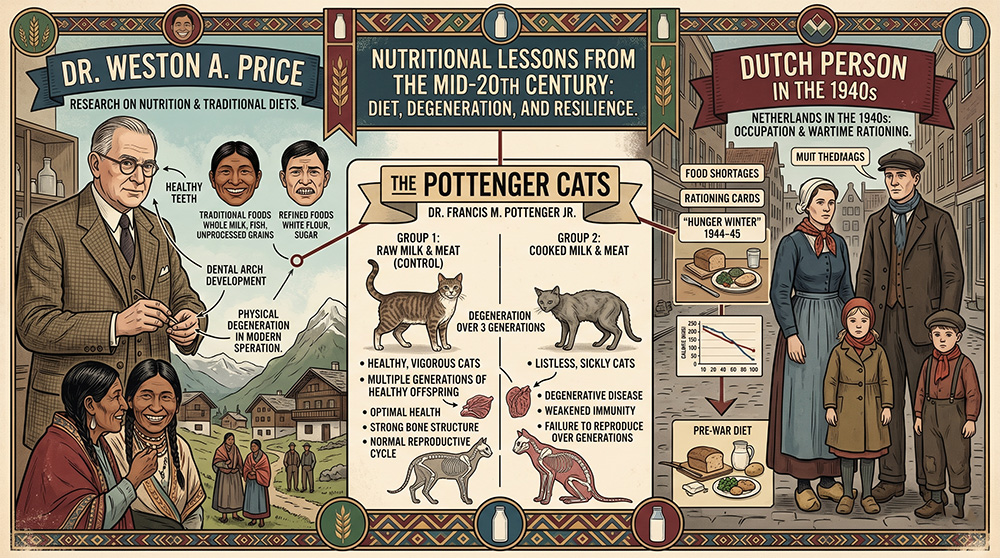
While Keys was constructing his diet-heart hypothesis in the 1950s, an earlier tradition of nutritional science was being quietly forgotten. Dr. Weston A. Price was a Cleveland dentist who, in the 1930s, embarked on a decade-long world journey to study the health of populations living on traditional, pre-industrial diets. He examined remote Swiss villages, Gaelic communities in the Outer Hebrides, Inuit and Native American peoples of North America, Melanesian and Polynesian islanders, African tribes, Australian Aborigines, Maori communities in New Zealand, and indigenous peoples of South America.
Everywhere he went, Price found the same pattern. Populations eating their traditional diets — which, without exception, included substantial animal fats, organ meats, and dairy products where animals were kept — showed extraordinary dental health, wide facial arches, straight teeth, and very low rates of the chronic diseases that were becoming common in industrialised countries. When the same populations adopted Western foods — white flour, sugar, vegetable oils, tinned goods — dental decay, narrow facial arches, and chronic disease followed within a generation.
Price identified what he called “Activator X”: a fat-soluble compound present in the organ meats and butter of grass-fed animals, in fish eggs and shellfish, and found in particular abundance in the deep-golden butter produced by cows grazing on rapidly growing green grass in spring. The richer the yellow colour of butter, Price noted, the higher its Activator X content. He found this substance played a critical role in mineral absorption, bone development, and what he described as the “maximum utilisation of body-building minerals.”
In 2007, the Weston A. Price Foundation confirmed what nutritional scientist Chris Masterjohn, PhD, had been arguing for years: Activator X is vitamin K2, specifically the MK-4 form. Vitamin K2 is now understood to be essential for directing calcium into bones and teeth (rather than into arteries), activating vitamin K-dependent proteins involved in cardiovascular health, and working synergistically with vitamins A and D — the other fat-soluble vitamins abundant in animal fats. Vitamin K2 intake, unlike vitamin K1, has been shown in epidemiological studies to be inversely associated with heart disease. It is found almost exclusively in the fats and organ meats of grass-fed animals, and in aged cheeses and fermented foods. It is, in other words, present precisely in the foods the low-fat movement told us to avoid.
Among the peoples Price studied, butter from spring-grazing cows was treated not merely as a food but as something close to sacred. Swiss mountain communities preserved their high-vitamin spring butter for use by pregnant women and growing children. African cattle-keeping tribes prized the fat of their animals above all other foods, and considered certain animal fats to carry spiritual and medicinal power. The Masai of Kenya and Tanzania — a semi-nomadic people who subsisted largely on milk, blood, and meat from their cattle — showed low rates of heart disease despite consuming a diet of extraordinary fat content, a finding that intrigued researchers for decades.
The K2 Paradox: The fat-soluble vitamin Weston Price called “Activator X” was identified in 2007 as vitamin K2 (MK-4). Unlike vitamin K1, K2 directs calcium away from arteries and toward bones — and it is found almost exclusively in the fats and organ meats the low-fat movement instructed the public to avoid. The omission was not merely a failure to add something; it was an active stripping-away of one of the most cardioprotective compounds in the food supply.
The French Paradox and Other Inconvenient Geographies
The French paradox was formally named in 1992, but the puzzle had been apparent to anyone who looked at the data for decades. France had saturated fat intake comparable to Britain and higher than the United States, along with similar levels of serum cholesterol, blood pressure, and smoking rates. Yet French cardiovascular mortality was dramatically lower. As late as the 1990s, France's coronary heart disease death rate in middle-aged men was less than a fifth of Finland's, despite comparable fat intake.
Several explanations were proposed over the years. Red wine and its polyphenols — particularly resveratrol — attracted enormous attention after Renaud's 1992 paper, and wine sales in North America rose by 40% in its wake. More recent research suggests that no single component of wine explains the paradox, and that the broader pattern of French eating — real food, eaten at the table, with minimal snacking, accompanied by vegetables and fruit — may be as important as any specific ingredient. What is harder to dismiss is the simpler reading: the French eat a great deal of natural saturated fat, and they do not die in large numbers of heart disease as a result.
The French paradox is not unique. The same pattern can be observed in Greece, Spain, Italy, and Switzerland. The Maasai, the Inuit, and numerous other traditional peoples consuming high-fat diets showed low cardiovascular disease rates until industrialised food arrived. The “paradox” only appears paradoxical if you accept the premise that saturated fat inevitably causes heart disease. Remove that premise, and the paradox dissolves.
The Low-Fat Catastrophe
The consequences of the diet-heart hypothesis being adopted as official policy without sufficient evidence were not trivial. From the late 1970s onward, governments, health organisations, and food manufacturers aligned behind the message: eat less fat, replace animal fats with vegetable oils, choose low-fat or fat-free products. The 1980 US Dietary Guidelines, and their successors, embedded this advice into the food pyramid and into the subsidised food supply for a generation.
What happened next is not disputed, even by those who continue to defend the advice. Obesity rates rose sharply. Type 2 diabetes rates climbed. Metabolic syndrome — the cluster of elevated blood sugar, high triglycerides, low HDL cholesterol, central obesity, and high blood pressure that is the best single predictor of cardiovascular risk — became dramatically more prevalent. According to Nina Teicholz, in 1960 approximately equal proportions of American calories came from fat and carbohydrates, at around 40% each. By the 2000s, carbohydrates had risen to 50% of calories while total fat had declined to around 30%. Meanwhile saturated fat consumption had fallen, precisely as recommended. The epidemic of metabolic disease continued to worsen.
The low-fat message had a secondary effect that compounded the problem: it drove the removal of fat from food products, which required manufacturers to replace the fat with something else. That something was, overwhelmingly, sugar and refined carbohydrates. Fat gives food flavour and texture. Remove it and the product becomes unpalatable without another source of sensory reward. The result was a food supply that was lower in fat and dramatically higher in added sugars and processed starches — the dietary components that are now most strongly associated with insulin resistance, metabolic dysfunction, and cardiovascular disease.
Dr. Catherine (Cate) Shanahan, a family physician and biochemist who trained at Cornell University and who has served as Director of the Los Angeles Lakers PRO Nutrition Program, argues in her book Deep Nutrition: Why Your Genes Need Traditional Food that the real metabolic disaster of the twentieth century was not the consumption of natural saturated fats, but their systematic replacement with unstable, highly processed polyunsaturated seed oils. Shanahan identifies what she calls the “Hateful Eight” — eight seed oils including canola, corn, cottonseed, soybean, sunflower, safflower, grapeseed, and rice bran oil — as the primary drivers of oxidative stress, inflammation, and the chronic disease epidemic. These oils, she argues, are inherently unstable at the molecular level, prone to oxidation during processing and cooking, and produce a range of toxic byproducts — including what she terms “megatrans” fats from repeated high-temperature use — that are genuinely harmful to arterial and cellular health.
Saturated fat is not a toxin. It is a class of molecules that human beings have been consuming, in substantial quantities, for the entirety of our evolutionary history.
GlamBon Health & Science EditorialWhat Does the Current Evidence Actually Show?
As of the mid-2020s, more than 20 review papers have reanalysed the evidence base for the diet-heart hypothesis and reached broadly similar conclusions. A 2020 paper co-authored by Brenna and colleagues, published in the Journal of the American College of Cardiology, found that food-based saturated fats are not uniformly harmful and that the evidence supporting current guidelines to restrict saturated fat is weaker than commonly understood. A 2025 systematic review and meta-analysis published in the JMA Journal — examining randomised controlled trials of saturated fat restriction for cardiovascular disease prevention — found that saturated fat reduction showed no significant benefit on cardiovascular mortality or all-cause mortality.
The broader scientific picture that has emerged is roughly this: natural saturated fats, consumed as part of whole foods, do not appear to cause cardiovascular disease or increase all-cause mortality. The substitution of saturated fat with refined carbohydrates has been harmful. The substitution of saturated fat with trans fats (hydrogenated vegetable oils) was clearly harmful. The substitution of saturated fat with linoleic-acid-rich seed oils may also be harmful, particularly in the context of chronically elevated omega-6 to omega-3 ratios. Saturated fat raises LDL cholesterol in many people, but LDL particle size and number, and the ratio of LDL to HDL, are more informative cardiovascular risk markers than total LDL alone. And fat-soluble vitamins — A, D, and K2 — which are carried almost exclusively in animal fats, play critical roles in cardiovascular, skeletal, and immune health that the low-fat movement inadvertently disrupted.
None of this means saturated fat is without nuance. There are individuals — sometimes called “hyper-responders” — whose LDL cholesterol rises substantially in response to dietary saturated fat. Whether this elevation is harmful depends on a range of factors including LDL particle characteristics, inflammation markers, and overall metabolic health.
The ApoE4 Question: Who Might Need to Be Careful?
The ApoE gene codes for apolipoprotein E, a protein involved in lipoprotein metabolism. It comes in three common variants: ε2, ε3, and ε4. The ε4 allele — carried by roughly 25% of the population in one copy, and around 2–3% in two copies — has long been associated with elevated cardiovascular risk and is also the strongest known genetic risk factor for late-onset Alzheimer's disease.
For decades, it was assumed that ApoE4 carriers were particularly sensitive to dietary saturated fat, and that they should be especially diligent about restricting it. The mechanism proposed was that ApoE4 affects lipoprotein metabolism in ways that cause saturated fat to raise LDL more substantially than in ApoE3 carriers. Some clinical research supported this, and many clinicians continue to advise ApoE4 carriers to follow low-saturated-fat diets.
However, the picture is considerably less clear than this advice implies. A study examining the RISCK randomised controlled trial found that while ApoE4 carriers did show greater reductions in total cholesterol and apolipoprotein B when saturated fat was replaced with low-glycaemic-index carbohydrates, the clinical significance of this effect was modest and the broader health implications uncertain. More substantially, a body of evidence from Scandinavian populations — where ApoE4 carriage is relatively common — has raised questions about whether the ApoE4-saturated-fat relationship is as straightforward as previously believed. In some of these analyses, ApoE4 carriers who consumed more red meat and animal fat did not show the expected increase in adverse health outcomes, and in some cases showed better outcomes than ApoE4 carriers eating lower-fat diets. The reasons for this are not fully understood, and may relate to the overall dietary pattern, the presence of protective nutrients like vitamin K2 and omega-3 fats in animal foods, or as-yet-uncharacterised gene-diet interactions.
The honest answer is that ApoE4 carriers should be monitored carefully and work with clinicians experienced in lipid biochemistry, not simply told to avoid butter. The relationship between this genotype, dietary fat, and health outcomes is genuinely complex and remains an active area of research.
The Making and Unmaking of a Consensus
In a peer-reviewed paper published in 2023 in Current Opinion in Endocrinology, Diabetes and Obesity, Nina Teicholz — founder of the Nutrition Coalition and one of the journalists who did most to bring suppressed nutritional data into public view — traced the full arc of the diet-heart hypothesis from its origins in the 1950s through to the present. The paper's title was “A short history of saturated fat: the making and unmaking of a scientific consensus.”
The central argument is both simple and, given the weight of institutional resistance to it, significant: the evidence against saturated fat was, from the beginning, weaker than the consensus it generated. The clinical trials designed to test the hypothesis did not support it. The data that contradicted the consensus was not published, was left in basements, or was attributed to other causes. And the policy built on this foundation — governing the diets of hundreds of millions of people across decades — has contributed to a public health crisis whose dimensions are still unfolding.
Saturated fat is not a toxin. It is a class of molecules that human beings have been consuming, in substantial quantities, for the entirety of our evolutionary history. It is the fat found in the most nutrient-dense foods ever identified — organ meats, grass-fed dairy, pastured eggs, bone marrow. It carries fat-soluble vitamins without which human metabolism cannot function properly. It provides stable, clean fuel for the heart, which preferentially burns saturated fat over other energy sources. It does not, based on the evidence we now have, clog arteries. Arteries are not drain pipes. The pathology of atherosclerosis involves inflammation, oxidised LDL, endothelial dysfunction, and plaque formation — processes that natural saturated fat does not initiate, and that the processed carbohydrates and seed oils that replaced it may well exacerbate.
The fat in a pat of spring butter, rich and golden from the K2 and beta-carotene of grass-fed cows — the same fat that traditional peoples treated as sacred, that Weston Price found in every thriving culture he studied, that the low-fat movement told us would kill us — turns out to have been doing its job all along. It is we who stopped trusting it.■