Spend ten minutes on any café terrace and watch how people get up from their chairs. The thirty-year-old rises without a thought. The seventy-five-year-old plans it: hands on the armrests, a pause, a push, a moment to find balance before the first step. Nobody remarks on it. We call it getting older. But what we are watching is muscle, and the quiet arithmetic of what happens when there is less of it.
It is a scene worth thinking about, because it sits where two debates meet that are usually held in separate rooms. In one, scientists argue that the protein we need rises, not falls, as we age. In the other, governments are steering us, with the best of intentions, toward diets built around plants. Both conversations matter. They are rarely held at the same table.
This is my attempt to seat them together, and to ask a harder question about the land that feeds us all.
Why We Need More Protein as We Age, Not Less
Intuition says that as life slows down, appetite shrinks and activity falls, we need less of everything. For protein, the research says the opposite.
Muscle is never static. It is built and broken down every day, and what we eat, mainly protein, decides which way the balance tips. In young people, a decent serving of protein sends a strong signal to build. With age, that signal weakens, a phenomenon called anabolic resistance. In a 2015 review in the American Journal of Clinical Nutrition, the protein researcher Donald Layman and colleagues described the amount of protein a meal needs to switch on muscle building, the meal threshold, as one that rises with advancing age and with reduced physical activity, and added that resistance exercise lowers it. The consensus statement of the PROT-AGE study group put numbers on this for older people: around 25 to 30 grams of protein per meal, containing about 2.5 to 2.8 grams of leucine, the amino acid that does most of the signalling. It means that a day of toast, a small yoghurt and a modest dinner can fall short of the signal at every single meal.
Why does it matter so much? Because muscle is far more than movement. The physician Dr Gabrielle Lyon calls muscle the organ of longevity, and the data lend that phrase some weight, with an honest caveat. In the Prospective Urban Rural Epidemiology (PURE) study, which measured the hand grip of nearly 140,000 adults aged 35 to 70 in 17 countries, every 5-kilogram lower grip strength was associated with a 16 percent higher risk of dying from any cause, and grip strength predicted death better than systolic blood pressure did. That is an association, not proof that building strength prolongs life. The study's lead author said as much, noting that further research is needed to show whether improving muscle strength reduces the risk. But in the later decades of life, the practical meaning is hard to miss. Muscle is what stands between a stumble and a fracture, between recovering from an illness and not recovering, between living independently and not.
How Much Is Enough? From 0.8 to 1.2 to 1.6
The long-standing official figure, 0.8 grams of protein per kilogram of body weight a day, is the number most of us have in our heads. It deserves to be understood for what it is: a minimum designed to prevent deficiency, not a target for muscle, metabolic or ageing health. In a 2020 paper in Advances in Nutrition, Stuart Phillips, Douglas Paddon-Jones and Donald Layman wrote that although the RDA is adequate to avoid obvious inadequacies, many adults may benefit from protein quantity, quality and distribution beyond it. They made the point sharply with leucine: the RDA of 42 milligrams per kilogram is well below the 100 to 110 mg/kg they argue is needed to optimise muscle protein synthesis.
For older people, the case for more has been building for years. A 2018 perspective in the same journal proposed that older people should eat at least 1.2 grams per kilogram, with an emphasis on leucine, and noted that the often-cited fear that higher protein harms the kidneys or bones has no scientific foundation in humans. In January 2026, the new US Dietary Guidelines for 2025 to 2030 went further still, recommending 1.2 to 1.6 grams of protein per kilogram of body weight a day for healthy adults, and prioritising protein at every meal, although the official RDA itself remains at 0.8. For a woman weighing 65 kilograms, that range means roughly 78 to 104 grams a day, and for a 75-kilogram man, 90 to 120. My own reading is that the lower end is the sensible starting point for most people over 60, and that the upper end suits those who are active, recovering from illness, or eating little.
Three practical points follow. Distribution matters, so the aim is 25 to 30 grams at each main meal, not a single protein-heavy dinner. Quality matters, because the leucine and the other essential amino acids in a meal determine how well the signal works. And movement matters, because resistance exercise lowers the amount of protein needed to switch on muscle building. I would say that every older adult should be active, and I mean strength work, not only walking.
One caveat deserves honesty. The 2018 authors themselves pointed out that we still lack long-term intervention trials showing the benefits of intakes above the RDA in older people. The mechanistic and observational case is strong, and the cost of being wrong is low, but this is an area where the science is still catching up with the advice.
Bones Are Made of Protein Too
When we think of bone, we think of calcium. But the scaffolding on which that calcium sits is protein. A 2017 systematic review and meta-analysis from George Mason University, published in the Journal of the American College of Nutrition, put it plainly: protein makes up around 50 percent of bone volume and about a third of its mass. It forms an organic matrix, chiefly collagen, that holds the minerals in place. A bone with plenty of mineral and a thin protein mesh is, in a very real sense, a bone built on a poor frame, and bone is rebuilt continuously through remodelling, a process that needs its raw materials every day.
The clinical question is whether eating more protein translates into stronger bones. An expert consensus paper endorsed by the European Society for Clinical and Economic Aspects of Osteoporosis and the International Osteoporosis Foundation, led by René Rizzoli in Geneva, reviewed the systematic evidence and concluded that protein intakes above the then-current RDA may be beneficial in reducing bone loss and the risk of hip fracture, provided calcium intake is adequate. It found no evidence that the acid load of a higher-protein diet harms bone, and suggested that for older people, too little protein may be a bigger problem than too much. The earlier George Mason review reached a similar conclusion, though it noted that few of the underlying studies looked at actual fractures.
Two details matter for what follows. First, the benefit depends on calcium. Protein and calcium work together, and a bone-friendly diet needs both. Second, Rizzoli and colleagues were explicit that a balanced diet with sufficient protein benefits bone whether the protein is of animal or plant origin, as long as calcium is adequate. So the argument is not that animal protein is magic. It is that older bodies need enough protein and enough calcium, and that plant-based diets make both harder to reach, as the next sections show. The honest limit here is that long-term, well-controlled trials of protein and fracture are still needed.
Meanwhile, the Guidelines Are Moving the Other Way
It would be one thing if national advice were drifting toward more protein for older people. In several countries, it is moving toward more plants and less meat, with health and the environment as the stated reasons.
Germany's 2024 food-based guidelines from the German Nutrition Society advise eating no more than 300 grams of meat and sausage a week and put plant foods at the centre of the plate, with legumes given their own place for the first time. Denmark's 2021 guidelines lowered the recommended amount of meat from 500 to 350 grams a week and open with the advice to eat plant-rich, varied and not too much, a move explicitly tied to the government's climate targets. Canada's Food Guide, revised in 2019, tells people to choose plant-based protein foods more often. And in the Netherlands, a Health Council report advised a protein transition toward more plant-based protein, with a national target of half of protein coming from plants, and the Netherlands Nutrition Centre has now updated the Schijf van Vijf, capping meat at 300 grams a week, down from 500, and raising legumes to 250 grams a week.
Their stated aims are to improve public health and to reduce the environmental footprint of food. The climate argument is the official narrative, and I will come back to how much more nuanced it is. But look at who the new rules are written for. The German recommendations are explicitly for healthy adults aged 18 to 65. The Dutch weekly targets quoted in the trade press were set for adults aged 18 to 50. The guidelines are, in other words, built for people who still have their muscle, their appetite and their bone density. The population in which the protein question becomes a matter of mobility and independence is largely outside the frame.
That is where the two Dutch studies come in, because the Netherlands is not only a leader in plant-based guidance. It is also a country with a very good dietary database and researchers asking, with refreshing honesty, what the shift would mean for people over 65.
Dutch Study One: What if Older Adults Simply Ate Less Animal Food?
A research team at Wageningen University and the HAN University of Applied Sciences took the Dutch National Food Consumption Survey of 2019 to 2021 and picked out 607 community-dwelling adults aged 65 to 79, who had reported their food on two 24-hour recalls. They then did something clever. On paper, they swapped animal foods for plant-based ones in each person's real diet, in five scenarios: two flexitarian ones (replacing 40 percent and 80 percent of meat and fish), a pescetarian one, a vegetarian one and a vegan one. Two papers came out of this work, one on protein and one, published in July 2026, on micronutrients.
Protein. The first paper, in the Journal of Nutrition, Health and Aging (online in 2024, with a corrigendum in 2025), began with a diet in which about 62 percent of protein was animal-derived. In the flexitarian, pescetarian and vegetarian scenarios, the utilizable protein, which accounts for digestibility and amino acid quality, fell by only about 5 percent. In the vegan scenario it fell by nearly 35 percent in the corrected figures. In the original diet, 7.5 percent of men and 11.1 percent of women did not meet the estimated average requirement. That rose to 12.5 and 16.4 percent in the vegetarian scenario, and to 56.7 and 60.2 percent in the vegan one. The authors' summary is fair: a plant-rich diet costs little protein, while a vegan pattern makes inadequate protein intake a real risk. One thing is worth underlining. The threshold used here was the average requirement, a utilizable protein intake of 0.58 grams per kilogram, which sits below even the 0.8 of the official allowance. Measured against the 1.2 grams per kilogram that many experts now suggest, the picture would look worse for every group, omnivores included.
Micronutrients. The second paper, in Current Developments in Nutrition, used the same data. In the starting diet, intakes were generally adequate, apart from riboflavin, vitamin B6, folate and calcium, which is a reminder that the omnivores were not doing perfectly either. As the diets became more plant-based, vitamin B12 intake fell steadily and dropped below the threshold only in the vegan scenario. Vitamin A, the B vitamins, calcium, selenium and zinc were the nutrients most at risk. The paper's conclusion was that reducing or eliminating animal-based protein sources raises the risk of micronutrient deficiencies in older adults, while a modest reduction in meat and fish appeared feasible without extra risks. A separate Dutch modelling study across all ages, published in Nutrients in July 2026, found that protein intake would fall most in people aged 71 to 79, and that vitamin D intake was chronically low even before any change.
A note on interpretation. These are simulations, not people. Real vegans may supplement, may eat more tofu than the model assumed, or may be unusually well informed. But the direction is consistent, and its size depends heavily on how far the shift goes: modest in a plant-rich diet, large in a vegan one.
Dutch Study Two: People Who Have Lived It for Forty Years
Simulations ask what might happen. The second study, from the same Wageningen group, asked what actually has. Published in The Journal of Nutrition in 2026, it is a small and rare one: 26 adults aged 72 to 80, of whom 20 were vegetarians who had followed their diet for a median of 42 years and six were vegans, who had been vegan for about ten years after roughly three decades as vegetarians. They were compared with omnivores. Everyone recorded all they ate and drank for three days, and the researchers assessed not only protein quantity but its quality, meal by meal and across the day.
The headline is stark but needs reading with care. Protein intake fell below the recommended allowance, the 0.8 grams per kilogram, in 83 percent of the vegans, 40 percent of the vegetarians and 25 percent of the omnivores. In other words, one in four omnivores missed even the old minimum, which suggests that this is a problem well beyond plant-based diets. But the plant-based groups were worse off, and the vegans also ate significantly less energy overall. Protein quality was also an issue: lysine and methionine were the amino acids most likely to limit quality in plant-based meals, and quality was lowest at breakfast, which is when many of us reach for toast, porridge or fruit. (Some vegan breakfasts did well, notably those built on tofu, soy yoghurt, soybeans, nuts, seeds and whole grains.) On micronutrients, none of the vegans met the recommended intakes of calcium, iron, zinc, folate, vitamin B12 and vitamin D. The vegetarians generally had enough iron and folate but fell short on several of the others. Omnivores had gaps too, and supplements were common in all three groups. The authors described the study as exploratory, and with six vegans, that is the right word.
There is a way to see what happens when people switch. The same group ran a 12-week randomised trial, called the Vold study, in 72 healthy adults over 65 who normally ate meat at least five days a week. One group kept eating as usual, one adopted a self-selected vegan diet, and one adopted the vegan diet and did resistance exercise twice a week. At the end, the vegan group had lost thigh muscle volume (0.61 litres, against almost none in the omnivores) and 1.15 kilograms of appendicular lean mass, while the omnivores gained 0.05 kilograms. The group that also lifted weights lost about half as much: 0.35 litres and 0.62 kilograms. Exercise helped, but did not fully protect.
The counterweight, from the same team, deserves equal billing. In a 10-day crossover trial in active older adults with an average age of 72, a carefully designed, well-balanced vegan diet did not compromise daily muscle protein synthesis compared with an omnivorous one, and it improved LDL and total cholesterol. The lesson I take from the pair is not that plants cannot work. It is that a vegan diet designed by nutrition scientists can, while one that people compose for themselves, as most do, tends to leave protein short.
What the Wider Evidence Adds
The Dutch work does not stand alone. The largest study of fractures by diet is the EPIC-Oxford cohort, which followed 54,898 people for an average of 18 years. Compared with meat eaters, vegans had a 43 percent higher risk of fractures anywhere in the body and 2.3 times the risk of hip fracture, equivalent to about 15 extra hip fractures per 1,000 people over ten years. Vegetarians and people who ate fish but not meat also had a higher risk of hip fracture. Vegans in the study had lower body mass, calcium and protein intake, which explained part of the difference but not all of it. As always, this is observational work, in a mostly white European population, so it shows an association, not a cause.
At the other end of life, a 2026 paper in the American Journal of Clinical Nutrition followed more than 5,000 Chinese adults aged 80 and over. People who ate no meat were less likely to reach 100 than meat eaters, but only if they were underweight, and the difference did not appear in those who included fish, dairy or eggs. The authors suggested that modest amounts of animal-source foods may help prevent undernutrition and muscle loss at very old ages. Again, this is an association, but it is consistent with a pattern: in the oldest old, the greater danger seems to be losing weight and muscle, not missing out on years of cardiovascular protection.
I want to be fair to the other side, because the case for plant-rich eating is real, but it is narrower than it is often presented. Vegetarians and vegans do tend to have lower LDL cholesterol, and the carefully designed vegan diet in the Dutch crossover trial lowered it. In EPIC-Oxford, which followed 48,188 people for 18 years, vegetarians (vegans included) had a 22 percent lower rate of ischaemic heart disease, about 10 fewer cases per 1,000 people over ten years, but a 20 percent higher rate of stroke, about 3 more cases per 1,000, mostly haemorrhagic. The lead author noted that very low cholesterol may be linked to haemorrhagic stroke, although the cause is not established. Whether this adds up to a longer life is much less clear. The EPIC-Oxford cohort found no difference in mortality before the age of 90 between vegetarians and meat eaters, while the Adventist Health Study 2 in North America found 12 percent lower all-cause mortality in vegetarians, in a group that also smoked less, drank less and exercised more. Healthspan is harder to measure and less studied. Most of this evidence comes from younger and healthier people, which is precisely the point. Lower cholesterol is a marker, not an outcome, and the costs of too little protein in later life arrive quickly, in strength, balance and bone.
Put the studies side by side and the same nutrients keep appearing: protein itself, especially its quality (lysine and methionine in plant meals), vitamin B12, which has no natural plant source, calcium, vitamin D, zinc, selenium, iron and vitamin A. And the omnivores were no heroes. In the Dutch data, even the starting diets fell short on riboflavin, vitamin B6, folate and calcium, vitamin D was low across the board, and one in four omnivores in the small study missed the protein allowance. Nobody is eating perfectly. The question is how much room each pattern leaves for error, and from the age of 65, the evidence says that vegan diets leave the least.
The Diets Side by Side
Here are the key numbers from the studies above. They come from different designs and populations, so they should be read as separate pieces of evidence, not as one comparison.
| Measure | Omnivore | Vegetarian | Vegan |
|---|---|---|---|
| Intake below the average protein requirement, simulated diets of adults 65 to 79 (men / women) | 7.5% / 11.1% | 12.5% / 16.4% | 56.7% / 60.2% |
| Change in utilizable protein versus the current diet, same simulation | Reference | About 5% lower | About 35% lower |
| Protein below the 0.8 g/kg allowance, real intakes, ages 72 to 80 (small study) | 25% | 40% | 83% |
| Vitamin B12, simulated diets of adults 65 to 79 | Adequate | Lower, but above the threshold | Below the threshold |
| Calcium, iron, zinc, folate, B12, vitamin D, real intakes, ages 72 to 80 | Some gaps | Short on several; iron and folate generally adequate | None of the six met by any vegan participant |
| Change in appendicular lean mass over 12 weeks, adults 65 and over (randomised trial) | +0.05 kg | Not tested | −1.15 kg (−0.62 kg with resistance exercise) |
| Hip fracture risk, EPIC-Oxford cohort | Reference | Higher | 2.3 times higher |
Is It Ethical to Tell Older Adults to Eat More Plants?
This is the question the data pushes us toward, and it deserves a careful answer, not a slogan from either camp.
Start with the strongest case for the other side. Plant-rich eating is linked with lower LDL cholesterol and a lower risk of ischaemic heart disease. The people writing the guidelines are acting on genuine concerns about health and about the planet. Many people also choose a vegetarian or vegan diet for ethical reasons about animals, which deserve respect. And the Dutch work itself shows that a moderate shift, a modest cut in meat and fish, appears feasible for older adults without extra micronutrient risk, and costs little protein.
Now the case I find harder to dismiss. The people most exposed to a protein shortfall are those with the least capacity to absorb it: the older, the frailer, the less hungry, the less mobile. They are also often the people with the least say over what lands on their plate. Guidelines do not stay in the pamphlet. As the Nordic Council of Ministers noted when its own recommendations appeared, such guidance shapes school meals and the food served in hospitals and care facilities. A policy written for healthy 18- to 65-year-olds can quietly become the menu on a ward where the residents are 85. In medicine, a recommendation is expected to be tested in the population to whom it is addressed. For older adults, we have a handful of simulations, one tiny cross-sectional study and a single 12-week trial that point toward harm when the diet is vegan and self-selected, and no long-term outcome trials at all.
So here is where I come out. It is hard to defend a blanket recommendation to move toward plants that does not distinguish by age. It is easier to defend three things. First, age-specific guidance that sets protein at 1.2 to 1.6 grams per kilogram and says so loudly, with a protein target per meal. Second, a clear distinction between plant-forward, which the evidence suggests older adults can manage, and plant-only, which needs planning, supplements for vitamin B12, vitamin D and often calcium, and a protein strategy built on soy foods, legumes and enough total food. Third, respect for the older person who chooses a vegan diet on principle, which means helping them do it well, with blood tests, a dietitian and strength training, not leaving them to find out by falling.
An ethics of nutrition that does not ask what happens to the most vulnerable people at the edge of its recommendations is not finished yet.
And the Land That Feeds Us
Nothing in the argument so far is a defence of the way most animal food is produced today. I am an opponent of factory farming and of vast monocultures that treat food as a commodity to be traded, and I am convinced that regenerative agriculture, and responsible grazing and animal husbandry, are the way forward. I also want to hold those convictions to the same standard as everything else in this piece, so here is what the evidence supports, and where it is less settled.
The pollution is real. Intensive livestock systems rely heavily on veterinary antibiotics, and much of what goes in comes out. One study of manure from Portuguese poultry, pig and dairy farms noted that up to 90 percent of an ingested dose can be excreted unchanged or only partly metabolised, which turns the waste of treated animals into a reservoir of antibiotic residues and resistant bacteria. A review in Frontiers in Microbiology concludes that spreading animal manure on soil is a main route by which residues and resistance genes enter the soil and water system. Food that costs the earth something it cannot repay is not cheap.
The footprint is more nuanced than the headlines. The official narrative is that eating plants instead of animals is simply better for the environment. Parts of that hold up: in Dutch modelling for adults aged 18 to 65, replacing animal-based protein with plant-based alternatives lowered environmental impacts, except for the water footprint. But an FAO-led analysis estimated that 86 percent of what livestock eat is not edible by humans, that 77 percent of the land used to produce feed is grassland and pasture, and that two-thirds of that cannot be converted to cropland. Grazing animals can turn land that cannot grow food into food, while an animal fattened on cereals in a feedlot is a different proposition. The footprint depends on the system, the place and the species, which is why I distrust any answer that fits on a slogan.
The nutrient decline needs care. It is often said that the nutrients in our crops have fallen steadily for 50 years. The most cited study, by Donald Davis and colleagues, compared USDA food tables for 43 garden crops between 1950 and 1999 and found median declines of about 6 percent for protein, 16 percent for calcium, 15 percent for iron and vitamin C, and 38 percent for riboflavin. Davis later wrote that the apparent declines of 5 to 40 percent were hard to dismiss, while admitting that old food tables are inherently limited. Critics argue that comparing tables decades apart is unreliable. The leading explanation is not that soil has run out of minerals but a dilution effect: breeding for yield produces bigger plants whose bulk is mostly carbohydrate, and side-by-side plantings of high- and low-yield broccoli and wheat varieties show lower mineral concentrations in the high-yield ones. In other words, the fault may lie less in the soil than in what we select for, which is, in its own way, the commodity logic I am objecting to. Vegetables remain among the most nutrient-dense foods we can eat.
Regenerative farming is promising and contested. There is no agreed definition of regenerative agriculture, and the evidence on soil carbon is mixed: an evidence review from the University of Galway found that increases range from no significant difference to as much as 3 tonnes of carbon per hectare per year. Regenerative grazing is, in the words of one review, controversial and strongly contested, and a survey of 58 studies concluded that it does not universally promote biodiversity, though it can be adapted to do so. I read that as a reason to be specific about what we are asking farmers to do and to measure it, not a reason to give up.
Who stays on the land? This is the part that comes from my own life. I grew up, until I was 11, in a communist country, and I remember the ideological push to leave the farmland behind, to modernise by moving to cities, working in factories and consuming whatever those factories produced. Today the push is economic, not ideological, but the pattern rhymes. Between 2005 and 2020, the EU lost about 5.3 million farms, 37 percent of the total, including 2.6 million mixed farms and 1.6 million livestock farms. In 2020 only 11.9 percent of farm managers were under 40, and 57.6 percent were 55 or older. No one is proposing that we all leave the cities and buy a cow. I only want a system that helps people stay on the land, if they wish, and thrive, because the person who tends soil and animals well is the one who makes both good protein and a living landscape possible.
In Practice: Reaching the Target on Any Diet
Whatever you believe about animals and the planet, the arithmetic of the target is the same: roughly 1.2 to 1.6 grams of protein per kilogram a day, spread so that each main meal delivers 25 to 30 grams, with strength training to make the most of it. If you have kidney disease or another condition that affects protein handling, follow your doctor's advice on the amount. Everyone else can start here.
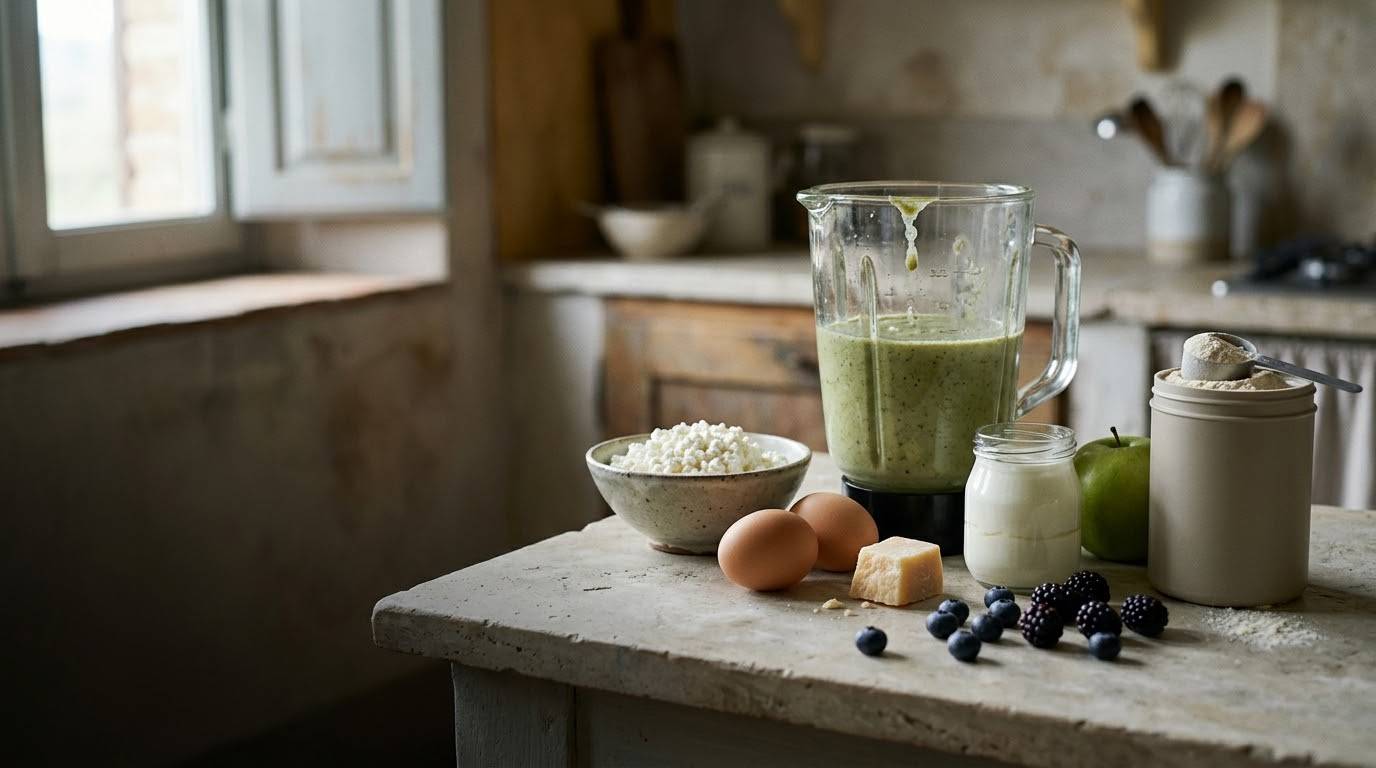
If you eat animal foods, it is easier than it sounds. Three eggs scrambled with 30 grams of grated Parmesan give about 29 grams of protein and roughly 2.6 grams of leucine in five minutes. 200 grams of cottage cheese with a boiled egg gives about 28 to 31 grams of protein. A portion of cooked salmon or chicken with a yoghurt does the same at lunch. Breakfast is the meal most often left short, so start there.
If you are vegetarian, eggs and dairy carry most of the weight, and the Dutch simulations suggest that a vegetarian pattern costs relatively little protein and keeps vitamin B12 above the threshold. Do the same arithmetic per meal, and do not let a meal of bread, jam and fruit stand in for breakfast.
If you are vegan, or want to be, the research gives a fairly clear brief. Build protein into every meal, breakfast included, around tofu, tempeh, soy yoghurt, soybeans, lentils, nuts, seeds and whole grains, which in the Dutch food records produced the better-quality vegan breakfasts. Combine sources, because lysine and methionine were the amino acids that limited quality in plant meals. Make sure you eat enough overall, because the vegans in that study also ate less energy. Take vitamin B12, which has no natural plant source, and check your vitamin D and calcium, with iodine worth discussing too. Press reports of the German guidelines say that the German Nutrition Society advises supplementing calcium, B12 and iodine for people who avoid animal foods entirely. Read the labels: in the Dutch micronutrient study, most meat replacements for warm meals and nearly all plant drinks were fortified with B12 and vitamin D, while bread toppings rarely were. Ask your doctor for blood tests. And lift something: in the Vold trial, resistance exercise halved the muscle loss on a vegan diet.
Build Your Three Meals
Choose a way of eating, pick a meal, then tap foods to add them (tap again for a second or third portion). Each meal shows whether it reaches the 25 to 30 g protein and roughly 2.5 g leucine discussed above. A rule of thumb, not a prescription.
Add to breakfast
Food values are approximate, based on USDA food composition data and typical labels; brands, portions and cooking change them. Plant meals also differ in protein quality, which the numbers here do not capture. If you have kidney disease or are under medical care, ask your doctor before raising your intake.
For every pattern, the principle is the same. Know your number, spread it across the day, and treat strength training as part of nutrition, not an optional extra.
Questions You Will Probably Ask
The official allowance of 0.8 grams per kilogram of body weight a day is a minimum to prevent deficiency. A 2018 perspective in Advances in Nutrition proposed at least 1.2 grams per kilogram for older people, and the US Dietary Guidelines for 2025 to 2030 recommend 1.2 to 1.6 grams per kilogram for healthy adults. For a woman of 65 kilograms that is roughly 78 to 104 grams a day, ideally spread as 25 to 30 grams at each main meal. Long-term trials of intakes above the allowance in older people are still missing.
Ageing muscle responds less strongly to the protein in a meal, a phenomenon called anabolic resistance, so each meal needs more protein and more leucine to switch on muscle building. The PROT-AGE study group put the figure at around 25 to 30 grams of protein containing about 2.5 to 2.8 grams of leucine per meal. Resistance exercise lowers that threshold.
It can work with careful planning. In Dutch simulations of adults aged 65 to 79, a vegan diet raised the share falling below the average protein requirement to around 57 to 60 percent, and in a 12-week trial a self-selected vegan diet cost older adults 1.15 kilograms of lean mass. A well-balanced vegan diet designed by nutrition scientists matched an omnivorous one for muscle protein synthesis over 10 days. Older vegans need protein at every meal, vitamin B12, attention to vitamin D and calcium, blood tests and strength training.
Dutch simulations suggest a vegetarian pattern costs only about 5 percent of utilizable protein and keeps vitamin B12 above the threshold. In a small study of long-term vegetarians aged 72 to 80, 40 percent were below the 0.8 grams per kilogram allowance, against 25 percent of omnivores, so eggs and dairy need to be part of every meal, breakfast included.
Protein makes up around 50 percent of bone volume and about a third of its mass. An expert consensus led by René Rizzoli concluded that intakes above the allowance may reduce bone loss and the risk of hip fracture, provided calcium intake is adequate, and found no evidence that higher protein harms bone. Long-term trials on fractures are still needed.
It depends on the system. Dutch modelling found that replacing animal protein with plant protein lowered environmental impacts for adults aged 18 to 65, except for the water footprint. An FAO-led analysis estimated that 86 percent of what livestock eat is not edible by humans, and that much grazing land cannot be converted to cropland. Grass-fed animals on land that cannot grow crops are a different proposition from animals fattened on cereals in a feedlot.
Back to the Café Terrace
I return to the people rising from their chairs. What I take from all this reading is not a verdict against plants, nor a defence of the way most of our meat and milk are made. It is three connected thoughts.
The first is that muscle and bone are organs we feed, and that they ask for more protein as we age, not less: around 1.2 to 1.6 grams per kilogram, spread across the day, with strength training to put it to work. The second is that dietary advice written for healthy 18- to 65-year-olds should not be quietly extended to the oldest and frailest among us. The best evidence we have, from the Netherlands and elsewhere, says that a plant-rich diet can work for older adults, while a self-composed vegan diet often does not, unless it is carefully planned, supplemented and paired with exercise.
The third is that the protein an older body needs has to come from somewhere, and where it comes from matters. It comes from soil that is tended or soil that is mined, from animals that graze or animals that are confined, from farms that are still there or farms that have quietly disappeared. Between 2005 and 2020, the EU lost 37 percent of its farms, and fewer than one farm manager in eight is under 40. I do not know whether regenerative grazing will deliver everything its advocates promise, because the evidence on soil carbon and biodiversity is still mixed. But I would rather bet on farmers who are able to stay on the land and look after it than on a food system that treats protein as a commodity and the people who produce it as an afterthought.
So I want a food system in which a woman can reach her protein target with food from a farm she could name, run by someone who was able to stay and thrive. It is not a nostalgic wish. Staying upright, in the end, takes muscle, bone and a food system that is still standing.
Sources
Checked on 13 October 2026. Most journal papers were read as published abstracts or institutional summaries. The mindbodygreen article and the ScienceDaily article were read in full. The study of long-term vegetarians and vegans (Wildemast et al.) was read through a secondary summary, so its figures rely on that summary. The 2024 protein simulation study was corrected in 2025, and the corrected figures are used here.
Protein needs and ageing
- Layman et al., 2015, Defining meal requirements for protein (American Journal of Clinical Nutrition)
- PROT-AGE position paper, Bauer et al., 2013
- Phillips, Paddon-Jones and Layman, 2020, on protein beyond the RDA (Advances in Nutrition)
- Perspective on protein requirements and optimal intakes in ageing (Advances in Nutrition, 2018)
- Dietary Guidelines for Americans 2025 to 2030, protein recommendation (Oklahoma State University Extension) and American Family Physician summary
- Leong et al., PURE study on grip strength and mortality (Healio summary) and NEJM Journal Watch commentary
- Success magazine profile of Dr Gabrielle Lyon, who calls muscle the organ of longevity
Bone
- Dietary protein intake and bone health, systematic review (PMC)
- NutraIngredients on the George Mason review of protein above the RDA and bone
- Rizzoli et al., expert consensus on protein and bone (abstract) and summary by an industry-funded institute
National guidelines
- German Nutrition Society, Food-Based Dietary Guidelines for Germany and FAO country page
- Plant Based News on the German guidelines (secondary source)
- Danish Official Dietary Guidelines 2021 and State of Green summary
- Review of guidelines in Germany, Canada and the Netherlands (Proceedings of the Nutrition Society)
- vegconomist on the updated Dutch Schijf van Vijf
- Dutch modelling study on replacing meat and dairy, including the national 50 percent plant protein target
- vegconomist on the Nordic Nutrition Recommendations
The Dutch studies and related trials
- Borkent et al., protein simulation in older adults, Journal of Nutrition, Health and Aging (PubMed, corrected abstract) and corrigendum with prevalence figures
- Borkent et al., micronutrient simulation in older adults, Current Developments in Nutrition, 2026 and full text
- de Vries et al., Dutch dietary modelling across age groups, Nutrients, 2026
- Wildemast et al., Journal of Nutrition, 2026 and mindbodygreen summary of the study
- Domić et al., self-selected vegan diet and muscle mass in older adults, American Journal of Clinical Nutrition, 2026 (abstract) and trial protocol
- Domić et al., 10-day crossover trial of a well-balanced vegan diet (PCRM summary, advocacy source)
Wider evidence
- Tong et al., EPIC-Oxford, vegetarian and vegan diets and fractures (ScienceDaily) and Science Norway
- Li et al., 2026, vegetarian diet and reaching 100 in China (ScienceDaily)
- Tong et al., EPIC-Oxford, ischaemic heart disease and stroke in vegetarians (BMJ, 2019; summary)
- Interview with the lead author on the absolute risks and the cholesterol hypothesis (secondary source)
- Orlich et al., Adventist Health Study 2, vegetarian diets and mortality (summary)
- Summary of the EPIC-Oxford mortality results, Appleby et al., 2016 (secondary source)
The land
- Davis et al., 2004, and later debate on nutrient decline in produce (summary)
- Davis, Declining fruit and vegetable nutrient composition, commentary and NutritionFacts on the evidence and critique
- What climate and environmental benefits of regenerative agriculture practices? (University of Galway)
- Morris, How biodiversity-friendly is regenerative grazing?
- Newton et al., What is regenerative agriculture?
- Antibiotic resistance determinants in livestock manure in Portugal (PMC)
- Checcucci et al., 2020, Spread of antimicrobial resistance genes through livestock manure (Frontiers in Microbiology)
- Eurostat, Farmers and the agricultural labour force and Agriland on the loss of 5.3 million farms
- Mottet et al., 2017, FAO analysis of livestock feed and land use (ILRI summary)
Meal builder
- USDA FoodData Central, for approximate protein and leucine values per portion