Arrival on the Petar Hektorović
The ferry that connects Vis to the rest of the world is named Petar Hektorović, after the sixteenth-century Croatian poet who was born on the nearby island of Hvar and spent his life writing about the sea. It departs Split’s main ferry terminal each morning with the unhurried certainty of something that has been doing this for a very long time. Two hours and twenty minutes later — past the islands of Šolta and Brač, past a stretch of open Adriatic that can be choppy in the shoulder season and glassy in July — it docks at the small port of Vis town, on the island’s eastern side.
The Petar Hektorović is not a scenic vessel. It is a working car ferry: small café, plastic seating, an outdoor deck with white plastic chairs bolted to the floor. But the moment you step off it onto the quay at Vis, something shifts. The harbour is lined with stone-and-plaster buildings in the Dalmatian manner, their shutters faded to the colour of old sage. There are no tour bus queues. No souvenir market. No one is trying to sell you anything. A few locals are picking up freight. A cat is sitting on a mooring bollard. This is the arrival the island has been staging for visitors since 1989 — the year it was first opened to the outside world after four decades as one of Yugoslavia’s most fortified military secrets.
Vis has two ferry crossings daily in peak season, and one in winter. That single schedule is, in the most literal sense, the pulse of the island. When the ferry comes, Vis wakes up. When it leaves, the island returns to itself. It is a rhythm that shapes everything: the pace of daily life, the character of the restaurants, the quality of the light at eleven o’clock in the morning when the harbour is quiet and the Adriatic is doing its particular thing with the colour blue.
We decided that Vis was the island that looked most like Greece. It is beautifully unspoiled.
Bill Darby — Location Manager, Mamma Mia! Here We Go Again2,400 Years on 90 Square Kilometres
The island’s name derives from Issa, the Greek colony founded here in the early fourth century BC by Dionysius the Elder, tyrant of Syracuse. Issa was no backwater: it minted its own coins and founded colonies on the mainland. One of them, Aspálathos, is now the city of Split. When you board the ferry in Split, you are, in a pleasing inversion, sailing from daughter to mother.
What followed was a fairly standard Adriatic biography: Romans, Venetians (whose palazzo architecture still lines both harbours), a brief Napoleonic interlude, then the British, who defeated the Franco-Venetian fleet in the Battle of Vis in 1811 and left behind Fort George — now a restaurant with improbably good views. Then the Austrians, the Italians, and eventually Yugoslavia.
The twentieth century is where the story gets interesting. During the Second World War, Vis became headquarters for Marshal Tito and the Partisan resistance — the makeshift airstrip from which RAF sorties were flown is now, fittingly, the site of Roki’s winery. After the war, the Yugoslav People’s Army turned the island into one of its most fortified naval bases: over 30 military installations, submarine tunnels carved into cliffs, bunkers, and an atomic rocket command. Foreign visitors were banned. Locals needed permits to fish. The JNA finally left in 1992.
The long isolation was, accidentally, the best thing that ever happened to Vis. While Hvar was building hotels, Vis was building submarine bases. The result is an island that entered the tourism age with its stone architecture intact, its agricultural traditions unbroken, and its vineyards still producing the same indigenous grape varieties the Greeks planted two and a half thousand years ago.
Two Towns, Two Personalities
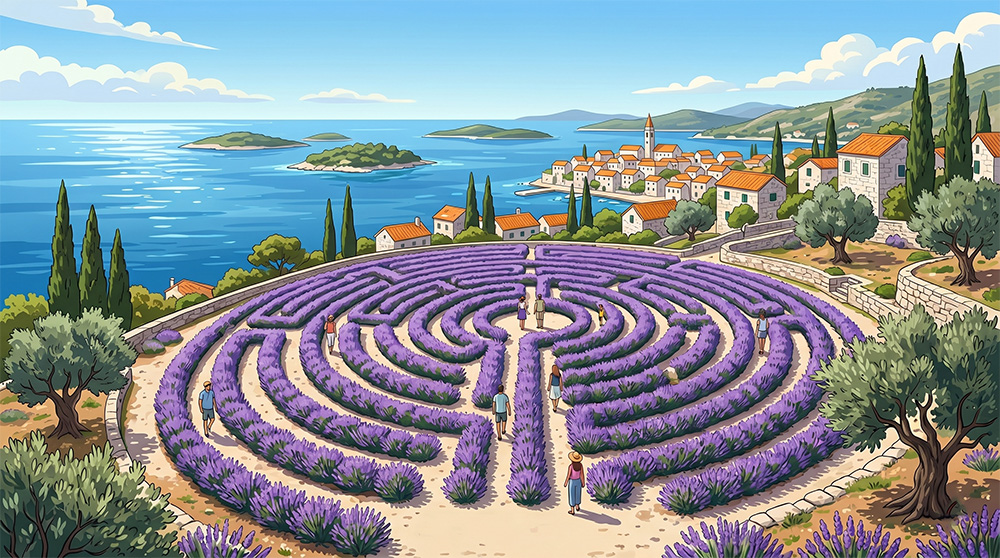
Vis town and Komiža are the island’s two main settlements, located respectively on the eastern and western coasts and connected by a single 15-kilometre road that climbs through the island’s terraced interior, past olive groves and vineyards, with views over both seas. They are less than half an hour apart by car. In character, they are considerably further.
Vis town is the island’s administrative hub and ferry port, and it has a certain coastal-capital gravity to it. The town is divided into two distinct halves: Luka, the working harbour end where the ferry docks and the fishing boats tie up; and Kut, the neighbourhood to the east where the Venetian-era palaces of island aristocrats have been converted into restaurants, wine bars, and private accommodation. It was in Kut’s cobbled lanes and waterfront terraces that the production team of Mamma Mia! Here We Go Again — the 2018 ABBA musical sequel starring Lily James, Amanda Seyfried, Meryl Streep, Pierce Brosnan, and Cher — built their market square set and filmed much of what was supposed to be the fictional Greek island of Kalokairi. The location manager’s verdict, after scouting virtually every island on the Croatian coast, was that Vis was the one that looked most convincingly like Greece. It is the kind of compliment that Vis islanders receive with amusement. They know what they have.
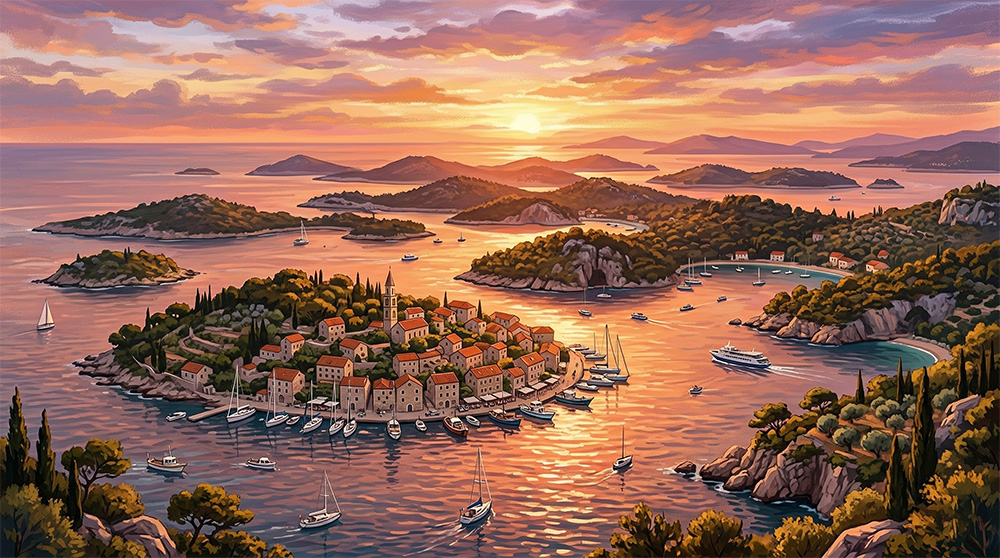
Komiža, on the western side, is smaller, quieter, and has a more intensely local feel. It is a fishing town first and a tourist destination second, built around a working harbour from which boats still depart in the early hours and return by mid-morning. The main promenade follows the curve of a small bay, with the tower of a sixteenth-century Venetian kula at one end and the wooded hill of Muster rising behind the town. Komiža’s atmosphere in summer is warm and social without being hectic. In the evenings, families and locals mix freely with visitors at the harbour-side konobas. The sunsets, viewed from Komiža with the island of Biševo silhouetted in the west, are unobstructed and extraordinary.
The administrative capital. Ferry port, Kut’s Venetian palaces, the most dining variety, the strongest historical texture.
A working fishing town. Quieter, more intensely local, and the closest base for Blue Cave excursions and the best sunsets on the island.
The choice between the two towns tends to divide visitors along temperamental lines. Those who want easy access to the ferry, more dining variety, and a stronger historical texture tend to prefer Vis town. Those who want the most authentically island experience, the best sunsets, and the closest base for a Blue Cave excursion tend to prefer Komiža. Both choices are correct.
The Military Island, Reimagined
One of the things that makes Vis genuinely distinctive among Croatian islands is the sheer scale and variety of its military history — and the inventive ways in which that history has been turned into something a visitor can experience.
The submarine tunnel near Vis town harbour is the island’s most photographed military remnant: a vast channel cut directly into the coastal cliff, large enough to shelter submarines up to 110 metres long, now open to the sea and to any sailing boat whose skipper wants the novelty of motoring through it. Strictly speaking, motorised vessels are not supposed to enter. This does not stop them. Walking the tunnel on foot, with a torch, is a different and more contemplative experience: the concrete walls, the rusted metal tracks on which submarines were rolled, the ventilation shafts, the absolute darkness beyond the beam of the flashlight.
Guided military tours of the island have become a genuine tourist industry in their own right. Land Rover and quad bike safaris depart from both towns, visiting Tito’s cave on Mount Hum, the Cold War bunkers and cannon emplacements at Cape Stupišće, the abandoned radar installations at Vela Glava, and the former atomic rocket command site. These tours serve a double purpose: they provide access to parts of the island’s mountainous interior that are otherwise difficult to reach, and they offer views of both coasts simultaneously from the ridge of Hum — at 587 metres, the island’s highest point and the best vantage on the central Dalmatian archipelago. Fort George, the British fortification built in 1813, now operates as a restaurant and wedding venue with genuinely spectacular views over Vis town and the bay of St George.
The Blue Cave Window: The Modra Špilja on the small island of Biševo, five kilometres south-west of Komiža, is best visited between approximately 11am and noon, when the angle of sunlight through a submerged opening in the cave floor illuminates the interior with an electric silver-blue light of peculiar intensity. The cave is accessible only by small boat — tours depart Komiža harbour from early morning and typically combine the visit with the Green Cave on Ravnik and Stiniva beach. Children take to these full-day tours unreservedly.
The Beaches
Vis has been named, repeatedly, as home to one of the most beautiful beaches in Europe: Stiniva, a narrow inlet on the island’s southern coast, enclosed by limestone cliffs that rise on both sides and nearly meet overhead, leaving only a thin slice of sky above a pebble beach of extraordinary clarity. The cliffs give the cove an amphitheatre quality; the water inside them, protected and still, is a shade of turquoise that invites the word impossible. Stiniva was awarded the title of Europe’s most beautiful beach by the European Best Destinations website from a shortlist of close to 300 candidates.
Access is either by a steep path down from the clifftop — manageable for active adults and school-aged children, but challenging enough to require good footwear and a degree of commitment — or by boat, which is how most visitors arrive in peak season. In July and August the beach becomes considerably crowded. The experience of arriving by boat at dawn or in late afternoon, when the tour boats have departed, is considerably more memorable.
Beyond Stiniva
Srebrna beach, on the north-eastern tip of the island, offers a different experience: two adjacent bays separated by a rocky promontory, one traditionally used by families and one clothing-optional, with calm shallow water and a more open aspect that makes it better for young children. Zaglav, near the village of Milna on the northern coast, is one of the island’s rare sandy beaches — a genuine rarity in Croatia — with a restaurant, shallow entry, and calm conditions that make it ideal for families with small children. Grandovac, within walking distance of Vis town, is a long rocky beach set in pine shade with easy access and reliable calm water. Gusarica, on the southern edge of Komiža, sits directly below the sixteenth-century Church of St Nicholas and offers some of the clearest water on the island. Kameščak, tucked into a cove on the approach to Komiža from the east, is one of the island’s quieter and least-visited beaches — natural spring water from volcanic rock once made it an important freshwater source for the town.
Eating on Vis
The food culture of Vis is built on a foundation of extreme freshness and near-total localism. The island’s fishing boats supply the island’s restaurants directly; the octopus on the menu at dinner was likely in the sea that morning. The olive oil is local — small family producers, or OPGs as they are known in Croatia, press oil from trees that have grown on the island’s terraced hillsides for centuries. The wine is local. Almost everything else — the capers, the figs, the anchovies, the carob — comes from the island’s own soil or waters.
Vis Town: Pojoda
Pojoda, in the Kut neighbourhood of Vis town, is consistently regarded as the finest restaurant on the island — a beautifully set establishment with a terrace overlooking the bay, impeccable Dalmatian cooking, and fair prices that would be unremarkable in Split and feel almost extravagant in a town this size. The prawn and barley risotto is a signature dish. The octopus salad, the lentil and squid brodet, and the daily fresh-fish menu are all reliably excellent.
Komiža: Bako and Jastožera
In Komiža, the two essential addresses are Konoba Bako and Jastožera, both positioned on the gastro enclave of the beach at Pol Kalafotovo. Bako is built around Greek and Roman artefacts recovered from the seabed by the restaurant’s founder, Tonko Borčić Bako, who dived the waters around Vis for decades; the menu centres on fresh langouste lobsters and seasonal Dalmatian seafood. Jastožera — the name means ‘lobster pot house’ — is more theatrical: dining tables on a floor of planks above the sea, with boats able to pole directly in underneath. The cuttlefish risotto, the langoustines, and the pasta with clams are the things to order.
The Interior: Roki’s
Roki’s, in the island’s interior on the former WWII airstrip, occupies a category entirely its own. It is a working winery and restaurant in an open courtyard surrounded by olive groves and vines, accessed by arrangement (call ahead; transport is provided for groups of four or more). The menu is built around peka — the slow-cooked Dalmatian method in which meat or fish and vegetables are sealed under a bell and buried in embers — alongside fresh fish and the winery’s own Plavac Mali and Vugava wines. An evening at Roki’s has the quality of being received into someone’s home, generously and without fuss. It is one of the better meals available on any Croatian island.
Senko: A Cove of Its Own
For something more remote, Konoba Senko — known simply as Senko — operates from a cove on the island’s southern coast, accessible only by taxi or boat, and offers an interactive meal of several hours built entirely from local and organic ingredients. The owner, Senko Karuza — a Croatian writer of some renown as well as a cook — prepares smoked fish broth, home-cured fish, bean stew with pasta, and grilled fish over olive-wood embers, talking guests through the natural history of the island’s ingredients as each course arrives. Booking is essential and logistically requires some commitment. This is entirely the point.
What the Island Produces
The agricultural landscape of Vis’s interior — terraced hillsides covered in vineyards and olive groves, with fig, carob, and citrus trees along the stone walls — is as close to an ancestral Mediterranean landscape as one can find on the Croatian coast. The long military closure inadvertently protected it from the development pressures that reshaped more accessible islands, and the family farms and OPGs that work the land today are, in many cases, continuing traditions that stretch back to antiquity.
Vugava is the island’s signature grape: an ancient white variety, cultivated here since Greek times, producing a full-bodied wine with a distinctive honey richness and a minerality that reflects the island’s limestone soils. It is found almost nowhere else. Plavac Mali, the indigenous red of the southern Dalmatian islands, is grown widely on Vis and reaches a particular intensity here. Kurteloška, a white variety, completes the island’s vinous identity. Winery tours and tastings are available at several producers, including Roki’s, Lipanović, and the Fields of Grace vineyard. Rogač in Komiža offers a wide selection of local wines by the glass.
The olive oil from Vis is cold-pressed and intensely flavoured. Small-batch producers sell direct from their farms and through shops in both towns. Carob — the dark seed pod with a natural sweetness that predates refined sugar by several thousand years — has been processed on Vis for more than fifty years. The island is home to Croatia’s only remaining carob mill, still operating in Komiža, which produces carob flour, carob syrup, and the digestif Rogačica: a liqueur made from carob pods and island brandy, intensely aromatic, slightly bitter-sweet, and impossible to find anywhere else. Hemp oil, pressed from locally grown plants, has been making its way into island shops and restaurants as part of a broader interest in indigenous agricultural products.
The Viški Hib is the island’s most distinctive food souvenir: a round cake made of dried figs, fennel seeds, and travarica — the local herb brandy distilled from grape pomace and wild herbs. Traditionally, the hib is pressed into shape by hand and stored in bay and sage leaves until Christmas, when it is served with a glass of travarica. For ancient Mediterranean peoples, the fig was a sacred tree, associated with fertility and abundance; the Hib is, in its modest, dried-fruit way, a continuation of something very old. It is found in every alimentari on the island.
Summer, and What Comes After
Vis in summer — July and August in particular — is a transformed island. The ferry runs multiple times daily. The harbours of both towns fill with sailing yachts from across Europe. Every restaurant table is taken. The boat tours to the Blue Cave depart in convoys. Stiniva is crowded by 10am. The energy is warm and gregarious: Dalmatian summers have a particular quality of sociability that feels inclusive rather than overwhelming, and Vis manages its tourism with more grace than most islands its size.
But it is worth knowing that Vis is also, by the standards of Hvar or Dubrovnik, genuinely low-key. There are no beach clubs. No DJs. No excursion boats playing amplified music. The island attracts a clientele that is, broadly, there for the food and the sea and the peace — families, couples, sailors, and the kind of traveller who considers the lack of a souvenir market a quality rather than a deficiency.
September is, by consensus, the ideal time to visit: the sea is at its warmest, the crowds have thinned, the light has the particular golden softness of the Mediterranean in early autumn, and the restaurants are less harried. October brings the grape harvest and the pressing of the new olive oil, and a different kind of island life becomes visible: agricultural, purposeful, rooted.
Winter on Vis is a quiet thing. The population contracts to its year-round core of a few hundred people — fishermen, farmers, the families who have been here for generations. The ferry runs once daily. A handful of restaurants remain open; most close until April. The military tunnels are empty and dark. The harbour in Vis town holds only fishing boats. The island is, in this season, entirely itself — stripped of everything that tourism brings and left with the things that were always here: the sea, the stone, the vineyards, and the sound of a place that does not need an audience.
How to Get There, and What to Know
Getting There
Ferry: Jadrolinija operates the Petar Hektorović from Split to Vis town (2h 20m). In summer, two to three departures daily; in winter, one. Book vehicle spaces well in advance in July and August (capacity around 60 cars). Walk-on passenger tickets rarely sell out, but early booking is wise. Tickets available on jadrolinija.hr.
Catamaran: A faster (90-minute) catamaran service runs from Split to Vis town in summer, passengers only. No vehicles. From Hvar, Komiža is accessible by catamaran from Hvar town in approximately one hour.
Getting Around
Car rental is available in Vis town near the ferry port and is essential for reaching remote beaches and the island’s interior. Book in advance in peak season; specify automatic transmission if required. Scooters are a popular option for couples and solo travellers — the 15km road between Vis and Komiža is hilly but manageable. Taxis in both towns are useful for Stiniva, Roki’s, and remote locations; book ahead. Taxi boats run between beaches and harbours in summer for €10–20 per person.
When to Go
Best time: June and September for warm weather, warm sea, lower prices, and manageable crowds. July and August are peak season — busier, hotter, more expensive, but fully alive. October for the harvest season and complete authenticity. Avoid: arriving in August without accommodation booked. Hotels are limited (Hotel San Giorgio is the principal option in Vis town; apartments are the primary accommodation form across the island).
Vis does not offer itself easily. The ferry schedule imposes a natural filter. What it rewards, in return, is the feeling of having found something real.