For decades, the Tuscan trail was a well-trodden path between the Renaissance heavyweights of Florence and the leaning marvels of Pisa. But as we move into 2026, a new chapter is being written in the heart of Italy's most beloved region. GlamBon explores the rise of Lucca — the "undiscovered gem" that is finally, and deservedly, having its moment in the sun.
While the world's most famous cities grapple with over-tourism and diminishing authenticity, Lucca offers a refined, slower alternative. A new wave of international travellers — most notably from England and the Netherlands — is flocking to this walled sanctuary, drawn by a perfect cocktail of high culture, ancient history, and a lifestyle that feels both exclusive and authentically Italian.
01 The Crown Jewel: Lucca's Renaissance Walls
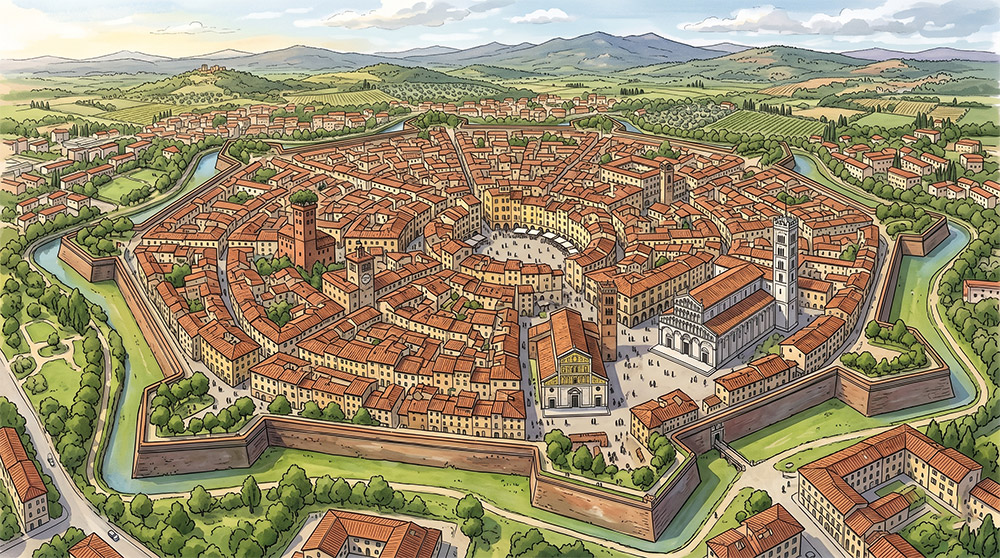
The defining feature of Lucca is, without a doubt, its massive ring of 16th-century Renaissance walls. Unlike most European cities that tore down their defences to modernise, Lucca kept hers perfectly — and completely — intact.
Today, these 4.2 kilometres of stone and brick have been transformed into something remarkable: a sophisticated, tree-lined elevated park that serves as the city's most beloved public space. It is, in every sense, the ultimate catwalk for the modern traveller.
Whether you're cycling on a vintage Italian frame, enjoying a golden-hour passeggiata, or simply sitting in quiet contemplation, the walls offer a dual vantage point unlike any other in Europe: the rolling Tuscan hills stretching to the horizon on one side, and the warm red-tiled rooftops of the historic centre below on the other.
Bicycle hire is available at multiple points around the wall circuit. For the full experience, hire a classic bicicletta and complete the full 4.2 km loop at sunset — the light over the Apuan Alps to the north is extraordinary.
02 A City Shaped by Time
Stepping through one of Lucca's grand medieval gates is to enter a living museum — one where Roman, medieval, and Renaissance history coexist within walking distance of each other. The city's history is layered like fine Italian silk: each era visible, each contributing something irreplaceable to the whole.
-
Roman
Piazza dell'Anfiteatro
The iconic piazza maintains the precise elliptical shape of the Roman arena that once stood on this site. Today it is a hub of chic cafés, boutique flower shops, and aperitivo culture — ancient engineering repurposed as one of Italy's most convivial public spaces.
-
Medieval
The Guinigi Tower
A genuinely surreal landmark: a medieval tower topped with ancient holm oak trees growing from its summit — a literal hanging garden above the rooftops. The Guinigi Tower has become one of Tuscany's most photographed subjects and symbolises the city's enduring bond with nature.
-
Renaissance
Giacomo Puccini's Birthplace
As the birthplace of the opera composer Giacomo Puccini, Lucca breathes music in a way few cities can claim. The sounds of opera drift through the cobblestone streets — particularly during the annual Puccini Festival — adding a cinematic dimension to every corner of the historic centre.
03 The International "Slow Travel" Boom
Why are English and Dutch travellers leading the charge to Lucca in 2026? The answer lies in what travel analysts are calling the "Souljourn" trend — a movement away from checklist tourism toward deeper, more intentional stays in secondary cities.
Travellers are increasingly seeking destinations that offer the same cultural density as Florence or Rome, but with a more intimate, liveable rhythm. Lucca fits this brief precisely: it has the history, the gastronomy, the art, and the architecture — but without the queues, the crowds, or the sense of being processed through a tourist conveyor belt.
"Lucca doesn't just ask you to look at its history. It invites you to live within it."GlamBon Feature, Spring 2026
With its boutique hotels housed in Renaissance palazzos, artisanal silk workshops continuing centuries-old traditions, and a high-end dining scene rooted in the hyperlocal produce of the Garfagnana and Versilia, Lucca has become the go-to destination for the international traveller who wants to experience Tuscany at its most genuine — exclusive, unhurried, and deeply, quietly elegant.
Searches for "Lucca Italy travel" among UK and Dutch travellers rose significantly in 2025–2026, coinciding with a broader pattern of interest in secondary Italian cities — Matera, Lecce, and Orvieto among them — as alternatives to over-saturated heritage hubs.
The GlamBon Verdict
Lucca is no longer just a day trip from Florence. It is a destination in its own right — a place where history is preserved in stone, opera drifts through Renaissance streets, and the lifestyle is as effortlessly elegant as a tailored Italian suit.
For the discerning traveller of 2026 — one who values authenticity over spectacle, depth over volume, and beauty over noise — Lucca is the Tuscan answer you didn't know you were looking for.
Why is Lucca a must-visit in 2026?
Lucca is a must-visit in 2026 because it combines exceptional historical depth — Roman amphitheatre ruins, medieval towers, 16th-century walls, and Puccini's operatic legacy — with the emerging slow travel trend. It offers the cultural richness of Florence without the overcrowding, making it the ideal destination for international travellers seeking an authentic Tuscan experience.
What are Lucca's Renaissance walls?
The Renaissance walls of Lucca are a 4.2-kilometre ring of 16th-century fortifications that completely encircle the historic city. Uniquely preserved when most European cities demolished theirs, the walls are now a tree-lined elevated park ideal for cycling and walking, offering views over both the Tuscan hills and the city's rooftops.
What is the Piazza dell'Anfiteatro?
The Piazza dell'Anfiteatro is a unique elliptical piazza in Lucca whose distinctive oval shape traces the exact footprint of a Roman amphitheatre that once stood on the site. Today it is surrounded by cafés, restaurants, and boutiques, and is considered one of the most characterful public spaces in all of Tuscany.
Is Lucca worth visiting as a standalone destination?
Absolutely. While Lucca was historically treated as a day trip from Florence or Pisa, it has firmly established itself as a standalone destination in 2026. The city offers boutique palazzo hotels, artisanal silk workshops, a high-end dining scene, Puccini Festival events, and a walkable historic centre rich enough to reward several days of exploration.
What is the "Souljourn" slow travel trend?
The Souljourn trend is a 2026 travel movement in which travellers — particularly from England and the Netherlands — prioritise secondary cities with high cultural density over the major tourist hubs. Rather than rapid checklist tourism, Souljourn travellers seek liveable, authentic destinations where they can spend more time and live within the local culture. Lucca is widely considered one of the defining Souljourn destinations of 2026.