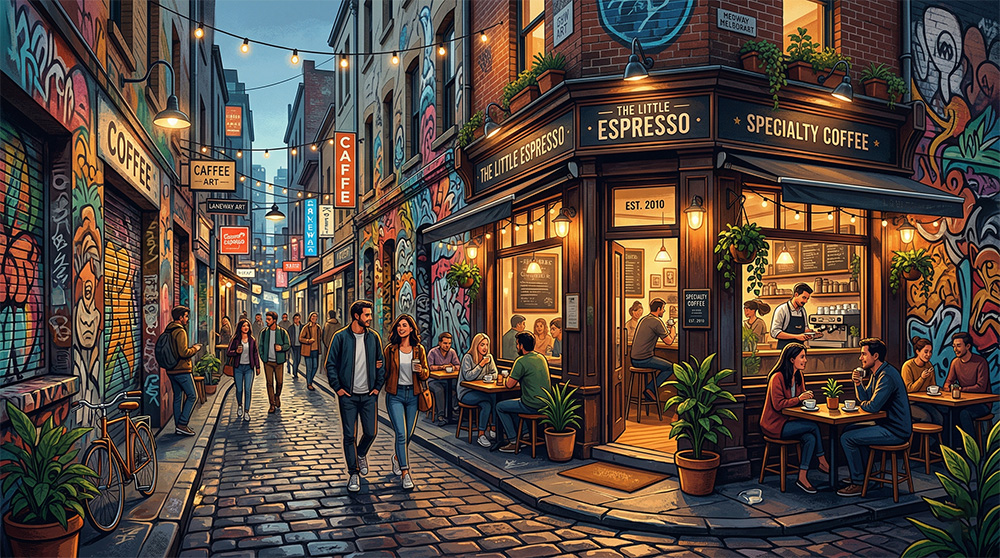
While London and New York have made strides, Melbourne remains the gold standard. But this wasn't an overnight evolution. It is a story that begins with a post-war migration wave and ends with a scientific obsession over "cherry-to-cup" transparency — a phrase that would have been incomprehensible to the first Italians who stepped off the boat in the 1950s and simply wanted something that tasted like home.
Ground Zero: The Italian Infiltration
The foundation of Melbourne's coffee obsession was laid in the 1950s. Following the 1956 Olympics, a wave of Italian immigrants arrived carrying nostalgia and the first Gaggia lever-press espresso machines the city had ever seen.
Before this, Australia was a tea-drinking outpost of the British Empire. Then came Pellegrini's Espresso Bar. Opening on Bourke Street in 1954, it became the cultural anchor of a city still finding its identity. With its checkered floors, long mirrors, and the constant steam of the machine, Pellegrini's didn't just serve coffee — it served a sense of European cool. It was here that Melbourne learned that coffee was meant to be drunk standing up, fast, and with a certain ritualistic reverence that no teapot could rival.
The Third Wave: From Commodity to Craft
If the Italians brought the machine, Mark Dundon brought the bean. In the early 2000s, the "Third Wave" of coffee began to crest — a movement that shifted focus away from dark-roasted, bitter commodity coffee toward lighter roast profiles that highlighted the unique terroir of the coffee cherry itself.
Dundon is often cited as the godfather of this shift. He founded St Ali in South Melbourne in 2005, turning an old warehouse into a temple of roasting. In 2008, he sold St Ali to Salvatore Malatesta — another visionary who transformed the brand into a global lifestyle powerhouse. Dundon went on to found Seven Seeds, a roastery that remains the intellectual heart of the Melbourne scene, built on direct trade and radical transparency in the supply chain. Suddenly, coffee wasn't just "hot and black." It was floral, acidic, fruity, and complex — and Melbournians, to their credit, took to it immediately.
A Thriving Ecosystem of Excellence
Today, the scene is no longer a few pioneers. It is a dense forest of world-class roasters, each with a distinct philosophy and a loyal suburb.
The Geography of the Order
Despite its global influence, Melbourne coffee remains a hyper-local affair, governed by strange suburban allegiances that outsiders find baffling and locals find entirely rational. While the city's default setting is the latte — served in an iconic glass rather than a ceramic cup — geography dictates your froth.
Find yourself in the bohemian enclave of East Brunswick and the flat white reigns supreme — a nod to the suburb's purist, old-school roots. Travel east to the leafy, family-oriented streets of Doncaster, however, and the cappuccino is the undisputed king, complete with a generous dusting of chocolate powder that would make a Fitzroy barista shudder visibly. Order a flavoured syrup anywhere near Collingwood and you will not be asked to leave, but you will absolutely be judged.
Laneway Spot Finder
Choose your vibe and we'll match you to your perfect Melbourne café
The Hidden Laneways: Where to Go
While the grand history of Pellegrini's defines the city's origin story, the soul of Melbourne's current coffee scene is tucked into its "little" streets and narrow brick alleys. Finding these spots requires looking up for a sign, peering down a dead-end, or ducking into the basement of a heritage building — and that difficulty is entirely the point.
Patricia Coffee Brewers
Widely considered the quintessential Melbourne experience, Patricia is a standing-room-only operation tucked into a legal district corner. It serves a rotating selection of beans from the city's top roasters — Seven Seeds and Market Lane among them — with an atmosphere that is polished yet utterly unpretentious. No complex syrup menus. No chairs. Just exceptional coffee, delivered with personalised expertise.
Manchester Press
A former printing press turned high-ceilinged warehouse café, hidden deep within a narrow bluestone alley. Its legendary bagels — from classic lox to creative seasonal toppings — are matched by a commitment to high-extraction filter coffee that keeps it perpetually full. One of the most consistently busy spots in the CBD, and deservedly so.
Brother Baba Budan
A tiny, high-energy space operated by the Seven Seeds team, recognisable immediately by its ceiling covered in vintage wooden chairs — an installation that is either charming or unsettling, depending on your mood. The tight quarters encourage a sip-and-go culture that captures the city's morning rhythm perfectly. The house blends are among the most consistent in Melbourne.
Krimper Café
For those who want to linger, Krimper is a moody, romantic space in a converted sawmill with furniture crafted from old lift doors. The menu leans toward hearty, seasonal brunch dishes, and a second pour-over feels not only justified but encouraged by the low-lit warmth of the room. A counterpoint to the standing-room intensity of the CBD laneways.
Little Rogue
A Japanese-inspired hideaway on a quiet street, recognisable by its distinct blue door. It specialises in creative lattes — matcha, black sesame — paired with delicate cakes and baked goods in a minimalist interior that prioritises calm over spectacle. The antidote to a frenetic Melbourne morning, and one of the city's most quietly beloved spots.
The Verdict
Melbourne's coffee scene shows no sign of cooling. It has survived a global pandemic, the rise of home brewing, and the fluctuating price of green beans. It persists because, for Melbournians, coffee is not a product. It is the social glue — the ritual that structures the day, defines the suburb, and signals who you are before you've said a word.
In a city that prides itself on its liveability, the quality of the morning brew is the ultimate metric. As Salvatore Malatesta has put it, Melbourne doesn't just drink coffee — it breathes it. Whether you're at a stand-up bar in a laneway or a high-tech lab in the suburbs, the standard is the same: a "good" cup is simply the bare minimum. What comes next is the conversation.
Before You Go
Why is Melbourne considered the world's best coffee city?
What is the difference between a flat white and a latte in Melbourne?
Which Melbourne laneway cafés are worth seeking out?
What drove Melbourne's Third Wave coffee movement?
What coffee order should I ask for in Melbourne?