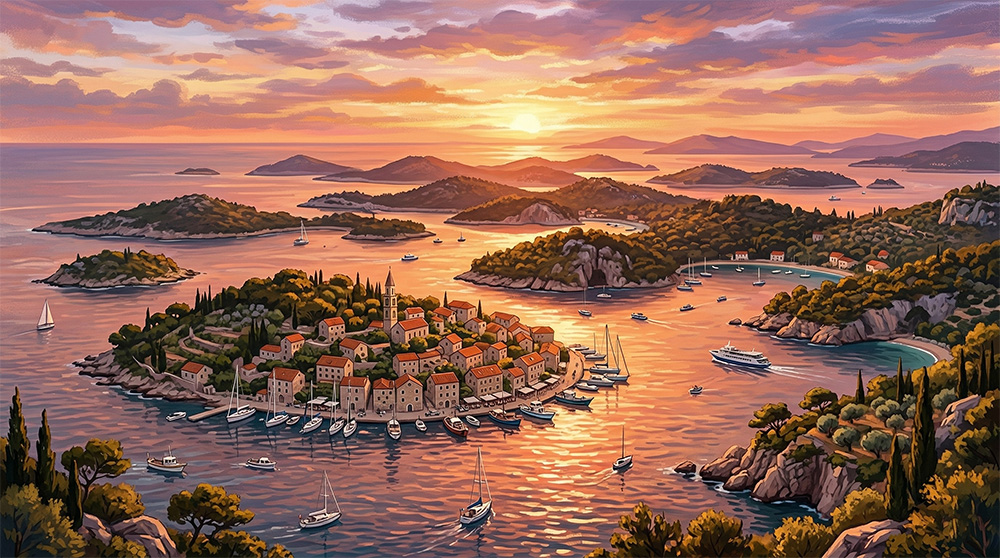
The Adriatic has a way of tricking the eye. From the deck of a ferry leaving Hvar, the water isn't just blue; it's a shifting palette of sapphire and liquid silver, so clear you can see white pebbles on the seabed thirty feet below. This is the Croatian coast — a ribbon of karst limestone, ancient Roman ruins, and a culinary tradition that feels like a conversation between the Mediterranean and the Alps.
For years, Croatia was the "best-kept secret" of the Mediterranean. Today, it is simply the standard. Whether you are wandering through the mist-shrouded hilltop villages of Istria or docking at a sun-drenched Dalmatian island, the country offers a rare kind of luxury: the luxury of time, preserved in stone.
The Green North: Istria's Hilltop Secrets
Our journey begins in Istria, the heart-shaped peninsula in the north that often feels more like Tuscany than the Balkans. Here, the landscape is defined by "Green Istria" — a rolling interior of oak forests and vineyards where the pace of life is measured in seasons, not minutes.
In the centre of this greenery sits Motovun, a medieval fortress-town perched atop a hill like a stone crown. In autumn, the valley below is swallowed by thick white mist, leaving only the town's bell tower visible, floating above the clouds. Just a short drive away is Hum — officially recognised as the "smallest town in the world." With its two streets and fewer than thirty residents, it is a living museum of Glagolitic history.
The true lure of Istria, however, is underground. This is the land of the white truffle. In local konobas — the Croatian word for a traditional family tavern — the scent of "white gold" is inescapable. The signature dish is fuži, a hand-rolled, flute-shaped pasta tossed in a rich, buttery sauce with shaved truffles. It is a dense, earthy experience that pairs perfectly with a glass of local Malvazija wine.
The Liquid Gold Revolution
Perhaps the most significant shift in Croatia's global standing is found not in its restaurants or its resorts, but in its olive groves. For decades, Italy and Spain were the undisputed titans of the olive oil world. But the results of the 2026 New York International Olive Oil Competition have sent shockwaves through the industry.
While the "Big Two" entered thousands of samples, Croatia achieved a staggering 80.6% success rate — the highest of any major producing nation. With 596 Gold Awards, Croatian producers from Istria and Dalmatia outperformed regions ten times their size. This isn't mass-produced oil; it is boutique, small-batch liquid gold that is increasingly becoming the darling of Michelin-starred chefs worldwide. To taste it — pressed from ancient Istrian trees, poured over nothing more than good bread and coarse salt — is to understand why.
The Stone Heart: Zadar and Split
Travelling south, the coast hardens into the rugged beauty of Dalmatia. In Zadar, the city's ancient Roman forum sits adjacent to the ultra-modern Sea Organ. Designed by architect Nikola Bašić, this experimental instrument uses the energy of the waves to push air through underwater pipes, creating a haunting, rhythmic music of the sea. Beside it, the Greeting to the Sun — a massive solar-powered circle of glass — creates a synchronised light show as the sun dips below the horizon. I sat there for an hour, entirely unable to leave.
Then there is Split. At its core is Diocletian's Palace — a 1,700-year-old Roman retirement home that has evolved into a living, breathing city. People hang their laundry from Roman arches. Cafes operate inside the skeletons of ancient temples. The palace was never abandoned; it simply adapted, absorbing centuries of life without losing an ounce of gravitas.
For the modern traveller, Split is also synonymous with Game of Thrones. The cool, dark cellars of the Palace served as the location where Daenerys Targaryen kept her dragons. A short trek up to the Klis Fortress reveals the towering walls of Meereen. The line between ancient history and contemporary mythology blurs pleasantly here.
The Archipelago: 2,715 Hours of Light
To truly understand Croatia, you must leave the mainland. The Dalmatian islands are a constellation of distinct personalities — each worth a trip in its own right.
- Brač Famous for its white limestone — the same stone used to build the White House — and the V-shaped Zlatni Rat beach, which shifts its tip depending on wind and current. The island rewards slow mornings and long lunches.
- Hvar Officially the sunniest spot in the Adriatic, boasting an average of 2,715 hours of sunshine per year. Beyond the glitzy yacht parties of Hvar Town, the interior is a lavender-scented paradise of ancient stone walls and abandoned villages.
- Vis The furthest inhabited island from the coast, Vis was a secret military base until the 1990s. This isolation preserved its "Mediterranean as it once was" character — quiet, rugged, and home to the luminous Blue Cave, where the sea glows an otherworldly electric blue.
- Korčula Often called "Little Dubrovnik," this walled island city is a maze of herringbone-patterned streets. It is the birthplace of the Grk and Pošip grapes — crisp, mineral-heavy white wines that are the perfect companion to the island's fresh oysters.
Which Island Is Yours?
Answer four questions and we'll match you to your perfect Dalmatian island
What draws you to a destination?
How do you prefer to spend your evenings?
What's your ideal crowd level?
Which phrase best describes your travel style?
The Dalmatian Table: A Slow-Cooked Love Letter
If Istria is about truffles and butter, Dalmatia is about the sea and the slow fire. The regional masterpiece is brudet — a rich fish stew cooked with tomatoes, vinegar, and whatever the fishermen caught that morning. There is no single recipe; the dish is a daily negotiation between the sea and the cook.
For a more celebratory meal, there is pašticada — a beef roast marinated for days in vinegar and wine, then slow-cooked with prunes, figs, and bacon until it falls apart at the touch of a fork. It is a dish of patience and intention. And no visit to the coast is complete without crni rižot — black risotto, coloured with cuttlefish ink, tasting intensely of the Adriatic in a single mouthful.
The Finale: The Pearl of the Adriatic
The journey inevitably ends in Dubrovnik. Even the heavy crowds of midsummer cannot dull the majesty of its 16th-century walls. This was the primary filming location for King's Landing, and standing atop the Lovrijenac Fortress — the Red Keep — looking out over the terracotta rooftops and the shimmering sea, it is easy to see why the production could have filmed nowhere else.
As you walk the limestone-paved Stradun at night, the stone reflecting the streetlights like a mirror, you realise that Croatia's appeal isn't just its beauty — it's its resilience. It is a coast that has been Roman, Venetian, Austrian, and Yugoslavian, yet has remained stubbornly, beautifully itself.
In a world that is moving too fast, Croatia offers a different pace. It is the pace of an olive tree growing, a wave hitting a Roman wall, and a sun that refuses to set on the most golden coast in Europe. Come for a week; you will spend the rest of your life trying to return.
Before You Go
When is the best time to visit Croatia's Dalmatian coast?
What is Croatia's most iconic food and wine pairing?
Why is Croatian olive oil considered among the world's best in 2026?
Which Croatian island is best for first-time visitors?
Which Game of Thrones filming locations can I visit in Croatia?