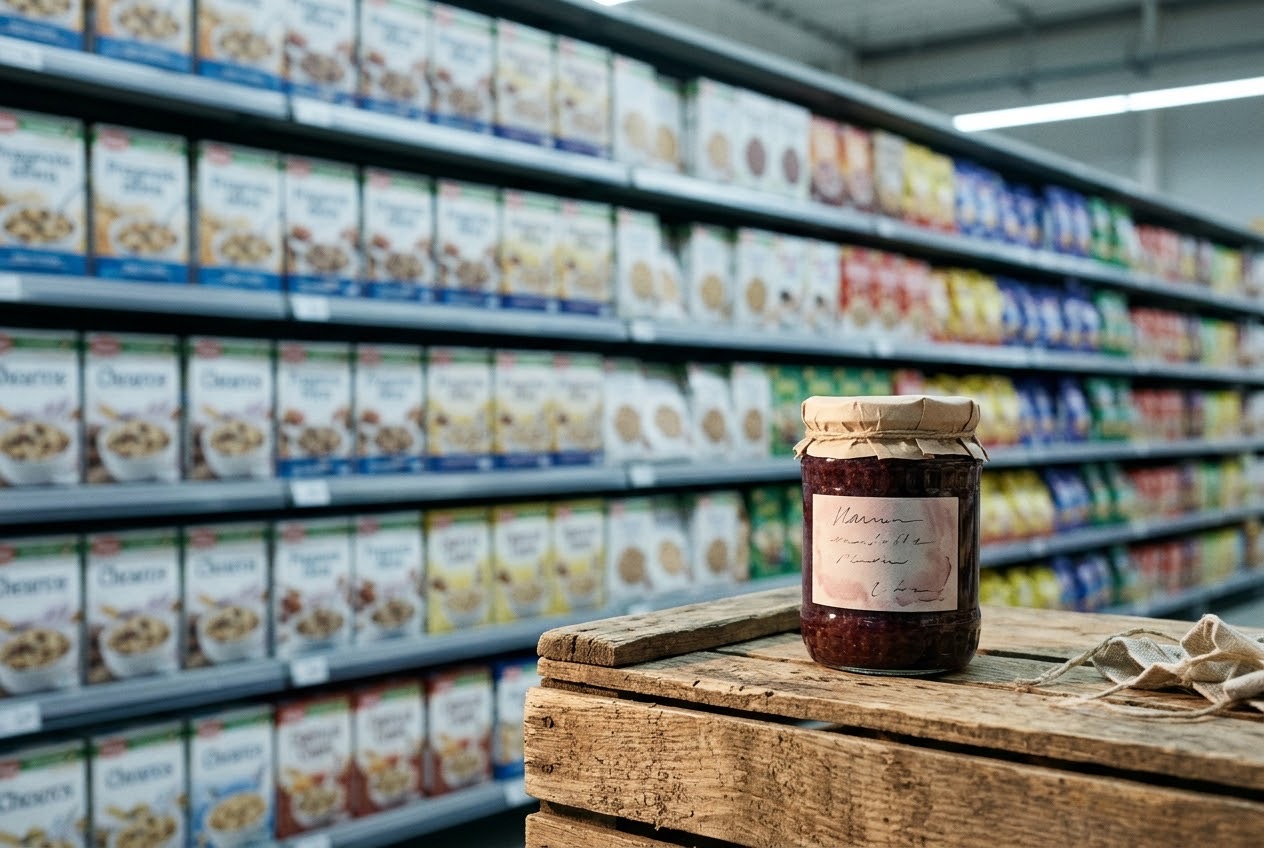
On the supermarket shelf, a silent war has been running for years. Most shoppers walk past the front lines every day without noticing. On one side stand the Goliaths—conglomerates with billion-dollar marketing budgets, global distribution networks, and dedicated teams whose sole function is to ensure their products live at eye level, in every store, on every continent. On the other side stand the Davids: niche players operating out of farmhouses, family kitchens, and converted warehouses, who lack the billboards but possess something far more volatile than capital. They possess uncompromising quality.
As consumers become increasingly literate about what they put in their bodies, on their bodies, and into their homes, the traditional marketing machine is hitting a wall it did not see coming. The argument is no longer simply about price. It is about the fundamental difference between a product designed to be sold and a product designed to be used—and the growing number of people who can tell the difference on the first taste.
When your marketing budget is zero, your product must be its own advertisement.
A recurring truth in every niche categoryI.The Conglomerate Playbook: Marketing Over Matter
For a global conglomerate, a brand is rarely a passion project. It is a financial asset—a line item on a portfolio to be managed, optimised, and eventually monetised. Their dominance in the marketplace is not built on being the best at what they make. It is built on being everywhere.
The mechanics of this dominance are worth understanding. Sales-driven innovation means that new product development in a large corporation typically involves new packaging, seasonal line extensions, or limited-edition flavours rather than genuine breakthroughs in quality. Research and development is filtered through the lens of risk management: will this change move enough additional volume to justify the capital outlay? The answer, almost always, is no—which is why the answer, almost always, is to leave the formula alone and spend the money on marketing instead.
Then there is the Mergers & Acquisitions Carousel. Conglomerates treat brands the way traders treat equities: buy into categories performing well, divest from those that are not. The consequence is that the stewardship of a brand—its recipe, its supply chain, its relationship with its community—is subject to boardroom decisions made by people who have never tasted the product and have no intention of doing so.
*Source: [Research citation placeholder — confirm before publishing]
II.The Illusion of Choice
Walk down the aisle of any major supermarket and the apparent variety is staggering. Dozens of competing brands, competing claims, competing price points. The illusion is meticulous. The reality is that a significant proportion of those products—across cereals, bottled water, snacks, personal care, and pet food—trace back to a handful of parent companies whose names appear nowhere on the packaging.
This is the Illusion of Choice, and it is maintained not by deception in any traditional sense but by shelf architecture. Conglomerate budgets buy what practitioners call "real estate": the eye-level shelf position, the end-of-aisle display, the checkout lane slot. When you see a product at eye level in every store globally, it is not necessarily because it is the best product in its category. It is because the manufacturer paid for that position—a fact the manufacturer has no obligation to disclose, and the retailer has every financial incentive to conceal.
For the niche player, this landscape should be insurmountable. No budget for real estate. No celebrity to lend the packaging a borrowed glow. No PR team to manage the narrative. And yet, consistently, in category after category, the artisans are winning on the only metric that cannot be purchased: what happens after the first purchase.
You cannot buy a second purchase. Retention is the one metric that advertising cannot counterfeit.
Independent brand strategy, 2025III.The Niche Advantage: A Mandate, Not a Choice
The niche player's relationship with quality is not aspirational. It is existential. A small protein bar producer in Tuscany, a family-run olive oil cooperative in Andalusia, an independent skincare formulator in London—none of them have the safety net of a celebrity spokesperson, a fifty-person communications team, or a marketing budget capable of compensating for a bad product. For them, the product is the only advertising that matters.
The structural differences between these two operating models—the conglomerate and the niche player—are not subtle. They manifest in every decision, from ingredient sourcing to customer communication.
| Dimension | Large Conglomerate | Niche Player |
|---|---|---|
| Primary Driver | Quarterly earnings & market share | Product integrity & customer need |
| Innovation Style | Low-risk, incremental: packaging & line extensions | High-risk, quality-focused breakthroughs |
| Customer Interaction | Data-driven, impersonal, survey-mediated | Community-driven, direct, feedback-heavy |
| Success Metric | Efficiency, scalability, margin | Retention, brand loyalty, word of mouth |
| Ingredient Sourcing | Global supply chain, cost-optimised | Direct relationships, provenance-driven |
| Brand Stewardship | Managed by portfolio teams with P&L targets | Owned by founders with personal reputation at stake |
IV.The Industrialization Trap
We have seen the pattern play out with enough regularity that it now has a name. A small, artisanal brand earns a devoted following. It attracts attention. A conglomerate makes an offer. The founders—exhausted, cash-constrained, and understandably tempted by a cheque large enough to make the next thirty years comfortable—accept. The press release speaks of "shared values" and "accelerated growth." Then, over the following eighteen months, the product quietly changes.
Real honey becomes high-fructose corn syrup. Hand-pressed oils become "efficient" alternatives processed at scale. The baker who sourced flour from a single mill in the Dolomites is replaced by an automated mixing system fed by the cheapest available commodity supply chain. The changes are individually invisible, collectively transformative, and entirely logical from the perspective of the acquirer's balance sheet.
This is the Industrialization Trap. To justify the acquisition cost—which was, after all, a premium paid for a quality-driven brand—the conglomerate must find "synergies." The corporate euphemism for cutting costs. By streamlining the supply chain and scaling production from thousands of units to millions, the very soul that made the brand attractive in the first place is stripped away. The brand remains. The product does not.
The historical record is consistent. Across food, beverage, beauty, and apparel, the post-acquisition quality degradation of beloved independent brands is well-documented by the communities that loved them first.
V.The Crossroads: Sell Out or Stick It Out?
For the founders of niche companies that gain traction, the crossroads arrives with uncomfortable inevitability. The cheque is on the table. The investors—if there are any—are pushing for liquidity. The opportunity to reach people who would otherwise never encounter the product is genuinely compelling. What do you do?
This is not a question with a clean answer. Both paths carry real costs and real benefits, and the honest version of the debate is worth having without the sentimentality that tends to obscure it.
Sell Out
Acquisition provides the capital and distribution infrastructure to reach people who would otherwise never encounter the product. A local gem can become a global household name. The founder exits with financial security and, ideally, a transition agreement that preserves the brand's values for a defined period.
Stick It Out
Remaining independent preserves the founder's authority over every ingredient, supplier relationship, and product decision. The brand's integrity—the thing that built the following in the first place—remains intact. More importantly: by refusing to compromise, independent niche players raise the entire market.
VI.Raising the Market: The Niche Player's Hidden Power
There is a dimension to the niche player's position that tends to be undervalued, even by the niche players themselves. By refusing to dilute their product, they do not merely serve their existing customers better. They move the entire category.
Consumer expectations are not static. They are trained. When a committed independent demonstrates that a protein bar can be made without seventeen ingredients that read like a chemistry exam, customers begin to ask why all protein bars cannot be made that way. The question, once asked in sufficient numbers, is a form of market pressure that advertising budgets cannot silence indefinitely. Conglomerates, whose product development teams monitor these sentiment shifts with considerable attention, are eventually forced to respond. New formulations. Cleaner labels. The removal of ingredients that have quietly been a source of quiet consumer discomfort for years.
The artisan did not do this by competing with the giant. They did it by existing at a higher level—and being visible enough that the comparison became impossible to ignore.
The niche player does not need to beat the giant. They need only to make the comparison unavoidable.
The New Market Reality, GlamBon Research 2026VII.The New Market Reality
The era of blind consumption is over. The consumer who bought the product at eye level because it was at eye level, who trusted the brand because it had a large font and a reassuring heritage claim, who read "natural" on the front and did not think to read the ingredients on the back—that consumer is an increasingly rare species. In their place stands someone considerably more inconvenient for the conglomerate: a customer who knows the difference, has the tools to verify it, and is part of a community that will hear about it either way.
While conglomerates still own the shelf space, niche players own something more durable: the trust. And trust, unlike a shelf position, cannot be bought with a better distribution deal or a more aggressive promotional budget.
For the small company navigating this landscape, the most secure strategy is not necessarily the fastest exit. It is the long-term cultivation of a brand that cannot be replicated by a machine or a marketing budget—a product whose quality is so genuinely, demonstrably superior that the only way for a giant to acquire it is to risk destroying the very thing they paid for.
In the battle between Nestlé and the artisan, the winner is not the one with the loudest voice. It is the one with the best taste—and the patience to let the market find out.
Frequently Asked Questions
The Industrialization Trap describes what happens when a conglomerate acquires a beloved niche brand and, to justify the acquisition cost, systematically strips its quality. Real ingredients are replaced with cheaper alternatives, handcraft is replaced with automation, and the soul that made the brand desirable is traded for margin efficiency—usually within 18 months of the deal closing.
Niche brands lack the safety net of a large marketing budget, celebrity endorsements, or prime shelf placement. This forces the product itself to carry all the weight. Without the ability to compensate for mediocrity with visibility, quality becomes a matter of survival—not aspiration. The product must be its own advertisement.
When a niche player refuses to compromise on quality and gains a loyal following, it creates upward pressure across the entire category. Conglomerates are eventually forced to improve their own products or risk losing market share to the artisan. Independent niche players can single-handedly elevate industry standards simply by existing at a higher level and being visible enough that the comparison becomes impossible to ignore.
The decision is genuinely complex. Selling provides capital and reach that independent founders cannot match—but historically comes at the cost of the product integrity that built the brand's value in the first place. The Industrialization Trap is real and well-documented. Founders who stay independent retain control of both their recipe and their reputation—and the power to raise the market around them.
The Illusion of Choice refers to the practice by which a small number of conglomerates own hundreds of brands across every consumer category, creating the appearance of diverse options on store shelves. In reality, a single parent company may own competing products sitting side by side—all subject to the same cost-cutting logic and quarterly earnings pressures, regardless of how different the packaging makes them appear.