There is a specific kind of silence that accompanies the death of a landscape. It isn't the dramatic crash of a falling glacier or the roar of a wildfire; it is the quiet, persistent sigh of the wind carrying away the very skin of the earth.
According to the more somber projections circulating through the UN's environmental corridors, we may have fewer than 60 harvests left before our topsoil simply vanishes. We are, quite literally, running out of dirt. For a civilization that prides itself on the "cloud" and the "metaverse," it is a grounding, perhaps humiliating, realization: all our digital sophistication rests on a few inches of biological matter that we have treated with the same disregard as a spent cigarette.
But if you travel to the rolling hills of Virginia's Shenandoah Valley, you will find a man who thinks the "end of the world" is simply a failure of imagination.
topsoil remaining
dependent on soil
signs of degradation
The High Priest of the Pasture
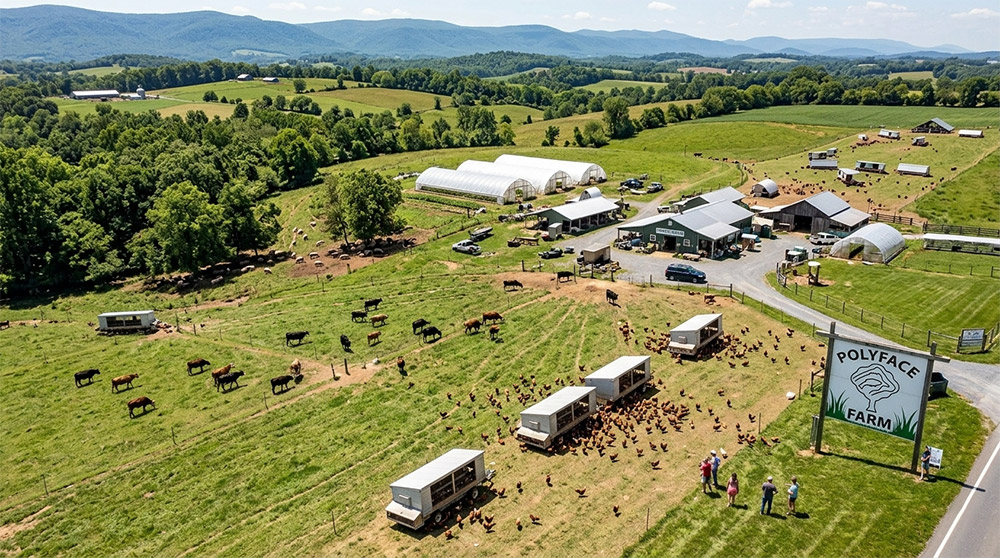
Joel Salatin does not look like a revolutionary. Dressed in worn denim and a wide-brimmed hat, the self-described "Christian-libertarian-environmentalist-capitalist lunatic" is the mastermind behind Polyface Farms. To the industrial agricultural complex, Salatin is a nuisance; to the culinary elite and the health-conscious vanguard, he is a saint.
Salatin's philosophy, which has become a cornerstone of the regenerative movement, is deceptively simple: Nature doesn't do monocrops. In the industrial model, we have segregated the animal from the land, creating concentrated animal feeding operations that are as ecologically disastrous as they are aesthetically repulsive. Salatin, instead, choreographs a complex ballet of the beasts. Cows graze the "salad bar" of diverse grasses; chickens follow in "egg mobiles" to sanitize the pasture and provide nitrogen-rich fertilizer; pigs aerate the forest floor.
The result isn't just world-class brisket. It is the rapid creation of new topsoil — proof that an atavistic return to biological synergy is more "high-tech" than any lab-grown meat.
Joel Salatin, Polyface FarmsHis farm is a carbon-sequestering sponge, proving that an atavistic return to biological synergy is more "high-tech" than any lab-grown meat. While industrial farms lose inches of soil to erosion and chemical runoff — essentially mining the earth until it is hollow — Salatin is building it back, layer by layer, season by season.
The Savory Paradox
If Salatin is the movement's priest, Allan Savory is its embattled general. A Zimbabwean ecologist with a penchant for challenging "settled science," Savory hit upon a realization decades ago that turned the environmental movement upside down: The desert isn't caused by livestock. The desert is caused by their absence.
For years, the "green" orthodoxy told us that cattle were the enemy — hoofed locusts that overgrazed the land into dust. Savory's Holistic Management argues the exact opposite. On the vast, brittle grasslands of Africa and the American West, the removal of large, tightly-bunched herds of herbivores has led to desertification. Without the pounding of hooves to break up the soil crust and the concentrated deposit of manure to kickstart the biological engine, the land dies and the carbon escapes into the atmosphere.
Savory's solution? More cows. Managed correctly — moved in dense herds that mimic the patterns of ancient wild ruminants fleeing predators — livestock become the ultimate tool for re-greening the planet. They are the biological pumps that drive the water cycle. It is a delicious irony: the very steak you were told was destroying the planet might actually be the only thing capable of reversing the expansion of the Sahara.
Managed holistically, livestock become the ultimate tool for re-greening the planet — biological pumps that drive the water cycle. The steak you were told was destroying the planet may be the only thing that can save it.
Allan Savory, The Savory InstituteThe New Terroir
The stakes go far beyond the aesthetic of a green landscape. This is about a fundamental restoration of human health and ecological sovereignty. When the soil is dead, the food is empty; when the food is empty, the culture follows.
Regenerative agriculture is, at its heart, an act of epicurean subversion. It is about restoring the terroir of our lives — the idea that vitality starts in the microbial life of the earth and flows upward into the soul of a community. It rejects the Technocratic Pantry of synthetic substitutes in favor of something far more radical: actual nature.
We are currently living through a Dust Bowl of the spirit, a period where our connection to the physical reality of the earth has been severed by screens and synthetic solutions. But the soil-preneurs and the holistic grazers are offering a way back. They are showing us that desertification — both of the land and of our culture — is not inevitable.
As the sun sets over a Polyface pasture, the air smells of crushed clover and damp earth, a scent more intoxicating than any perfume found on the Rue du Faubourg Saint-Honoré. It is the smell of life being built, layer by layer, inch by inch. We may be down to our last few harvests, but as Salatin and Savory have proven, the earth is remarkably forgiving. It just needs us to get out of the way — and perhaps, to bring the cows back home.