In the cultural landscape of 2026, cosplay has transcended its origins as a subcultural hobby to become a multi-billion-dollar global industry and a sophisticated art form in its own right. No longer dismissed as mere "playing dress-up," modern cosplayers occupy a unique creative space — part master artisan, part digital influencer, part performance artist — breathing life into the pixels and pages of our most beloved stories.
The journey from convention hallway to cultural institution has been swift and seismic. Within a single generation, cosplay has produced its own economy of specialist materials, educational publishers, loyalty programs, and celebrity practitioners. It has spawned academic conferences, brand sponsorship deals once reserved for professional athletes, and a creator economy that generates tens of millions of dollars in tutorial content each year. And yet, at its core, the craft remains animated by the oldest of human impulses: the desire to inhabit another world, if only for a day.
The Living City: The Lucca Comics Phenomenon
While conventions exist on every continent — from Comiket in Tokyo to San Diego Comic-Con — few capture the soul of the cosplay community quite like Lucca Comics & Games. Held each October in the heart of Tuscany, the festival does something that no convention center can replicate: it turns a living medieval city into a stage.
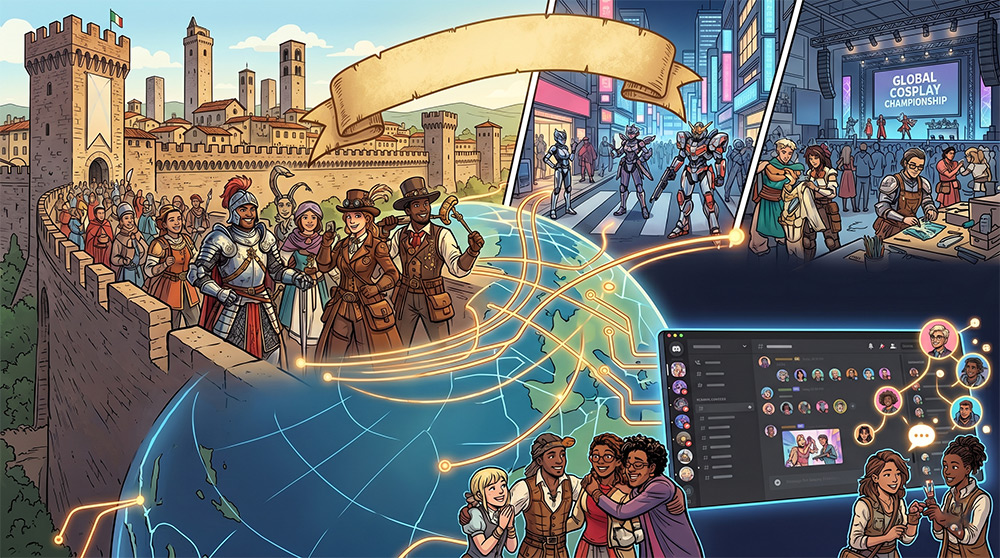
Lucca's narrow cobbled streets, Renaissance-era piazzas, and intact city walls become the scenery for tens of thousands of costumes across five days. There is no separation between the convention and the city — you queue for espresso beside someone in full Dark Souls plate armor; you navigate the ramparts alongside a parade of Studio Ghibli characters. This integration is not incidental. It is what makes Lucca feel less like a trade show and more like a collective hallucination, joyfully shared.
The walls of Lucca have held back armies. In October, they hold in something stranger and more wonderful — a city that has agreed, together, to become someone else for a week.
— Festival observer, Lucca Comics & Games 2025The Giardino degli Osservanti serves as the festival's unofficial heart: a "Community Village" where the rhythmic clatter of 3D-printed armor being fitted meets the rustle of hand-stitched silk sleeves. It is where hobbyists, semi-professionals, and world-class builders converge to share techniques, compare materials, and simply celebrate what they have made.
At the competitive heart of the festival sits the Extreme Cosplay Gathering (ECG) Italian Stage — a qualifying round for the international ECG circuit and one of the most technically rigorous cosplay competitions in Europe. Judging here goes far beyond stage presence and showmanship. Panels of specialist judges evaluate builds on a detailed rubric that scrutinizes the invisible as much as the visible: the seams hidden inside a gauntlet, the load-bearing logic of a fifteen-kilo backpiece, the structural integrity of props that must survive both travel and performance.
How ECG Judges a Build
| Criterion | What judges look for | Weight |
|---|---|---|
| Screen accuracy | Fidelity to source material proportions, color, and detail hierarchy | |
| Craftsmanship | Quality of construction, seam finishing, surface treatment | |
| Structural integrity | Load distribution, wearability, prop durability under movement | |
| Presentation | Stage performance, character embodiment, audience connection | |
| Innovation | Novel techniques, problem-solving, use of emerging materials |
The Brands That Build the Heroes
Behind every competition-winning build and every viral social post is a supply chain of highly specialized brands that have grown up alongside the community. These are not passive retailers; they are active participants in the culture, hosting workshops, sponsoring builders, funding tutorials, and cultivating the kind of brand loyalty that consumer goods companies can only dream of. They provide, in essence, the vocabulary through which cosplayers create.
The gold standard in thermoplastic sheeting, Worbla's heat-and-shape methodology has become the lingua franca of armor construction. The "Worbla Community" — thousands strong and richly documented online — shares scraps-to-props tutorials that embody the craft's sustainable, iterative spirit. The material can be reheated and remolded indefinitely, making mistakes a feature, not a failure.
Arda transformed wig styling from a black art into an accessible craft. Their tiered "Wigmancer" loyalty program rewards repeat customers with education as much as discounts, while their library of video tutorials — covering everything from heat-curling to full-scale teasing — has become a rite of passage for newcomers to the craft.
Creality's affordable FDM printers have democratized complex prop fabrication. By 2026, the company actively sponsors cosplay workshops and summits worldwide, and maintains a pattern library where top builders share printable files. A cosplayer can now download, slice, and overnight-print a fully articulated gauntlet while they sleep.
The go-to for EVA foam in density grades from ultra-soft boning to rigid structural floor foam, TNT has built its reputation on consistent quality and cosplay-specific formulations. Their adhesive range — contact cements, flexible glues, and heat-bond films — addresses the specific stresses of wearable art in ways that general hardware suppliers cannot.
What distinguishes these brands from conventional craft retailers is their community orientation. They understand that a cosplayer who masters their product becomes an evangelist — posting builds, tagging materials, generating organic content that no advertising budget could replicate. The relationship is symbiotic, and increasingly, explicit: brand ambassador programs, co-designed product lines, and sponsored convention booths now form a structured ecosystem of mutual benefit.
From Hobbyist to Educator: The Creator Economy
Perhaps the most significant structural shift in cosplay culture over the past decade has been the emergence of the professional educator-cosplayer. Where earlier generations of skilled builders guarded their techniques, the dominant ethos in 2026 is one of radical generosity: the most respected figures in the community are invariably those who give away as much knowledge as they produce craft.
Author of multiple craft books including works on foam smithing and sewing for cosplay, Quindt has turned professional cosplay into a publishing and education enterprise. Her pattern PDFs — sold directly to fans — have introduced tens of thousands of builders to structured garment construction. Her philosophy of "Build Stuff and Help Others" has become an unofficial creed of the modern craft community.
One of the first cosplayers to be recognized as a "brand" in her own right, Han has collaborated with fabric suppliers to develop cosplay-specific materials — stretch velvets, metallic organzas, and boned corset fabrics now sold under her name in major craft chains. Her decades of competition experience have shaped judging standards worldwide, and she remains one of the community's most vocal advocates for craft quality over spectacle.
The financial mechanics of this creator economy are varied and sophisticated. Revenue streams include digital pattern sales, Patreon-style subscription tutorials, YouTube monetization, Twitch streaming of build sessions, convention appearance fees, brand ambassador contracts, book publishing advances, and workshop ticket sales. For the top tier of professional cosplayers, annual revenues comfortably reach six figures — built not on spectacle alone but on the steady compounding of educational trust.
The most respected builders I know spend more time answering questions in Discord than they do in their workshops. That willingness to teach is what actually defines this community.
— Professional cosplayer and ECG judge, speaking at Lucca 2025The 3D Printing Revolution
Of all the technological shifts that have reshaped cosplay in the past five years, none has been more democratizing than the mainstreaming of consumer 3D printing. What was once a specialist tool requiring significant capital investment — in both hardware and technical expertise — is now as accessible as a sewing machine, and considerably faster for certain classes of problem.
The workflow that has emerged is elegant in its division of labor: concept artists and experienced builders design and share parametric digital files through platforms like MyMiniFactory and Printables; newcomers download, scale, and print those files on affordable FDM machines; post-processing — sanding, priming, painting — remains a hands-on craft skill that no printer can replace. The result is a layered economy of digital design, accessible fabrication, and traditional finishing that has dramatically lowered the barrier to complex builds without eliminating the skilled labor that gives them value.
Brands like Creality have responded to this opportunity not just with hardware but with community infrastructure: sponsored summits bring together top cosplay builders as technical advisors; resulting community libraries give customers direct access to professional-grade files. The sponsorship calculus is shrewd — a competition-winning cosplayer photographed with their printer generates more authentic purchase intent than any traditional campaign.
The Digital Village and the Future of Fandom
Social media remains the exhibition space where cosplay reaches its broadest audience, but the texture of that relationship has shifted significantly by 2026. The era of algorithm-driven virality — chasing platform reach through increasingly spectacular builds — has given way to something quieter and more durable: the rise of niche Discord communities, Patreon-gated workshop series, and regional meetup networks that prioritize depth over scale.
These digital villages function as craft guilds: spaces where questions receive detailed answers from experienced practitioners, where works-in-progress receive substantive critique, where beginners find mentors and veterans find intellectual peers. The conversations happening in a well-moderated cosplay Discord — about the compressive strength of different EVA densities, or the correct approach to aging leather appliqués — represent a genuine transfer of specialized knowledge that formal education rarely accommodates.
Alongside this shift toward depth, the community has embraced a broader and more deliberately inclusive identity through the "Cosplay for All" movement. Original characters (OCs) — costumes designed entirely by their wearers rather than sourced from existing IP — are now celebrated with the same enthusiasm as screen-accurate builds. Creative reinterpretations that merge cultural references, swap genders, reimagine settings, and blend aesthetics are understood not as lesser versions of the craft but as its most inventive expressions.
This inclusivity has practical consequences for the competitive scene as well. Major competitions now feature dedicated OC categories; judges are trained to evaluate original design on its own terms rather than measuring it against source material that doesn't exist. The shift reflects a maturing understanding that fidelity to a reference image, while impressive, is only one of many ways to demonstrate mastery.
Highlights & Cosplay at Lucca Comics & Games 2025 — a visual tour of the scale, atmosphere, and craftsmanship that define Europe's most distinctive convention experience.
A Craft Anchored in Wonder
It is tempting, surveying this landscape of billion-dollar markets, professional educator-influencers, and internationally standardized competition rubrics, to conclude that cosplay has been fully industrialized — that the fan at the sewing machine has been replaced by the professional at the build station. The reality is considerably more heartening.
The infrastructure has grown because the community has grown, and the community has grown because the underlying impulse — to step into a character you love, to inhabit a world you want to be real — remains as potent as it ever was. The thermoplastic and the 3D printer are tools in service of that impulse, not replacements for it. The tutorials and the Discord servers exist to help more people do the thing they already want to do, with more skill and less frustration.
As the industry continues its upward trajectory through 2026 and beyond, what keeps it honest is precisely this: at the center of every competition build, every scraps-to-props tutorial, every Discord thread debating the merits of contact cement versus heat-bonding — there is a fan who looked at a character on a screen and thought, I want to be that, just for a moment. That desire is the foundation everything else is built upon, and it is, as foundations go, remarkably sturdy.